
Anticoagulant Procedure Risk Calculator
What Are Your Medications?
What Procedure Are You Having?
Why Your Blood Thinners Matter More Than You Think Before a Cosmetic Procedure
If you’re on blood thinners - whether it’s warfarin, aspirin, rivaroxaban, or apixaban - and you’re thinking about a cosmetic procedure like a facelift, laser treatment, or even a simple skin biopsy, you need to know one thing: stopping your medication might be riskier than keeping it.
For years, doctors told patients to stop all blood thinners before surgery. It seemed logical: less blood thinning = less bleeding. But research over the last 30 years has flipped that idea on its head. In fact, stopping these drugs can lead to strokes, heart attacks, and even death - far more dangerous than the bruising you might get after a procedure.
The Real Risk: Stopping Your Medication
A 2014 survey of 168 Mohs surgeons found 46 serious events after patients stopped their blood thinners: 3 deaths, 24 strokes. Half of those happened after warfarin was stopped. Nearly 40% followed aspirin withdrawal. These weren’t minor blips - these were life-altering or fatal events.
Meanwhile, bleeding during minor cosmetic procedures like mole removals or eyelid lifts rarely gets worse when you keep taking your medication. A 2023 review of 13 studies showed that continuing direct oral anticoagulants (DOACs) like apixaban led to just a 1.74% chance of bleeding complications. That’s lower than the 0.15% chance of a clot forming if you stop them.
Here’s the hard truth: the risk of a blood clot from stopping your anticoagulant is real. The risk of bruising from keeping it? Usually just a temporary purple patch.
Not All Blood Thinners Are the Same
When doctors talk about "blood thinners," they’re lumping together three very different kinds of drugs:
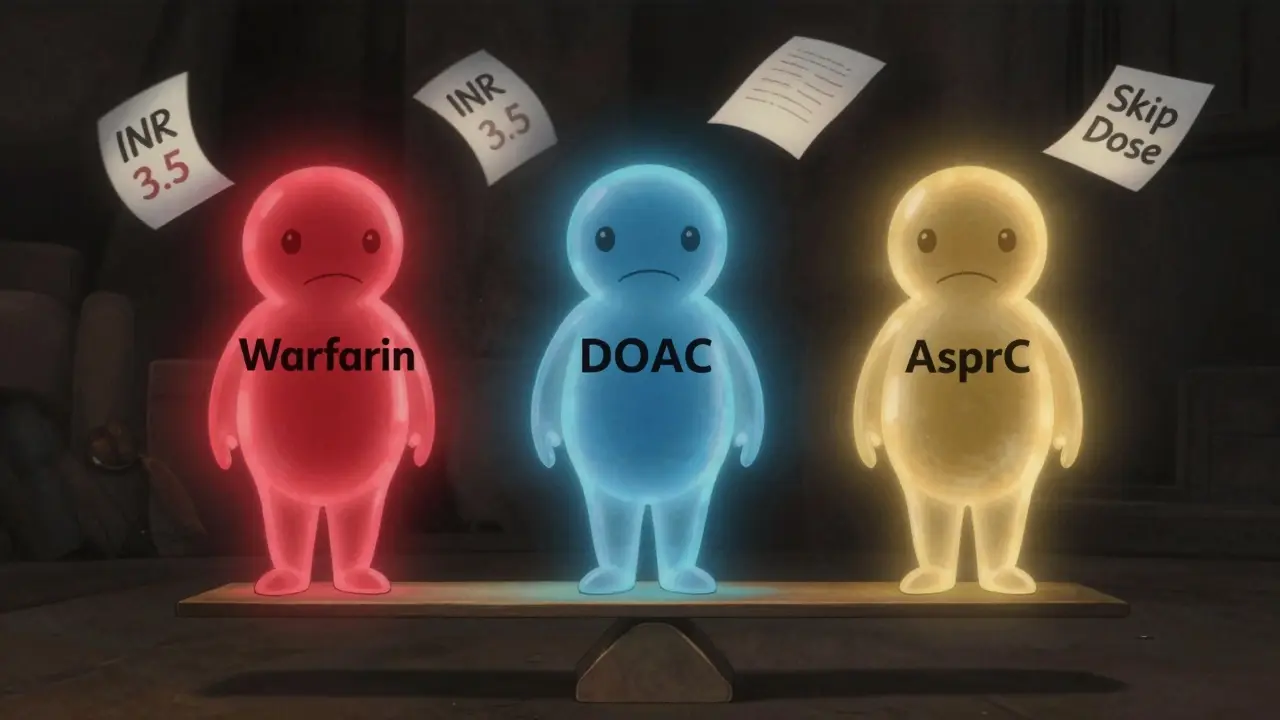
- Warfarin (Coumadin): Older, requires regular INR blood tests. Bleeding risk jumps when INR goes above 3.5. Studies show warfarin users are nearly 4 times more likely to bleed during facial surgery than those on other drugs.
- DOACs (rivaroxaban, apixaban, dabigatran): Newer, don’t need blood tests. They leave your system in 9-17 hours. This means you can safely skip your morning dose the day of surgery and still be protected from clots.
- Antiplatelets (aspirin, clopidogrel): These don’t thin your blood - they stop platelets from clumping. Multiple studies confirm aspirin users have no significant increase in bleeding after skin procedures. Even high-dose aspirin is generally safe.
So if you’re on aspirin for heart health, don’t panic. You likely don’t need to stop. If you’re on warfarin? Your INR level becomes critical. If you’re on apixaban? Your doctor can tell you to skip one dose - and that’s it.

What Kind of Procedure Are You Getting?
Not all cosmetic procedures carry the same bleeding risk. The British Society of Dermatologists (BSDS) 2023 guidelines break them down simply:
- Low-risk procedures: Shave biopsies, small excisions under 2 cm, laser treatments, chemical peels. Continue all anticoagulants.
- Moderate-risk procedures: Larger excisions, liposuction, some injectables. For DOACs: skip the morning dose. For warfarin: ensure INR is below 3.5.
- High-risk procedures: Facelifts, rhinoplasty, eyelid surgery, breast lifts, major body contouring. DOACs: stop 24-48 hours before. Warfarin: stop 5 days before if INR is high. Aspirin: usually continue.
Facial procedures are especially tricky. The face has dense blood vessels. Even a small bleed can affect your breathing, vision, or healing. That’s why surgeons here are extra cautious - but they’re not telling you to stop your meds unless they absolutely have to.
Why Bridging With Heparin Is Usually a Bad Idea
You might hear about "bridging" - stopping your oral anticoagulant and injecting heparin instead. It sounds smart: keep you protected while reducing bleeding. But for cosmetic procedures? It’s not.
Heparin increases bleeding risk without lowering clot risk in this setting. A 2023 review found no benefit in using heparin bridges for elective cosmetic surgery. In fact, it often leads to more hematomas, longer recovery, and extra ER visits.
Doctors now avoid it unless you have a mechanical heart valve or recent clot history. For most people on DOACs or warfarin for atrial fibrillation? Just manage the dose. Don’t switch.
What Your Surgeon Should Ask You
A good surgeon won’t just ask, "Are you on blood thinners?" They’ll dig deeper:
- What drug are you on? (Name and dose)
- Why are you on it? (Atrial fibrillation? Past DVT? Mechanical valve?)
- When was your last INR test? (If on warfarin)
- Have you had bleeding or clots before?
- Are you on more than one blood thinner? (Double therapy = higher risk)
If they don’t ask these questions - or they say "just stop everything" - find someone who does. The 2023 BSDS guidelines say patients on single-agent therapy (one blood thinner) can safely proceed with most procedures. Dual therapy? That’s where things get complicated. You might need to delay the procedure until you’re on one drug only.
What You Can Do Right Now
Don’t wait until the day before your appointment. Start this conversation now:
- Get a copy of your latest blood test results - especially INR if you’re on warfarin.
- Write down your medication: name, dose, how long you’ve been taking it.
- Ask your cardiologist or GP: "Is it safe to keep taking this during a cosmetic procedure?" Get their answer in writing.
- Bring all this to your cosmetic surgeon. Don’t assume they know your full history.
Most patients on blood thinners don’t need to stop. In fact, stopping often causes more harm than good. The goal isn’t to avoid all bruising - it’s to avoid a stroke.
The Bottom Line
There’s no one-size-fits-all answer. But here’s what the evidence shows:
- Aspirin and clopidogrel? Keep taking them. No need to stop.
- DOACs (apixaban, rivaroxaban)? Skip the morning dose before surgery. No need to stop days early.
- Warfarin? Get your INR checked. If it’s under 3.5, you’re likely fine. If it’s higher, work with your doctor to adjust.
- Don’t bridge with heparin. It adds risk with no real benefit.
- Don’t panic about bruising. A little purple skin is temporary. A clot can be permanent.
More than 25% of people getting cosmetic procedures in Australia and the U.S. are already on anticoagulants. This isn’t rare. It’s routine. And the medical community has caught up: the safest choice for most people is to keep taking their meds - carefully managed, not blindly stopped.
Casper MacIntyre
Hello, my name is Casper MacIntyre and I am an expert in the field of pharmaceuticals. I have dedicated my life to understanding the intricacies of medications and their impact on various diseases. Through extensive research and experience, I have gained a wealth of knowledge that I enjoy sharing with others. I am passionate about writing and educating the public on medication, diseases, and their treatments. My goal is to make a positive impact on the lives of others through my work in this ever-evolving industry.
9 Comments
-
Carla McKinney
February 15, 2026 AT 07:14I’ve seen too many patients panic and stop their DOACs out of fear. The real danger isn’t a bruise - it’s the silent clot that doesn’t announce itself until it’s too late. This article nails it. The data is clear: bleeding risk is manageable. Thrombosis isn’t.
-
Rachidi Toupé GAGNON
February 16, 2026 AT 11:02Bruising = temporary. Stroke = permanent.
I’m telling my sister to keep her apixaban before her eyelid job. She’s been stressing over purple circles like it’s a fashion faux pas. Lol. 🤦♂️ -
Jim Johnson
February 18, 2026 AT 07:41my dr told me to stop warfarin before a mole removal. i pushed back. showed him the 2023 review. he was shocked. now he’s updating his protocol.
knowledge is power. and so is a good INR number. -
Vamsi Krishna
February 18, 2026 AT 13:23I find it fascinating how society treats minor bleeding like a catastrophe while ignoring the silent killer lurking in the bloodstream. We are conditioned to fear visible harm, not invisible failure. The body doesn’t care about aesthetics. It cares about flow. And flow is life.
-
Sophia Nelson
February 19, 2026 AT 13:17This whole thing feels like medical gaslighting. They say 'don't stop' but then tell you to skip a dose, check INR, avoid heparin... so which is it? If it's so safe, why all the conditions?
-
Steve DESTIVELLE
February 20, 2026 AT 13:56The human body is not a machine to be tuned with pharmaceutical levers. We have forgotten that medicine is not about control but about harmony. The clot is not an enemy. The bruise is not a failure. Both are signals. We have turned healing into a spreadsheet and lost the soul of care.
-
athmaja biju
February 21, 2026 AT 16:42In India we dont even ask about blood thinners. Just do the procedure. People here dont even know what DOAC means. We believe in action not paperwork. If you can walk in you can walk out. Bruise? Ice. Stroke? God's will.
-
Reggie McIntyre
February 22, 2026 AT 01:32I love how this breaks down the drugs by type. I was on warfarin for AFib and had a facelift last year. My surgeon made me skip 5 days. I was terrified. Turns out my INR was 2.8. No bleed. No clot. Just a weird purple cheek for two weeks.
Now I’m on apixaban. Skip the morning dose. Done. So simple. Why do so many docs still overcomplicate this?


Write a comment
More Articles

Liability and Indemnification in Generic Transactions: What You Need to Know
Indemnification in commercial transactions shifts financial risk between parties through contract clauses. Learn how liability protection works, what triggers payouts, and how to negotiate fair terms to avoid costly surprises.

How to Keep a Medication List for Safer Care and Fewer Errors
Keep an accurate, up-to-date medication list to prevent dangerous errors, avoid harmful interactions, and ensure safer care during every doctor visit or emergency. Start today with a simple step-by-step guide.
The potential off-label uses of colchicine in medicine
As a blogger, I've recently come across some fascinating information about the potential off-label uses of colchicine in medicine. Colchicine, a well-known treatment for gout, is now being explored for its potential in treating other conditions such as cardiovascular diseases and certain types of cancers. Researchers are also investigating its anti-inflammatory properties, which could possibly help patients suffering from autoimmune diseases. While these off-label uses are still in the experimental phase, it's exciting to think about the potential benefits colchicine could have on a wider range of patients. I'll definitely be keeping an eye on future developments in this area, and I encourage you all to do the same!
Ojus Save
February 15, 2026 AT 04:49lol i just got a laser treatment last week and was freakin out about my aspirin. turned out i didnt need to stop. glad this post exists.