Every year, thousands of patients in the U.S. face delays or outright denial of life-saving medications-not because they can't afford them, but because there simply isn't enough to go around. This isn't a rare glitch. It's a systemic failure, and it's hitting generic drugs the hardest. By March 2026, there are still 270 active drug shortages in the U.S., and nearly all of them involve generic medications. These aren't obscure drugs either. They're the ones used for cancer treatment, heart attacks, seizures, infections, and chronic pain. When they disappear, the ripple effect is immediate, dangerous, and deeply unfair.
Why Generic Drugs Are the First to Vanish
Generic drugs make up about 90% of all prescriptions filled in the U.S. But they account for more than 70% of all shortages. Why? It comes down to money. While brand-name drugs can charge $100 or more per dose, many generic drugs sell for less than $1. Some sterile injectables, like vancomycin or cisplatin, earn manufacturers only 5-10% gross margins. That’s not enough to cover the cost of maintaining clean, FDA-compliant facilities, training staff, or keeping backup inventory. When a single machine breaks down or a batch fails inspection, there’s no financial cushion to keep production going.And it’s not just about profit. The manufacturing landscape has become dangerously concentrated. About 70% of generic drugs have only one or two FDA-approved producers. If one factory shuts down-because of a quality violation, power outage, or natural disaster-the entire country loses access. In 2023, the FDA reported that 62% of shortages were caused by manufacturing and quality issues. That means it’s not supply chain delays or raw material shortages alone. It’s the fact that these drugs are made in places where cutting corners is easier than investing in reliability.
The Global Supply Chain Is a Single Point of Failure
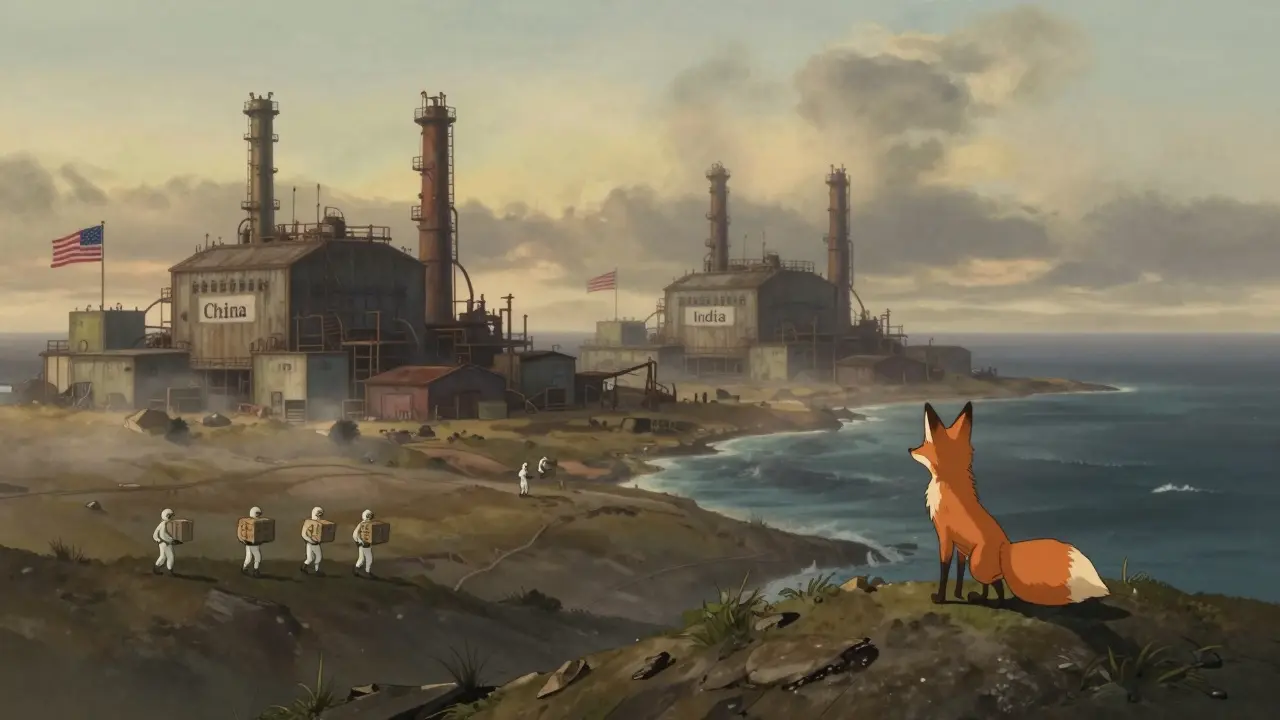
Over half of all drugs used in the U.S. are made overseas. And 80% of the active ingredients (APIs) come from just two countries: China and India. These facilities are often far from U.S. regulators, making inspections harder and enforcement slower. Between 2020 and 2024, FDA citations for manufacturing quality violations jumped by 35%. That’s not a coincidence. It’s a pattern. One facility in China can supply 60% of the nation’s heparin. One plant in India can produce nearly all of the country’s metformin. When one fails, the whole system stumbles.Worse, the number of U.S.-based generic drug manufacturing facilities has dropped by 22% since 2015. From 1,842 registered sites in 2015 to just 1,437 in 2024, the capacity to produce these drugs domestically is shrinking. The industry has bet on low-cost overseas production, but that strategy is now breaking down under pressure from tariffs, geopolitical instability, and pandemic-era disruptions. The FDA’s 2024 Drug Shortage Task Force warned that without geographic diversification, shortages will keep getting worse.
What Happens When Patients Can’t Get Their Medication
When a drug vanishes, it doesn’t just mean a pharmacy runs out. It means hospitals scramble. Pharmacists spend 15-20 hours a week just trying to find substitutes. That’s time taken away from patient care. In 2025, 72% of hospitals said drug shortages made their existing staffing shortages even worse. Nurses and doctors are forced to make decisions on the fly: Is this alternative drug safe? Will it interact with the patient’s other medications? Is the dose even appropriate?The consequences are real. A 2022 American Medical Association survey found that 63% of pharmacists had seen serious patient harm because of shortages. Cancer centers reported having to change chemotherapy regimens. Hospitals delayed surgeries because they couldn’t get anesthetics. Emergency rooms saw spikes in pain-related visits when opioid generics disappeared. One pharmacist on Reddit shared: “We’ve been out of vancomycin powder for eight months. We’re using alternatives that are less effective and cost three times as much. Patients are getting sicker because we can’t give them what they need.”
And it’s not just hospitals. Independent pharmacies spend an average of 12.3 hours per week tracking down alternatives. Nearly half of them said patients abandoned prescriptions because they couldn’t get the drug-or because the substitute cost too much. For someone on a fixed income, a $300 alternative isn’t an option. It’s a death sentence.
Price Goes Up When Supply Drops-But Only for Generics
Here’s something you won’t hear often: when a brand-name drug goes short, its price usually doesn’t change. Why? Because there are often alternatives, and the manufacturer still controls the market. But when a generic drug disappears? Prices spike. The median price increase for a generic in shortage is 14.6%. But the cost of the substitute? Sometimes it triples. That’s because the few remaining manufacturers hold all the power. They know patients have nowhere else to go.This creates a cruel cycle. Low prices attract manufacturers in the first place. But once they’re in, they can’t afford to invest in quality. When quality fails, production stops. And when production stops, the few remaining suppliers jack up prices. Patients pay the price-not just in dollars, but in health outcomes.
Who’s to Blame? It’s Not One Person
There’s no villain here. No single company is responsible. It’s a market design problem. The system rewards the cheapest bid, not the most reliable supplier. Hospitals and pharmacies buy based on price alone. No one asks: “Can this manufacturer consistently deliver?” “Do they have backup capacity?” “Have they had recent FDA violations?”The FDA knows this. In 2024, Commissioner Robert Califf told Congress: “The current market structure for generic drugs does not incentivize reliability and quality over lowest price.” The Congressional Budget Office predicts shortages will hit 350 by the end of 2026 if nothing changes. And the trend is clear: as profit margins shrink, manufacturers leave. As fewer companies make these drugs, the risk of failure grows. And as risk grows, shortages get longer. The median duration of a generic drug shortage has doubled-from 12 months in 2011 to 24 months in 2023.
What’s Being Done? And Why It’s Not Enough
There have been efforts. Executive Order 14050 in 2020 created a list of essential medicines and temporarily reduced shortages of those drugs by 32%. The FDA launched a Drug Shortage Task Force in 2024 with four goals: diversify manufacturing, create financial incentives, adopt advanced production tech, and improve early warnings.But these are fixes, not solutions. Financial incentives? They’re small. Advanced manufacturing? It’s expensive and slow to scale. Early warning systems? They’re still reactive, not predictive. And without changing how drugs are priced and purchased, none of it will stick. A 2025 Congressional Research Service report put it bluntly: “Without addressing the pricing structure that disincentivizes investment in quality manufacturing, generic drug shortages will remain a persistent threat to U.S. healthcare for the foreseeable future.”
The Human Cost Is Already Here
Behind every shortage statistic is a person. A cancer patient who can’t get cisplatin. A diabetic who can’t get insulin. A child with epilepsy whose seizure medication is out of stock. A veteran with chronic pain denied refills because the pharmacy has no supply. These aren’t hypotheticals. They’re happening every day, in every state.Hospitals are spending $213 million a year just managing shortages. That’s money that could go to hiring more nurses, upgrading equipment, or expanding mental health services. Instead, it’s going to frantic phone calls, emergency orders, and last-minute substitutions. And the burden falls hardest on the people who can least afford it: the uninsured, the underinsured, the elderly, and the poor.
This isn’t about politics. It’s about basic healthcare. If a drug is essential-if it saves lives, controls pain, or prevents death-then its supply should be treated like public infrastructure. Not a commodity to be bid down to the lowest price. We don’t let the power grid go out because it’s not profitable. We don’t let clean water fail because it’s too expensive to maintain. Why do we treat life-saving drugs any differently?

Casper MacIntyre
Hello, my name is Casper MacIntyre and I am an expert in the field of pharmaceuticals. I have dedicated my life to understanding the intricacies of medications and their impact on various diseases. Through extensive research and experience, I have gained a wealth of knowledge that I enjoy sharing with others. I am passionate about writing and educating the public on medication, diseases, and their treatments. My goal is to make a positive impact on the lives of others through my work in this ever-evolving industry.
11 Comments
-
Richard Elric5111
March 2, 2026 AT 16:53The systemic disintegration of the generic pharmaceutical supply chain constitutes an existential crisis in public health infrastructure. The commodification of life-sustaining pharmacological agents, predicated upon marginal profit margins, has engendered a structural vulnerability wherein the absence of redundancy precipitates catastrophic failure. One must interrogate the epistemological foundations of market-based healthcare rationing when human mortality becomes contingent upon corporate balance sheets.
-
Betsy Silverman
March 2, 2026 AT 21:22My mom's on a generic for her heart condition. We went six weeks without it last year. The pharmacy called every day. We finally got a substitute, but it made her dizzy. She’s 74 and on a fixed income. She didn’t complain. She just said, 'I’ll manage.' That’s not management. That’s resignation. We need to treat these drugs like oxygen-not something you bid on.
-
Ivan Viktor
March 3, 2026 AT 05:50So let me get this straight. We outsource the most critical meds to two countries, then wonder why things break? Wow. What a shocker. Next you’ll tell me water freezes in winter.
-
Zacharia Reda
March 3, 2026 AT 23:28I’ve seen this firsthand. My sister’s a nurse in rural Ohio. Last month, they ran out of insulin. Not the brand-name stuff-the generic. Patients were getting sent home with glucometers and prayers. Meanwhile, the hospital’s buying the same insulin at 4x the price from a single supplier who’s the only one left. That’s not capitalism. That’s extortion wrapped in a white coat.
-
Helen Brown
March 4, 2026 AT 12:38This is all a government plot. They want us sick so they can control us with the meds. The FDA doesn’t inspect factories. They just take bribes. China and India are working together to poison us. You think your diabetes meds are safe? They’re laced with microchips. Look up Project Monarch. It’s all connected.
-
John Cyrus
March 4, 2026 AT 13:49People dont get it. Its not the manufacturers fault. Its the hospitals for buying the cheapest crap. If they paid a little more theyd have reliable supply. Stop blaming big pharma. Blame the admins who cut corners. Its always the same. Cheap now pay later. Thats the problem
-
marjorie arsenault
March 5, 2026 AT 03:15I work with seniors. I see it every week. One woman missed her seizure meds for three weeks. She had two episodes. We got her a substitute. It didn’t work right. She cried. She said, 'I just want to be able to take care of my grandkids.' We need to do better. Not because it’s policy. Because it’s human.
-
Deborah Dennis
March 5, 2026 AT 03:36This is exactly why we need to shut down all overseas manufacturing. Immediately. The FDA is a joke. They inspect one plant every five years. And they call it 'oversight.' What a farce. We should be making every single drug in the U.S. And if it costs more? So what. Lives matter. Not profits.
-
Shivam Pawa
March 6, 2026 AT 17:38In India we make 80% of the world's generics. But we have 300 factories. Only 50 meet US standards. The rest? They make what sells. No oversight. No accountability. The system is broken because no one asks: who is responsible? We need traceability. Not tariffs. Not nationalism. Transparency.
-
Diane Croft
March 8, 2026 AT 16:20We can fix this. We have the tech. We have the talent. We just need the will. Let’s fund domestic production. Let’s reward quality over price. Let’s treat medicine like a right-not a product. It’s not radical. It’s basic.


Write a comment
More Articles
Narcolepsy: Understanding Daytime Sleepiness and Stimulant Treatment Options
Narcolepsy causes uncontrollable daytime sleepiness and is treated primarily with stimulants like modafinil and armodafinil. Learn how these medications work, their side effects, and why newer options like pitolisant are changing treatment.
How to treat skin irritations caused by insect bites and stings.
In my recent blog post, I've detailed some effective ways to treat skin irritations caused by insect bites and stings. I've included some home remedies like using a cold compress and applying a mix of baking soda and water to the affected area. I also discussed when to seek medical attention, especially if you're showing signs of an allergic reaction. Additionally, I emphasized the importance of not scratching the irritated area to prevent infection. Lastly, I mentioned some preventative measures to avoid insect bites in the first place.

Levi Viloria
March 1, 2026 AT 18:54I've been a pharmacist for 12 years and this is the reality we live in every day. We're not just filling scripts-we're playing whack-a-mole with suppliers. One day we've got metformin, next week it's gone. No warning. No backup. Just a patient standing there asking why their diabetes med disappeared. It's not about profit. It's about survival.