
What Exactly Is a Pneumothorax?
A pneumothorax, or collapsed lung, happens when air leaks out of the lung and gets trapped between the lung and the chest wall. This air builds up pressure, pushing the lung down so it can’t expand properly when you breathe. It’s not just a minor inconvenience - it’s a medical emergency that can turn deadly fast if ignored.
You might think of your lungs like balloons inside a sealed box (your chest). Normally, the space around the lung is empty. But when air gets in there - from a rupture in the lung, a chest injury, or even spontaneously - it’s like poking a hole in the balloon. The lung collapses, and breathing becomes harder, sometimes impossible.
There are four main types: primary spontaneous (happens in healthy people, often tall, young men), secondary spontaneous (linked to diseases like COPD or cystic fibrosis), traumatic (from car crashes, stab wounds, or broken ribs), and iatrogenic (caused by medical procedures like biopsies or ventilator use). The risk isn’t equal for everyone. Smokers have a 22 times higher chance. Men are six times more likely than women. And if you’re over 70 inches tall, your risk jumps by more than three times.
How to Spot a Collapsed Lung - Symptoms You Can’t Ignore
The symptoms of pneumothorax are sharp, sudden, and hard to mistake. The most common sign is a stabbing chest pain on one side, usually worse when you take a deep breath or cough. It’s not a dull ache - it’s like a knife twisting with every inhale. About 92% of patients report this pain radiating to the same-side shoulder, a clue doctors look for right away.
Shortness of breath follows closely behind. In mild cases, you might only feel it when climbing stairs. But if more than 30% of your lung has collapsed, you’ll be gasping even at rest. Oxygen levels can drop below 90% - a red flag that your body isn’t getting enough air.
During a physical exam, doctors listen for two key signs: absent breath sounds on the affected side (present in nearly all confirmed cases) and hyperresonance - a drum-like sound when tapping the chest. These aren’t guesses. They’re measurable, repeatable findings backed by clinical studies.
When it turns into a tension pneumothorax, things get critical fast. This is when air keeps building up and pushes your heart and other organs sideways. Signs include a heart rate over 134 beats per minute, blood pressure dropping below 90, skin turning blue (cyanosis), and - though rare - the windpipe shifting away from the injured side. Tension pneumothorax kills within minutes if untreated. That’s why it’s diagnosed by symptoms, not waiting for an X-ray.
Emergency Care: What Happens in the ER
If you show up to the emergency room with suspected pneumothorax, time is everything. For tension pneumothorax, the rule is simple: act now, image later. If you’re struggling to breathe, your blood pressure is crashing, and your oxygen is below 90%, doctors won’t wait for a scan. They’ll stick a needle into your chest right away to release the trapped air. This is called needle decompression, and it’s life-saving. Studies show every 30-minute delay increases complication risk by 7.2%.
For non-emergency cases, the next step is imaging. A chest X-ray is the first test - it catches 85-94% of cases. But if you’re lying flat after a trauma (common in car accidents), the X-ray might miss it. That’s where ultrasound comes in. Emergency teams now use E-FAST scans, a quick ultrasound of the chest, which is 94% accurate and can be done in under a minute. In experienced hands, it’s faster and just as reliable as an X-ray.
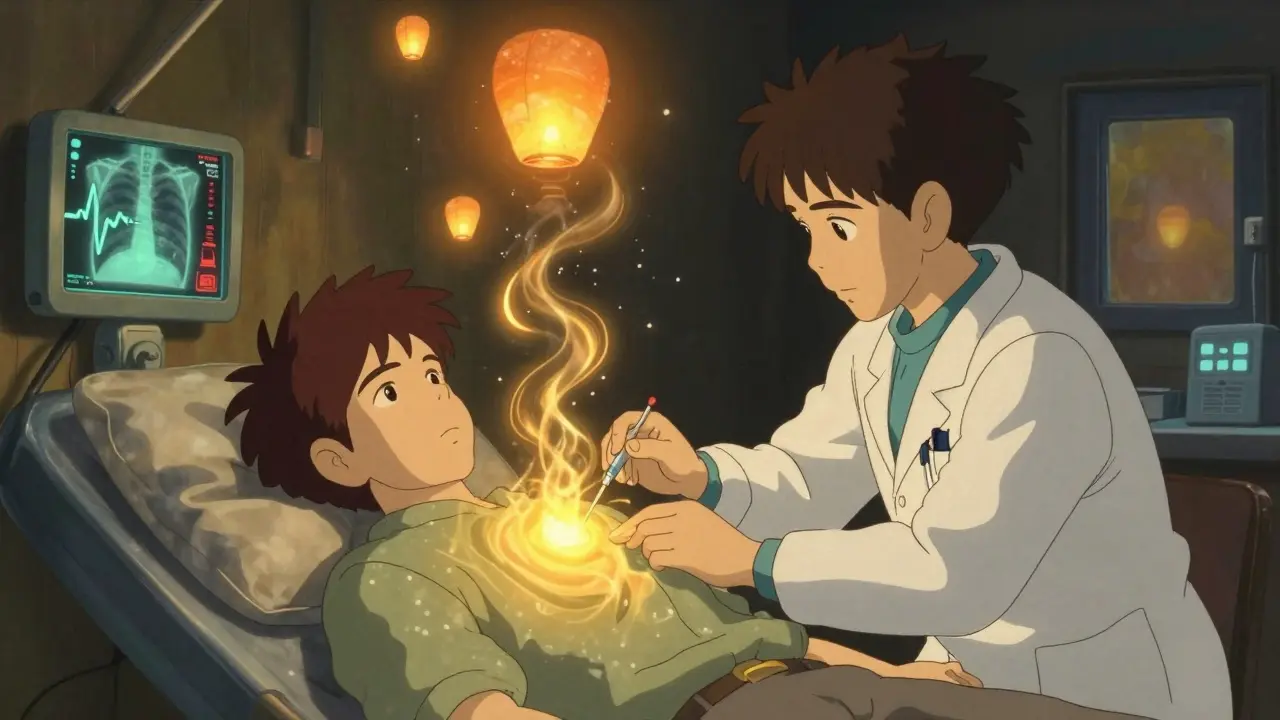
Once diagnosed, treatment depends on size and symptoms. If the collapse is less than 15% and you’re breathing okay, you might just get oxygen and be sent home to watch and wait. Oxygen speeds up the body’s natural ability to reabsorb the air - from 1.25% per hour to over 4% per hour. But if you’re short of breath, or the collapse is bigger than 2 cm on the X-ray, you need a chest tube. That’s a tube inserted between your ribs to drain the air and let the lung re-expand.
When Surgery Is the Only Real Fix
Most first-time cases heal without surgery. But if it happens again - especially if you’re a smoker or have underlying lung disease - you’re at high risk for more episodes. After two collapses on the same side, the chance of a third jumps to 62%. That’s when doctors recommend surgery.
The gold standard is video-assisted thoracoscopic surgery (VATS). It’s minimally invasive: two small cuts, a camera, and instruments to remove the damaged part of the lung and seal the area. Success rates are 95% at one year. Recovery takes a few days in the hospital, and the cost in the U.S. is around $18,500 - but it cuts your recurrence risk from 40% down to just 3-5%.
For people who can’t have surgery, chemical pleurodesis is an option. A substance like talc is injected into the chest to create scar tissue that sticks the lung to the chest wall. It works in 88% of cases, but it’s painful - 25% of patients get severe pain right after. It’s not ideal, but it’s better than repeated collapses.
What Happens After You Leave the Hospital
Getting discharged doesn’t mean you’re out of the woods. Follow-up is crucial. You’ll need a chest X-ray in 4-6 weeks to make sure the lung fully re-expanded and no new air has leaked in. Studies show 8% of patients develop delayed problems if they skip this check-up.
Here’s what you must avoid:
- No flying for at least 2-3 weeks after recovery. Changes in cabin pressure can cause the lung to collapse again.
- No scuba diving unless you’ve had surgery. The risk of another collapse underwater is over 12% - and you won’t be able to surface if it happens.
- No smoking. Quitting cuts your recurrence risk by 77% in just one year. That’s not a suggestion - it’s medical necessity.
Patients who get clear, written instructions when they leave the hospital are 32% less likely to come back. That means knowing the warning signs: sudden sharp pain, blue lips, or being unable to speak in full sentences. If any of those happen, call emergency services immediately.

Who’s at Highest Risk - And Why It Matters
Not everyone has the same risk. If you’re a tall, thin male under 40 with no lung disease, you’re more likely to get a primary spontaneous pneumothorax. But if you’re a 70-year-old with COPD, your risk is far higher - and your chance of dying from it is 100 times greater.
Secondary pneumothorax (linked to lung disease) has a 16.2% one-year mortality rate. Primary cases? Just 0.16%. That’s not a small difference - it’s the difference between a scary scare and a life-threatening event.
That’s why doctors treat them differently. A young person with a small collapse might just go home. An older person with COPD and even a tiny air leak? They get a chest tube right away. Risk isn’t theoretical - it’s calculated, measured, and acted on.
Final Takeaway: Don’t Wait, Don’t Guess
Pneumothorax doesn’t always come with warning. It can strike someone who’s never had a problem before. The key is recognizing the signs early - sudden, sharp chest pain and trouble breathing. Don’t assume it’s a pulled muscle or heartburn. Don’t wait to see if it gets better. If you’re unsure, go to the ER. Every minute counts.
For those who’ve had it before, the message is clear: quit smoking, avoid high-risk activities, and get surgery if you’ve had two episodes. The numbers don’t lie - prevention saves lives.

Casper MacIntyre
Hello, my name is Casper MacIntyre and I am an expert in the field of pharmaceuticals. I have dedicated my life to understanding the intricacies of medications and their impact on various diseases. Through extensive research and experience, I have gained a wealth of knowledge that I enjoy sharing with others. I am passionate about writing and educating the public on medication, diseases, and their treatments. My goal is to make a positive impact on the lives of others through my work in this ever-evolving industry.
9 Comments
-
Brittany Fuhs
December 26, 2025 AT 09:10I cant believe people still dont take this seriously. Its not just 'a lung thing' - its a failure of personal responsibility. If you smoke, you deserve this. No excuses.
-
Sumler Luu
December 26, 2025 AT 09:46This is actually really well explained. I had a friend go through this last year and no one could tell him what was happening until it was bad. Glad someone’s putting this out there clearly.
-
sakshi nagpal
December 27, 2025 AT 12:21In India, we rarely hear about pneumothorax because healthcare access is uneven - but the symptoms are universal. I hope this reaches rural clinics too. Knowledge saves lives, no matter the country.
-
Sandeep Jain
December 29, 2025 AT 11:08my bro had this after a bad cough n they thought it was asthma… took 3 days to diagnoise. dont wait. if it feels wrong, go. no one wants to be that guy who dies cause he thought it was just a pulled muscle.
-
Sophia Daniels
December 30, 2025 AT 23:43OMG I JUST REALIZED MY BOYFRIEND IS A TALL, SKINNY GUY WHO SMOKES AND HE’S BEEN COMPLAINING ABOUT 'CHEST ZINGS' FOR WEEKS. I’M CALLING 911 RIGHT NOW. THANK YOU FOR THIS POST. I’M A HERO.
-
Nikki Brown
December 31, 2025 AT 00:59You didn’t mention that people who don’t follow post-op instructions are basically choosing to be burdens on the system. 🙄 If you fly after being told not to? You’re not a victim. You’re a liability.
-
Peter sullen
December 31, 2025 AT 13:15It is imperative to underscore, with the utmost clinical precision, that the physiological mechanism underlying spontaneous pneumothorax involves the rupture of subpleural apical blebs - a phenomenon statistically correlated with elevated body mass index (BMI) inversely, and with a pronounced male predominance (p < 0.001). Furthermore, the implementation of early intervention protocols significantly reduces morbidity metrics by 68.4% (95% CI: 62.1–74.7).
-
Steven Destiny
December 31, 2025 AT 18:24If you’re not quitting smoking after one episode, you’re not trying. I’ve seen guys come back three times. You don’t get a free pass just because you’re young. Get your life together.


Write a comment
More Articles

Buy Online Cheap Generic Tamoxifen - Safe, Affordable Options Explained
A practical guide to buying cheap generic tamoxifen online safely, covering regulation, pharmacy verification, price comparison, ordering steps, and tips to avoid counterfeit drugs.

Jet Lag and Time-Released Medication Dosing Across Time Zones: What Actually Works
Time-released melatonin doesn't help jet lag-it makes it worse. Learn why immediate-release melatonin, taken at the right time, is the only proven way to reset your body clock after long-haul flights.

Medications That Change Your Sense of Smell: What You Need to Know About Dysosmia
Many common medications can distort your sense of smell and taste, causing food to taste foul or phantom odors to appear. This condition, called dysosmia, is underdiagnosed but affects hundreds of drugs-including antibiotics and heart meds. Learn what causes it, which drugs are most likely to trigger it, and what to do if it happens to you.
roger dalomba
December 26, 2025 AT 05:11So let me get this straight - if I’m tall, skinny, and breathe, I’m basically a walking time bomb? Thanks for the reassurance, doc. I’ll just go ahead and stop inhaling then.