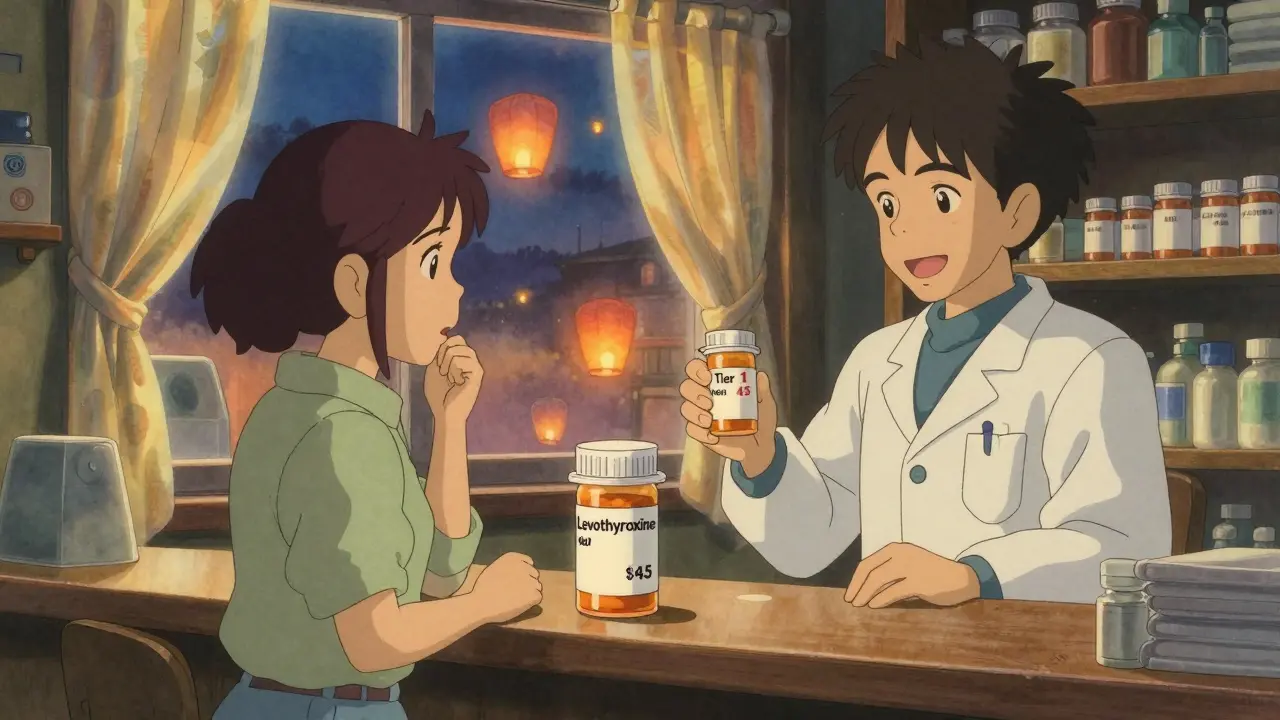
You pick up your prescription for levothyroxine, expecting to pay $5 like last month. Instead, the pharmacist says it’s $45. You check the bottle. It’s the same generic drug. Same dose. Same manufacturer. So why the huge jump?
Not All Generics Are Created Equal-By Your Insurer
The truth is, not all generic drugs are treated the same by your health plan. Even though they’re chemically identical to the brand-name version and to each other, insurers place them in different tiers based on one thing: money. Specifically, how much rebate the pharmacy benefit manager (PBM) got from the drugmaker. Most health plans today use a tiered system with four or five levels. Tier 1 is for preferred generics-usually the cheapest, often $0 to $15. Tier 2 might be preferred brand-name drugs. Tier 3? That’s where things get confusing. This is often where non-preferred generics land-even if they’re exactly the same as the Tier 1 version. Here’s the kicker: a generic drug can move from Tier 1 to Tier 3 overnight. No clinical reason. No safety issue. Just because the PBM’s contract with that manufacturer expired, and they didn’t renew it with a high enough rebate. That’s it.How Tiered Copays Work (And Why They’re Not About Quality)
Think of tiers like a pricing ladder. The insurer wants you to pick the cheapest option. But they don’t pick it because it’s better. They pick it because they got paid to push it. PBMs like Express Scripts, CVS Caremark, and OptumRx negotiate deals with drugmakers. The bigger the rebate, the lower the tier. A manufacturer might pay $10 per pill back to the PBM. If they pay $12, their generic lands in Tier 1. If they pay $8, it goes to Tier 2. The patient pays more, even though the drug is the same. A 2023 analysis by BOC Pharmacy Group found that 12-18% of generic drugs are classified as specialty medications-meaning they’re stuck in Tier 4 or 5-even though they’re not complex to use. Why? Because they cost more than $600 a month to make, so the PBM puts them in a higher tier to offset the cost. That’s not about clinical need. It’s about accounting.Why Your Levothyroxine Just Went from $5 to $45
Levothyroxine is one of the most common prescriptions in the U.S. and Australia. It’s a generic drug. Millions take it. But in 2024, UnitedHealthcare moved dozens of levothyroxine generics from Tier 1 to Tier 2 or 3 because their rebate deals changed. Patients saw their monthly cost jump from $5 to $40. Same pill. Same effect. Same doctor’s note. But now you’re paying eight times more. This isn’t rare. A 2023 Patient Advocate Foundation survey found that 41% of insured adults had a generic drug suddenly cost more-with no warning. And 68% couldn’t get a clear answer from their insurer. On Reddit, users post weekly: "Why is my generic suddenly Tier 3?" One user wrote: "My doctor says all generics are the same. My pharmacist says the same. But my insurance says no-this one costs $45. Why?" No one ever gives a real answer.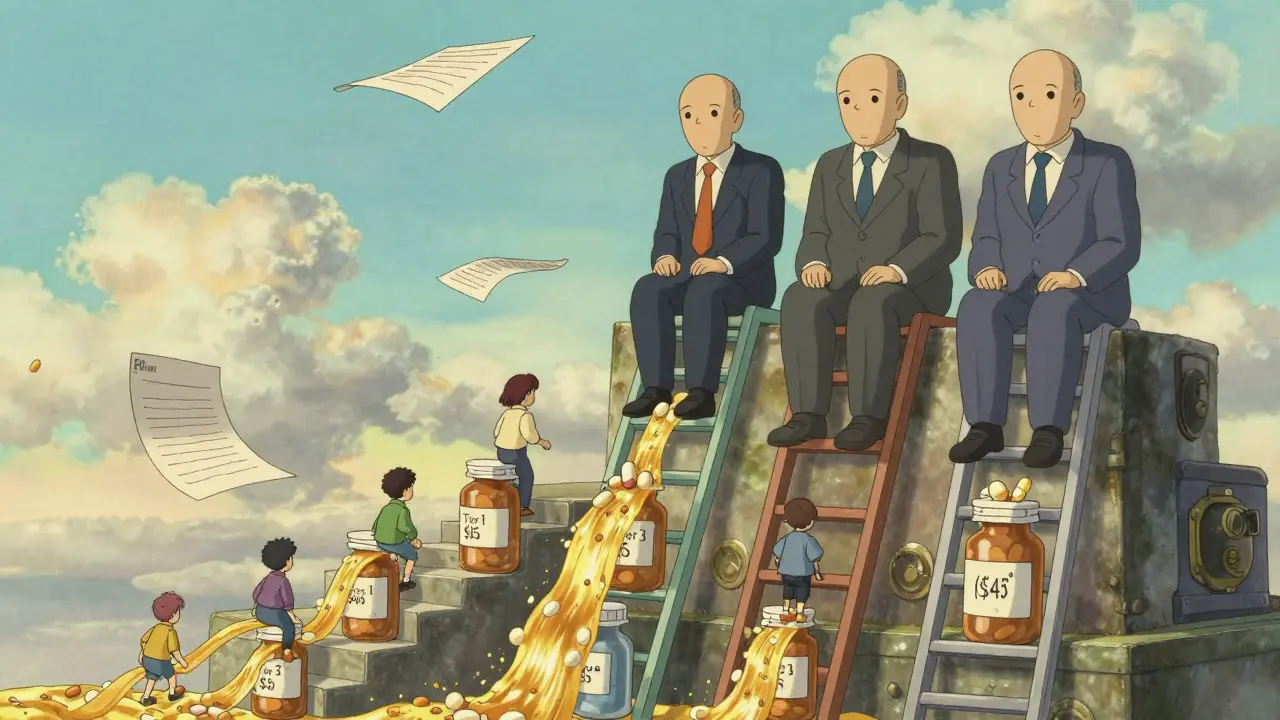
Specialty Generics Are the New Wild West
Some generics aren’t just pills. They’re biologics-complex drugs made from living cells. When these lose patent protection, generic versions (called biosimilars) enter the market. But because they’re expensive to produce, insurers treat them like specialty drugs. Take adalimumab, a generic version of Humira used for rheumatoid arthritis. Even though it’s a generic, it costs $5,000-$10,000 a month. Insurers put it in Tier 4 or 5. That means you pay 25-40% of that cost out of pocket. Even if you have good insurance, that’s $1,250-$4,000 a month. And here’s the trap: you can’t just switch. These drugs are often the only thing keeping you from severe pain or flare-ups. But your insurer might try to swap you to a different biosimilar-just because it’s on a lower tier. That’s called a therapeutic interchange. And it doesn’t always work.What You Can Do When Your Generic Gets Priced Up
You’re not powerless. Here’s what works:- Check your formulary every October. That’s when Medicare and most employer plans update their tiers. Use your insurer’s online tool-Humana’s Drug Cost Lookup or SmithRx’s tier comparison tool.
- Ask your pharmacist if there’s a preferred generic. They often know which version your plan favors. Sometimes, they can switch you without a new prescription.
- Request a tier exception. If your drug moved up and you’re stable on it, ask your doctor to file a form. The success rate is 63%, according to the Medicare Rights Center.
- Use manufacturer coupons. Many drugmakers offer savings cards that cut costs by 50-80%. These work even on Tier 4 drugs.
- Compare prices. Use GoodRx. Sometimes, paying cash at Walmart or Costco is cheaper than your copay.
Why This System Exists (And Why It Won’t Disappear)
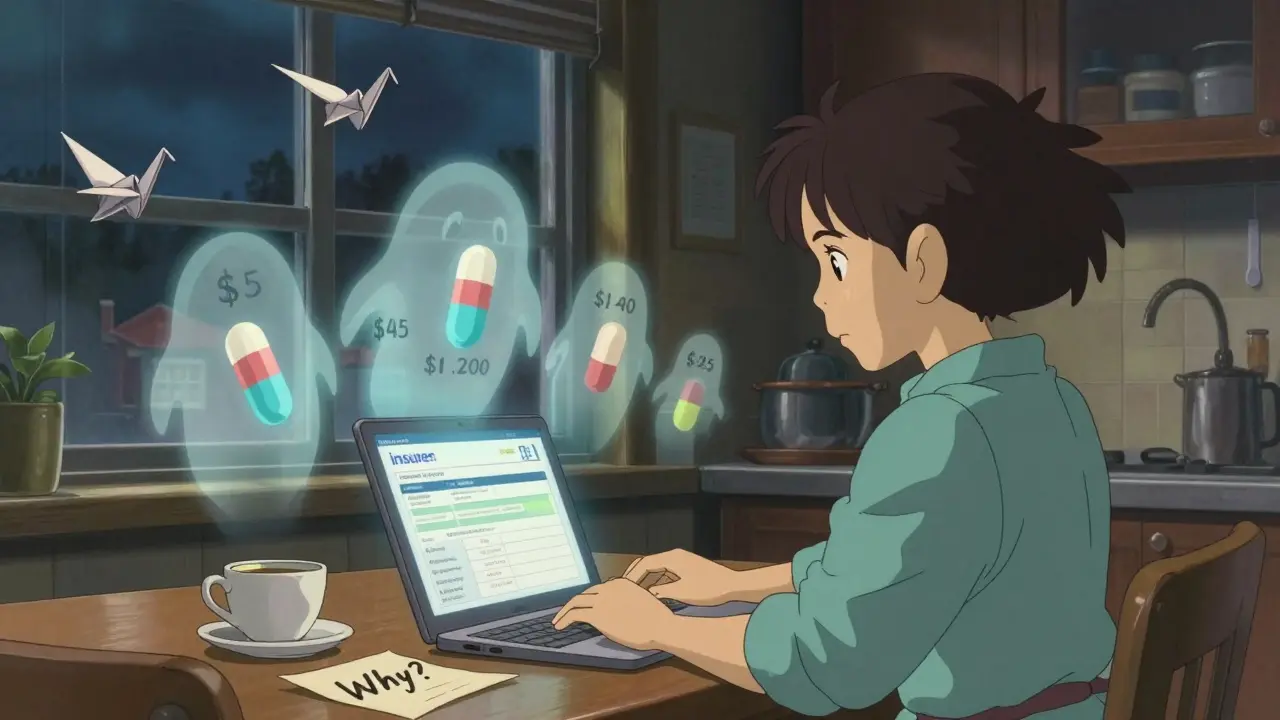
Tiered copays were created in the 1990s to slow rising drug prices. And they worked-sort of. Studies show they reduced spending on non-preferred brands by 15%. But they also created confusion, delays, and financial stress for patients. The system survives because it’s profitable for PBMs, not patients. PBMs make money from rebates, not from helping you pay less. The more tiers they create, the more control they have over which drugs you get. In 2024, Express Scripts moved 87 generic drugs to higher tiers-just because rebates dropped. No clinical reason. Just business. The Inflation Reduction Act (2025) caps out-of-pocket drug costs at $2,000 a year for Medicare patients. That’s good. But it doesn’t touch tiering. Your copay might still be $45 for a $5 drug. You just won’t pay more than $2,000 total for the year.What’s Next? Fewer Tiers, More Confusion
Industry analysts predict tier systems will simplify-from five tiers to four by 2026. But that doesn’t mean fairness. It means PBMs will group more drugs into fewer buckets, making it harder to predict costs. Biosimilars will be the next battleground. Multiple generic versions of the same biologic will be slotted into different tiers. You might have three versions of adalimumab. One costs $100. One costs $500. One costs $1,200. All are clinically the same. But your plan picks the middle one. And you’re stuck with it. The system isn’t broken. It’s working exactly as designed. For the insurers. Not for you.Bottom Line: Know Your Plan. Ask Questions. Fight Back
Generic drugs are supposed to save you money. But under tiered systems, they can cost more than the brand name. And no one tells you why. Your best defense? Stay informed. Check your formulary every year. Ask your pharmacist: "Is this the preferred version?" If your copay jumps, ask your doctor to file an exception. Don’t accept "that’s just how it is." It’s not. It’s a negotiation. And you’re the one paying for it. You’re not overpaying because you’re doing something wrong. You’re paying more because someone else made a deal behind the scenes. And you deserve to know about it.Why is my generic drug more expensive than the brand-name version?
It’s not about the drug-it’s about your plan’s contract with the manufacturer. Insurers assign tiers based on rebates, not clinical value. Sometimes, a generic gets placed in a higher tier because the drugmaker didn’t pay a big enough rebate to the pharmacy benefit manager (PBM). Even if the generic is chemically identical to the brand, it can cost more under your plan’s rules.
Can my insurer change my drug’s tier during the year?
Yes. While most formularies update in October, insurers can change tiers mid-year, especially for drugs where rebate deals expire. About 17% of commercial plans made changes between January and June 2023. You should get a notice, but many people miss it. Always check your plan’s formulary online if your copay suddenly increases.
What’s the difference between preferred and non-preferred generics?
There’s no clinical difference. Both generics contain the same active ingredient and work the same way. The terms "preferred" and "non-preferred" are purely financial. Preferred generics are the ones your insurer’s PBM negotiated the best rebate on. Non-preferred generics are the ones that didn’t offer enough money back to the PBM-even though they’re identical.
How do I find out which tier my drug is on?
Log into your insurer’s website and look for the "formulary" or "drug list" section. Most plans update this annually in October. You can also call your pharmacy or use tools like GoodRx or SmithRx to compare your plan’s tier pricing against other options. If you’re on Medicare, check the Medicare Plan Finder tool.
Can I appeal if my drug moves to a higher tier?
Yes. Ask your doctor to file a tier exception request. They’ll explain why you need this specific drug-for example, if you’ve been stable on it or if other versions caused side effects. Success rates are around 63%. If approved, your plan will cover it at the lower tier cost. Don’t assume it’s too late-appeals can be filed within 72 hours for urgent cases.
Are there programs to help pay for high-cost generics?
Yes. Many drug manufacturers offer patient assistance programs that can reduce your cost by 50-80%. These often work even for Tier 4 or 5 drugs. You can also use pharmacy discount cards like GoodRx or SingleCare. For specialty generics (like biosimilars), nonprofit organizations and state programs may offer additional help. Check with your pharmacist-they often know about these options.

Casper MacIntyre
Hello, my name is Casper MacIntyre and I am an expert in the field of pharmaceuticals. I have dedicated my life to understanding the intricacies of medications and their impact on various diseases. Through extensive research and experience, I have gained a wealth of knowledge that I enjoy sharing with others. I am passionate about writing and educating the public on medication, diseases, and their treatments. My goal is to make a positive impact on the lives of others through my work in this ever-evolving industry.
10 Comments
-
Cameron Hoover
December 22, 2025 AT 11:57I used to think generics were the answer... turns out they're just the latest way corporations profit off our health. I'm not mad, I'm just... heartbroken. 💔
-
Stacey Smith
December 23, 2025 AT 07:46Stop whining. If you can't afford your meds, get a better job. This is America. You don't get free stuff.
-
Ben Warren
December 23, 2025 AT 08:45The structural inefficiencies inherent in the current pharmaceutical benefit management ecosystem are a direct consequence of market-driven incentives that prioritize fiscal optimization over patient welfare. The tiered copay architecture, while ostensibly designed to incentivize cost-effective prescribing, has been perverted into a mechanism of rent extraction by third-party intermediaries whose fiduciary obligations lie not with the patient, but with shareholders. This is not a flaw-it is the system operating as intended.
-
Teya Derksen Friesen
December 23, 2025 AT 12:28In Canada, we don’t have this problem. Our public system negotiates bulk pricing. No tiers. No surprises. Just medicine. Maybe we should ask: why does the U.S. need so many middlemen?
-
Sandy Crux
December 25, 2025 AT 05:34I'm sorry, but... are we seriously still debating this? The PBM model is a textbook example of regulatory capture-where industry consultants design the rules that benefit them, while patients are left to navigate a labyrinth of arbitrary, opaque, and deliberately confusing pricing structures. The fact that this is even a conversation is a national shame.
-
Jason Silva
December 26, 2025 AT 06:13They're putting trackers in your pills, bro. 🤫 The PBM's tracking your usage, then selling your data to pharma so they can jack up prices. I saw a doc on YouTube-this is all part of the 'Medicare 2.0' plan. They want you dependent. Wake up. 🚨💊
-
mukesh matav
December 26, 2025 AT 22:19In India, generics cost less than $1. We don’t have PBMs. We don’t have tiers. Just medicine. Maybe the problem isn’t the drug-it’s the system.
-
Peggy Adams
December 28, 2025 AT 14:27I just found out my $5 levothyroxine got moved to tier 3 because the PBM didn’t get enough kickback. I’m not surprised. I’ve been waiting for the government to admit this whole thing is a scam.
-
Sarah Williams
December 29, 2025 AT 16:21You’re not alone. I had the same thing happen. I called my pharmacy, asked for the preferred generic, and switched without a new script. Saved $40. You can fight this. Don’t give up.


Write a comment
More Articles
Anticholinergics and Urinary Retention: How Prostate Issues Make Medication Risks Worse
Anticholinergics for bladder issues can worsen urinary retention in men with prostate enlargement. Learn how these medications interact with BPH, the risks involved, and safer alternatives. Includes real-world data, expert advice, and management strategies.
Eicosapentaenoic Acid: The Secret Ingredient for Boosting Your Overall Health and Well-being
Eicosapentaenoic Acid (EPA) has recently caught my attention as a secret ingredient that can significantly improve our overall health and well-being. Found in fish oil, this omega-3 fatty acid is known to reduce inflammation, lower the risk of heart disease, and even improve mental health. I've noticed that incorporating EPA-rich foods, like salmon and mackerel, into my diet has made a positive impact on my energy levels and mood. Additionally, taking fish oil supplements has been a convenient way to ensure I'm getting enough EPA. I highly recommend looking into EPA as a natural way to boost your health and well-being.

8 Classy Competitors to CVS.com You Need to Check Out in 2025
In 2025, the online healthcare landscape offers numerous alternatives to cvs.com, each with unique features and benefits. This article delves into eight standout competitors, highlighting their advantages and drawbacks to help consumers make informed choices. From innovative prescription services to holistic health platforms, these options are reshaping the way we approach healthcare shopping. Explore these alternatives to find the perfect match for your needs.
Erika Putri Aldana
December 21, 2025 AT 06:37This is why I stopped trusting insurance. 😒 Same pill, same doctor, same body... but now I'm paying $45? Bro, it's not medicine, it's a casino.