
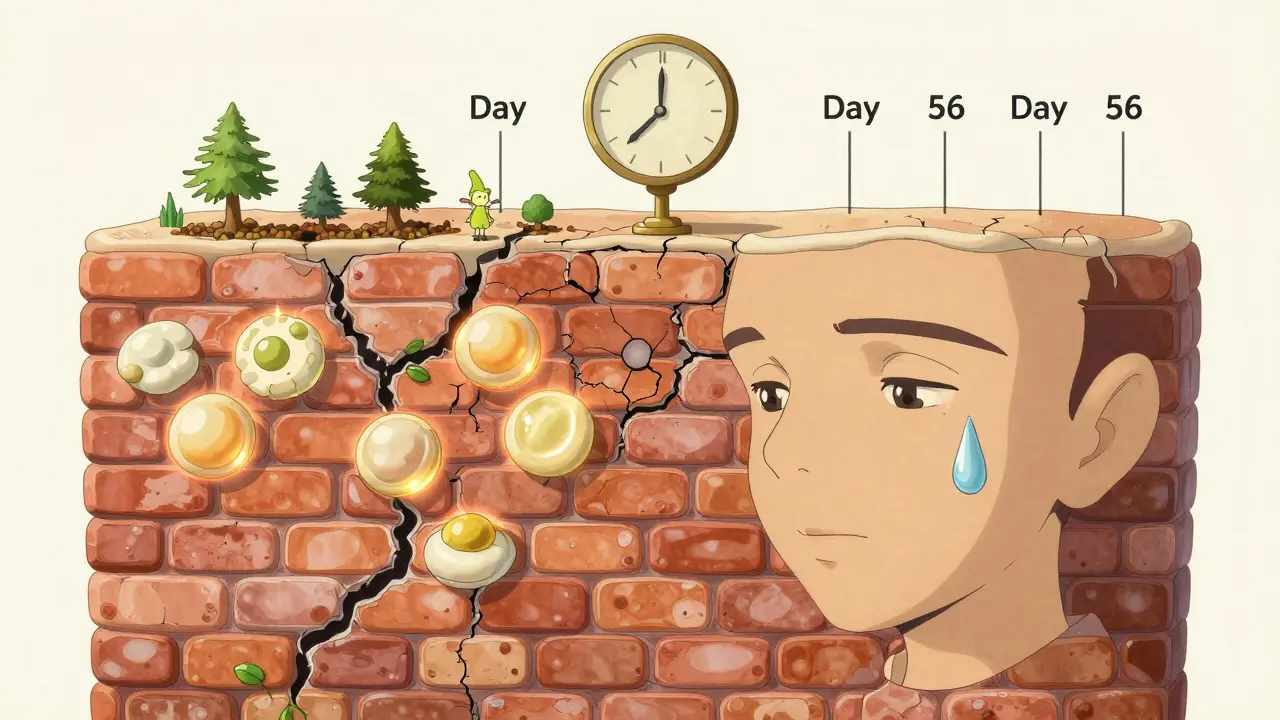
When your skin feels tight, itchy, and flaky, it’s not just dryness-it’s a broken barrier. In eczema, the outer layer of skin, called the stratum corneum, stops working like it should. Think of it like a brick wall where the bricks are skin cells and the mortar is made of lipids: mostly ceramides, plus cholesterol and fatty acids. In healthy skin, this mortar holds everything together, keeping moisture in and irritants out. But in eczema, that mortar is crumbling. Studies show people with atopic dermatitis have 30-50% less ceramide than those without it. That’s not a small gap. It’s the core reason why the skin leaks water, gets inflamed, and reacts to everything from soap to sweat.
Why Ceramides Are the Missing Piece
Ceramides make up about half of the skin’s lipid matrix. They’re not just any fat-they’re long-chain molecules that lock together like puzzle pieces, forming tight, water-resistant layers between skin cells. In eczema, the types of ceramides change too. You lose the long-chain ones like ceramide 1 (NP and AP), which are essential for structure, and get more short-chain versions that don’t hold the barrier together well. This imbalance leads to 40-60% higher transepidermal water loss (TEWL), meaning your skin loses moisture twice as fast as normal.Not all moisturizers fix this. Traditional ones like petroleum jelly or basic lotions just sit on top like a plastic wrap. They slow water loss temporarily but don’t rebuild the barrier. Prescription products like EpiCeram® and a ceramide-dominant emulsion developed by Crown Therapeutics that restores the skin’s natural lipid ratio work because they don’t just add ceramides-they add the right mix. The science is clear: you need the exact 3:1:1 ratio of ceramides to cholesterol to free fatty acids. If you’re missing even one piece, the repair fails. Research shows that using ceramides alone can actually slow healing by 15-25% compared to the full blend.
Real-world results back this up. In clinical trials, patients using full-spectrum ceramide emulsions saw 35-50% reduction in TEWL within days, with effects lasting over 72 hours. One study in the Journal of Dermatological Science found that after 8 weeks of daily use, participants reduced their steroid use from daily to once a week. That’s not just symptom relief-it’s changing the disease course.
Bathing Isn’t Just Cleaning-It’s Therapy
Most people with eczema think bathing helps. But if you’re doing it wrong, you’re making things worse. Hot showers, long soaks, and harsh soaps strip away the last bits of your skin’s natural oils. The key is the soak-and-seal method.Here’s how it works: Take a 10-15 minute bath in lukewarm water-no hotter than 32°C (90°F). Use a cleanser that’s fragrance-free and pH-balanced (around 5.5), with less than 0.5% sodium lauryl sulfate. Higher concentrations can spike TEWL by 25-40% in just one hour. After the bath, pat your skin gently-don’t rub. Then, within three minutes, apply your ceramide cream or ointment to damp skin. This simple timing trick boosts absorption by 50-70%. The moisture on your skin helps the ceramides sink in deeper, where they can rebuild the barrier instead of just sitting on top.
Do this once a day. Twice if you’re in a flare. But don’t overdo it. Bathing more than once daily, even with the right products, can still irritate sensitive skin. And never use loofahs, scrubs, or hot water. They’re like sandpaper on a broken wall.

Prescription vs. Over-the-Counter: What Actually Works
You’ll see ceramides in everything now-from $5 drugstore creams to $35 prescription tubes. But not all are equal.| Product Type | Example Brands | Ceramide Ratio | TEWL Reduction | Time to See Results | Cost (200g) |
|---|---|---|---|---|---|
| Prescription | EpiCeram®, TriCeram® | Exact 3:1:1 | 35-50% | 21-28 days | $25-$35 |
| OTC (High Quality) | CeraVe, Vanicream | Approx. 3:1:1 | 25-40% | 4-6 weeks | $10-$18 |
| Traditional Moisturizers | Vaseline, Aveeno | None or pseudo-ceramides | 20-30% | Immediate (temporary) | $5-$15 |
Prescription products like EpiCeram® are formulated to match your skin’s natural lipid profile. They’re tested in clinical trials and approved as medical devices by the FDA. Over-the-counter brands like CeraVe do a decent job-they contain ceramides, cholesterol, and fatty acids-but the concentrations aren’t always precise. Many users report improvement, but those with moderate-to-severe eczema often need the stronger prescription versions.
And here’s the catch: if a product doesn’t list the exact ratio of ceramides, cholesterol, and fatty acids, it’s probably not delivering true barrier repair. Some brands use synthetic “pseudo-ceramides” that mimic the structure but don’t function the same way. Clinical studies show these deliver 40% less barrier repair than real, physiological ceramides.
What Users Really Say
On Reddit’s r/eczema community, over 78% of users who tried ceramide-based products reported noticeable improvement in itching and dryness within 2-4 weeks. One person wrote: “After trying 10 moisturizers, EpiCeram cut my nighttime scratching from 8-10 times to 1-2.” That’s not luck-it’s science.But not everyone wins. On Amazon and Trustpilot, common complaints include:
- “Too greasy” (27% of negative reviews)
- “Took too long to work” (15%)
- “Didn’t help during a bad flare” (38%)
That last one is important. Ceramides aren’t fast-acting. They don’t calm redness like a steroid cream does. If you’re in a flare, you still need your prescription steroid. But once the flare is under control, switching to ceramides can keep it from coming back. Many users report being able to cut steroid use in half-or even stop it entirely-after 6-8 weeks of consistent use.
How to Use Ceramides Right
Getting results isn’t about buying the priciest product. It’s about consistency and timing.- Apply twice daily-morning and night. During flares, go to three times.
- Use after bathing-within 3 minutes of patting skin dry.
- Don’t skip-even when skin looks fine. Barrier repair takes 4-6 weeks to build.
- Check the ingredients-look for ceramide NP, AP, or AS, plus cholesterol and free fatty acids in a 3:1:1 ratio.
- Avoid irritants-no fragrances, alcohol, or sulfates in cleansers or lotions.
Many people fail because they stop too soon. They use it for a week, see no change, and give up. But barrier repair isn’t like a painkiller. It’s like building a wall brick by brick. You won’t see it until it’s done.
What’s Next for Eczema Treatment
The future is personalization. Researchers are now testing products that match your specific ceramide deficiency. One company, LEO Pharma, is developing a test that measures your skin’s ceramide levels and then prescribes a custom blend. Early trials show 30% better results in patients with low ceramide 1.Guidelines from the European Academy of Dermatology now recommend ceramide emulsions for all eczema severities. And with 45% of dermatologists recommending them as first-line maintenance therapy, the message is clear: barrier repair isn’t optional anymore. It’s the foundation.
For now, the best thing you can do is stop chasing quick fixes. Stop scrubbing, stop over-bathing, stop relying on steroids alone. Start rebuilding. With the right ceramide product and the right bathing routine, your skin can heal itself.

Casper MacIntyre
Hello, my name is Casper MacIntyre and I am an expert in the field of pharmaceuticals. I have dedicated my life to understanding the intricacies of medications and their impact on various diseases. Through extensive research and experience, I have gained a wealth of knowledge that I enjoy sharing with others. I am passionate about writing and educating the public on medication, diseases, and their treatments. My goal is to make a positive impact on the lives of others through my work in this ever-evolving industry.
13 Comments
-
Oana Iordachescu
February 23, 2026 AT 14:08Are we certain this isn’t just Big Pharma repackaging old ingredients under a new label? The 3:1:1 ratio sounds suspiciously precise-like a patent loophole. I’ve seen studies funded by dermatological corporations that ‘prove’ coconut oil cures cancer. Skepticism isn’t paranoia-it’s due diligence.
-
Michaela Jorstad
February 24, 2026 AT 22:44I love how this breaks it down. Seriously. So many people think moisturizer = solution. But it’s not about hydration-it’s about reconstruction. I used to slap on Vaseline and call it a day. Then I tried the full-spectrum emulsion-after three weeks, my skin stopped flaking like a snow globe. And yes-I did the 3-minute window religiously. It matters.
-
Chris Beeley
February 25, 2026 AT 17:53Let me tell you something, folks-this whole ceramide narrative is a beautifully orchestrated distraction. The real issue? Industrial toxins in our water supply. Glyphosate. PFAS. Microplastics. Your skin isn’t ‘deficient’-it’s protesting. Ceramides? They’re the Band-Aid on a bullet wound. Meanwhile, the pharmaceutical-industrial complex is cashing in on your desperation while your liver metabolizes their ‘miracle’ creams. Wake up. Your body is screaming. And no, a $35 tube won’t fix systemic toxicity.
-
Arshdeep Singh
February 26, 2026 AT 06:27Bro, you’re overcomplicating this. Skin is just another organ. You don’t need a 3:1:1 ratio like you’re baking a cake. Just use something thick. Stop scrubbing. Stop showering like you’re trying to win a medal. I used vaseline every night for 3 years. No ceramides. No science. Just grease. And guess what? My eczema vanished. Science? Nah. Simplicity wins.
-
James Roberts
February 26, 2026 AT 12:34Ohhh, so you’re telling me the $20 cream I bought last week isn’t magic… and I need to wait 6 weeks? And also, not bathe in boiling water? Wow. Mind blown. Next you’ll tell me that eating vegetables is good for you. /s. But honestly? This is the most honest thing I’ve read on this topic. I’ve been doing the soak-and-seal for 3 weeks now. My skin’s still not perfect. But it’s… breathing. And that’s enough.
-
Danielle Gerrish
February 28, 2026 AT 01:36Y’all. I went from daily steroid use to zero in 10 weeks. I cried the first time I woke up without a red, cracked arm. I thought I’d be on prednisone forever. I tried everything-oatmeal baths, coconut oil, aloe vera gel from the plant I named ‘Barry.’ Nothing worked. Then I found the 3:1:1 emulsion. I applied it after my 10-minute lukewarm soak. And then-I did it again. And again. And again. I didn’t miss a single day. Not one. And now? My skin looks like it belongs to someone who sleeps. I’m not ‘cured.’ But I’m not suffering. And that’s a revolution.
-
Jeremy Williams
February 28, 2026 AT 05:14In Japan, we call this ‘kōfuku no hada’-the skin of happiness. It’s not about products. It’s about ritual. The bath is sacred. The silence after. The gentle pat. The application-not as a chore, but as a prayer. I’ve watched my mother do this for 40 years. No science. No ratios. Just care. And yet, her skin is younger than mine. Maybe the answer isn’t in the lipid matrix… but in the intention behind it.
-
Freddy King
March 1, 2026 AT 22:06TEWL reduction? Ceramide NP? 3:1:1? Look-I respect the data. But let’s not pretend this is groundbreaking. This is just lipid biochemistry with a marketing budget. You’re telling me we didn’t know ceramides were structural lipids before 2020? Please. The real innovation here is packaging. The ‘clinical trial’ results? They’re statistically significant but clinically marginal. 35% TEWL reduction? That’s like saying your headache went from 8/10 to 5/10. You’re still in pain. And now you’re $30 poorer.
-
Laura B
March 2, 2026 AT 13:23I’ve been using CeraVe for 8 months. My dermatologist said it’s ‘adequate.’ But I didn’t notice anything until I started doing the 3-minute seal after every shower. It’s not the cream-it’s the timing. I used to skip it. Now I set a timer. I even left my phone in the bathroom so I wouldn’t scroll. And now? My skin doesn’t feel like sandpaper anymore. It’s subtle. But it’s real. And honestly? It’s the small things that change everything.
-
Robin bremer
March 4, 2026 AT 02:27OMG YES. I tried everything. Even that $80 cream with ‘bio-identical ceramides’ (lol). Then I went back to plain Vaseline + 3-min window. My skin went from ‘I’m gonna cry’ to ‘I forgot I had eczema.’ I’m not even mad anymore. Just… relieved. 🥹
-
Jayanta Boruah
March 5, 2026 AT 16:17While the ceramide ratio theory is mathematically elegant, it fails to account for epigenetic modulation of lipid synthesis pathways. Your genetic SNPs in CERS3 and SDR9C7 determine baseline ceramide production. A one-size-fits-all emulsion cannot compensate for heterozygous loss-of-function mutations. Therefore, empirical application without genetic profiling is scientifically indefensible. You are not repairing a barrier-you are performing biochemical trial and error.
-
Courtney Hain
March 6, 2026 AT 13:05Wait. So the FDA approved these as ‘medical devices’? That’s not a regulatory loophole-it’s a scandal. If this were a drug, it’d need Phase III trials. But because it’s a ‘device,’ they skip all the safety reviews. And now they’re telling you to apply it three times a day? What if you develop contact dermatitis? What if the cholesterol oxidizes? What if the ‘ceramides’ are just synthetic mimics? Who’s auditing this? Who’s watching? And why does no one talk about this? I’ve been reading the fine print. And I’m scared.


Write a comment
More Articles
How Saxagliptin Affects Insulin Resistance in Type 2 Diabetes
As a blogger focused on health and wellness, I recently came across some interesting research on how Saxagliptin affects insulin resistance in Type 2 Diabetes. From what I've gathered, Saxagliptin is a medication that helps to control blood sugar levels by increasing the release of insulin and reducing the amount of glucose produced by the liver. This ultimately results in better management of Type 2 Diabetes and improved overall health. I was impressed to learn that this medication can not only help those struggling with insulin resistance but also reduce the risk of long-term complications associated with diabetes. I'm eager to continue following this topic and sharing more insights with my readers.

How to Monitor Kidney Function for Safe Senior Dosing
Learn how to accurately monitor kidney function in seniors to avoid dangerous medication overdoses. Discover which eGFR equations work best, why creatinine can mislead, and what steps to take for safer dosing.

Behavioral Economics: Why Patients Choose Certain Drugs - Even When It Doesn’t Make Sense
Why do patients choose expensive drugs over cheaper, equally effective ones? Behavioral economics reveals how psychology - not logic - drives medication decisions. Learn how nudges, loss aversion, and defaults improve adherence and save lives.
Ashley Paashuis
February 21, 2026 AT 18:34Barriers don’t repair themselves overnight-this post nails it. I’ve been using CeraVe for six months now, and while it didn’t vanish overnight, the difference in my skin’s resilience is undeniable. No more waking up with cracked elbows. No more itching through Zoom calls. It’s slow, but it’s steady. And that’s the point.