
Medication Safety Checker
The FDA's new Patient Medication Information (PMI) provides clear, standardized information for all prescription drugs. Enter a medication name to see what key safety information you should expect to receive.
Your PMI Information
Usage Instructions
Your PMI should include:
- Start with "Use exactly as prescribed."
- Directions for use (how often, time, food requirements)
- Storage requirements
- What to do if you miss a dose
Safety Information
Your PMI should include:
- Special handling requirements
- Serious safety warnings
- Common side effects (affecting 1 in 10 or more people)
- Proper disposal instructions
Starting in 2025, every prescription you pick up at the pharmacy in the U.S. could come with a new, simple, one-page handout called Patient Medication Information (PMI). This isn’t just a minor update-it’s the biggest shift in how prescription drugs are explained to patients in decades. Right now, only about 150 out of thousands of prescription medications come with a Medication Guide. That means most people get a tiny label on the bottle with a list of side effects, maybe a warning, and instructions that are hard to read. The FDA’s new PMI rule changes all that. It’s designed to make sure everyone, no matter where they live or which pharmacy they use, gets the same clear, easy-to-understand info about their meds.
Why the FDA Is Making This Change
Every year in the U.S., about 1.3 million people are injured and 7,000 die because of medication errors. Many of these aren’t caused by doctors or pharmacists making mistakes-they happen because patients don’t fully understand how to take their drugs. Maybe they didn’t know to avoid alcohol with their painkiller. Maybe they didn’t realize their blood pressure pill needs to be taken on an empty stomach. Or maybe they skipped doses because the instructions were too confusing. The Institute of Medicine first flagged this problem back in 2006. Since then, the FDA has tried to fix it multiple times. Industry pushback, changing priorities, and bureaucratic delays stalled past efforts. But now, with rising rates of chronic illness and an aging population, the pressure is on. The new PMI rule is the FDA’s most serious attempt yet to cut down on preventable harm.What the PMI Will Look Like
Forget the long, dense pamphlets you sometimes get with your pills. The new PMI is just one page. It’s designed to be printed in 12-point font, with clear headings and plain language. No jargon. No marketing fluff. Just what you need to know to use your medicine safely. Here’s what’s required:- Start with “Use exactly as prescribed.” Right at the top. No exceptions.
- Directions for use. How often? At what time? With food or without? How to store it? What to do if you miss a dose?
- Special handling. For example, if your drug needs refrigeration, or if it can’t be crushed or split.
- Safety warnings. Serious risks like liver damage, allergic reactions, or dangerous interactions.
- Common side effects. Things that happen to more than 1 in 10 people.
- Disposal instructions. How to safely throw away expired or unused pills.
It’s Not Just Paper Anymore
The FDA knows not everyone wants or can read paper. So the new rule allows electronic PMIs too. You might get a text message with a link, an email, or a downloadable PDF from your pharmacy’s app. But here’s the catch: it has to be accessible. That means it needs to work with screen readers, be readable on small phones, and not require complex logins. Section 508 compliance is mandatory. This is a big deal for younger patients, people who use telehealth, and those who prefer digital tools. But it also raises concerns. What about older adults without smartphones? Or people without reliable internet? The FDA says pharmacies must still offer a printed copy if requested. No one gets left behind.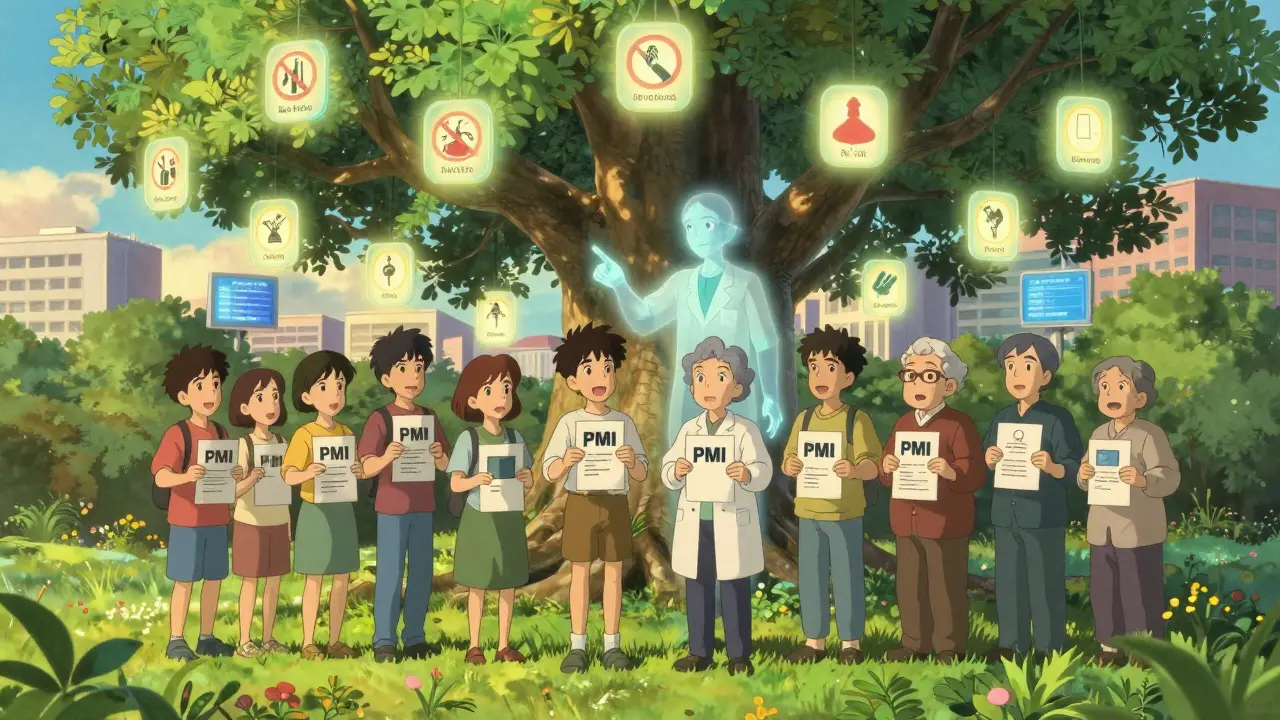
What’s Missing From the PMI
Here’s where things get tricky. The PMI focuses on safety and usage-but it doesn’t tell you how well the drug works. Researchers at the University of Pittsburgh tested a modified version they called “Decision Critical PMI.” For a drug like mifepristone, instead of saying “common side effects include fever,” their version said: “48% of patients experience fever.” That kind of specificity helps people decide if the side effect is likely to happen to them-or if it’s rare. The FDA’s current version says “common side effects” without numbers. That’s intentional. They want to keep the PMI short and simple. But critics argue that if patients are supposed to make informed choices, they need to know not just the risks, but the benefits too. How much does this drug lower blood pressure? Does it reduce the chance of stroke by 20%? Does it help 7 out of 10 people feel better? The FDA says providers are supposed to explain those details during the visit. But what if the patient doesn’t remember? Or didn’t ask? Or doesn’t trust their doctor? That gap could leave people confused-and possibly less likely to take their medicine as directed.Who’s Affected and When
This rule doesn’t just impact patients. It changes how drugmakers, pharmacies, and doctors operate.- Pharmaceutical companies will have to create, test, and submit a PMI for every single outpatient prescription drug they sell. That’s thousands of documents. They’ll have 24 to 36 months to comply, depending on their size.
- Pharmacies will need to add PMI distribution into their workflow. That’s an extra 30 to 60 seconds per prescription during the first year. Staff will need 2 to 4 hours of training, plus annual refreshers.
- Healthcare providers may need to update how they talk to patients about meds, since the PMI now handles the basics. But they won’t be responsible for creating the documents.
What This Means for You
If you take any prescription medication, you’ll see this change soon. The PMI won’t replace your doctor’s advice-but it will give you a consistent, reliable reference you can take home. No more guessing because your last prescription came with a different format than the one before. You’ll be able to compare side effects across meds more easily. You’ll know exactly how to store insulin or keep your epilepsy drug away from heat. You’ll understand what to do if you accidentally take too much. And if you’re a caregiver for an elderly parent or someone with multiple conditions? This could be a game-changer. No more juggling 10 different labels with conflicting instructions.What’s Next?
As of late 2023, the FDA had received over 1,200 public comments on the proposal. The final rule is expected in mid-2024. Implementation will start in 2025, with full rollout by 2026. The FDA has said it’s open to future updates. If research shows patients need more detail on benefits or effectiveness, they may expand the PMI later. The University of Pittsburgh’s ongoing study could influence that. Meanwhile, the European Medicines Agency is watching closely. If this works in the U.S., they may follow suit by 2025. This isn’t just about paperwork. It’s about safety. It’s about dignity. It’s about giving people the power to manage their own health with confidence-no matter their education level, income, or where they live.Will all my prescriptions have the new PMI?
Yes-if it’s a prescription you pick up for outpatient use. That includes pills, injections, patches, and even blood transfusions done outside the hospital. The only exceptions are drugs used only in hospitals or clinics, like IV antibiotics given in a treatment center. Over 90% of all prescriptions will be covered.
Can I still get the old Medication Guide?
No. The new PMI replaces the old Medication Guide for all covered drugs. The old guides were inconsistent and only required for a small number of high-risk drugs. The PMI is the new standard. Pharmacies will no longer distribute the old versions.
What if I don’t understand the PMI?
You’re not alone. The FDA designed the PMI to be easy to read, but if you’re still unsure, ask your pharmacist. They’re required to explain it to you. You can also ask your doctor for clarification. There’s no shame in asking-this is your health.
Will the PMI tell me how much the drug costs?
No. The PMI is strictly about safety, usage, and side effects. It doesn’t include pricing, insurance coverage, or copay information. That’s still handled by your pharmacy’s receipt or your insurer’s website.
Can I get the PMI before I pick up my prescription?
Some pharmacies may offer digital PMIs via email or app notifications before your prescription is ready. But the FDA doesn’t require it. You’ll definitely get it when you pick up your meds, either printed or electronically.
Why doesn’t the PMI list how effective the drug is?
The FDA chose to keep the PMI focused on safety and clear instructions to avoid overwhelming patients. They believe effectiveness details should come from your doctor during the consultation. However, researchers are pushing for future updates to include numbers like “this drug reduces symptoms in 70% of users.” That could change in later versions.

Casper MacIntyre
Hello, my name is Casper MacIntyre and I am an expert in the field of pharmaceuticals. I have dedicated my life to understanding the intricacies of medications and their impact on various diseases. Through extensive research and experience, I have gained a wealth of knowledge that I enjoy sharing with others. I am passionate about writing and educating the public on medication, diseases, and their treatments. My goal is to make a positive impact on the lives of others through my work in this ever-evolving industry.
11 Comments
-
Roisin Kelly
January 23, 2026 AT 05:02They’re hiding something. Why no cost info? Why no efficacy stats? This is just a way to make Big Pharma look good while we get stuck with pills we don’t understand and bills we can’t afford. I bet they’re already working on a subscription model for the PMI app.
-
Melanie Pearson
January 23, 2026 AT 09:53While the intent of the Patient Medication Information initiative is commendable, the structural implementation remains fundamentally flawed. The exclusion of quantitative efficacy data constitutes a critical epistemological deficit in patient autonomy. Without statistical context, informed consent is rendered performative rather than substantive. Furthermore, the assumption that plain language equates to comprehension ignores the cognitive load imposed by polypharmacy in elderly populations. The FDA’s failure to integrate clinical trial data, even in simplified form, represents a regression in risk-benefit communication standards.
-
Rod Wheatley
January 24, 2026 AT 23:45This is HUGE. Seriously. I’ve been a pharmacist for 22 years, and I’ve watched people die because they didn’t know to take their blood thinner on an empty stomach, or that their antidepressant shouldn’t be mixed with grapefruit juice. This one-page thing? It’s not just helpful-it’s life-saving. And the digital access part? Brilliant. My grandma can’t read the tiny print on the old guides, but she uses her iPad every day to FaceTime her grandkids. If we make it simple, accessible, and consistent? We’re finally treating patients like humans, not paperwork. Thank you, FDA. Please don’t let the industry water this down.
-
Uju Megafu
January 25, 2026 AT 22:04Who gave the FDA the right to decide what I need to know about my own body? This is socialist medicine. You think a government form can replace personal responsibility? You think a pamphlet will stop people from drinking while on painkillers? No. People are stupid. The solution isn’t more paperwork-it’s less medicine. Stop giving people drugs they don’t need, and they won’t need instructions.
-
Ben McKibbin
January 27, 2026 AT 15:32The real genius here is the restraint. The FDA didn’t try to cram every possible detail into one page-they focused on safety, clarity, and consistency. That’s radical in a system that’s been drowning us in legalese and marketing spin for decades. The omission of efficacy stats? Intentional. Not because they don’t matter, but because they belong in conversation, not on a handout. A PMI isn’t meant to replace the doctor-it’s meant to give you a solid anchor when you get home. And if you’re still confused? That’s when you call your pharmacist. Not because you’re dumb, but because you’re smart enough to know when to ask.
-
Andrew Rinaldi
January 28, 2026 AT 11:22I wonder if we’re over-indexing on the document and under-indexing on the relationship. The PMI is a tool, but medicine is still a human act. What if the real problem isn’t the information, but the time we spend listening to patients? Maybe we’re using this as an excuse to avoid deeper conversations. Still… I’ll take a clear label over a confusing one any day.
-
Sangeeta Isaac
January 29, 2026 AT 21:45So now my pills come with a ‘how not to die’ brochure… and it’s still not gonna tell me if it’ll make me gain 10 lbs or turn my urine neon green. But hey, at least the font’s bigger. I’ll take it. Also, if I get a text with a link to my PMI, I’m assuming it’s a phishing scam until proven otherwise. 🤓
-
Alex Carletti Gouvea
January 30, 2026 AT 15:36Why are we letting the FDA dictate how we get our meds? This is just another step toward federal control of healthcare. I don’t need a government-approved pamphlet to tell me how to take my medicine. I’ll take my chances with the old labels.
-
Philip Williams
January 31, 2026 AT 17:58As someone who manages medications for three elderly relatives, this is the most meaningful change I’ve seen in years. The inconsistency between pharmacies used to drive me insane. One place gave me a 4-page booklet with tiny text, another gave me nothing. Now? It’s uniform. And if it helps someone avoid a trip to the ER because they didn’t know to refrigerate their insulin? That’s worth every dollar.
-
Jarrod Flesch
February 1, 2026 AT 07:39Love this. Been waiting for this for years. My mum in Sydney had a stroke last year because she mixed her blood thinner with a herbal tea she read about online. If she’d had a simple, clear PMI? Maybe not. Also, the digital option? Perfect. I’ll send her the link, she’ll read it on her tablet, and I’ll get a notification if she opens it. 😊


Write a comment
More Articles

Kinetin Supplement: The Science Behind the Revolutionary Anti‑Aging Boost
Explore how kinetin works as a dietary supplement, its scientific backing, benefits, safety, and how it stacks up against other anti‑aging compounds.

Duphaston (Dydrogesterone) vs. Other Progesterone Options: A Practical Comparison
A detailed, easy‑to‑read comparison of Duphaston (dydrogesterone) with other progesterone options, covering mechanisms, side effects, costs, and when each drug is best.
8 Aducanumab Alternatives: What Else is Out There for Alzheimer's?
Confused by the options beyond Aducanumab for Alzheimer's? This article breaks down eight alternatives, from experimental drugs to currently available treatments. Each option gets compared side by side for how well it works, how it's taken, and what people have actually experienced. You'll find helpful details and clear pros and cons for each, including why some promising ideas just didn’t pan out. It's practical, candid, and tailored for anyone wondering what’s really out there besides Aducanumab.
Stephen Rock
January 22, 2026 AT 01:41The FDA’s PMI is just another bureaucratic vanity project. One page? Please. If you think a single sheet can replace 15 minutes of doctor-patient dialogue, you’ve never met someone who thinks ‘take as needed’ means ‘take until you feel better’.