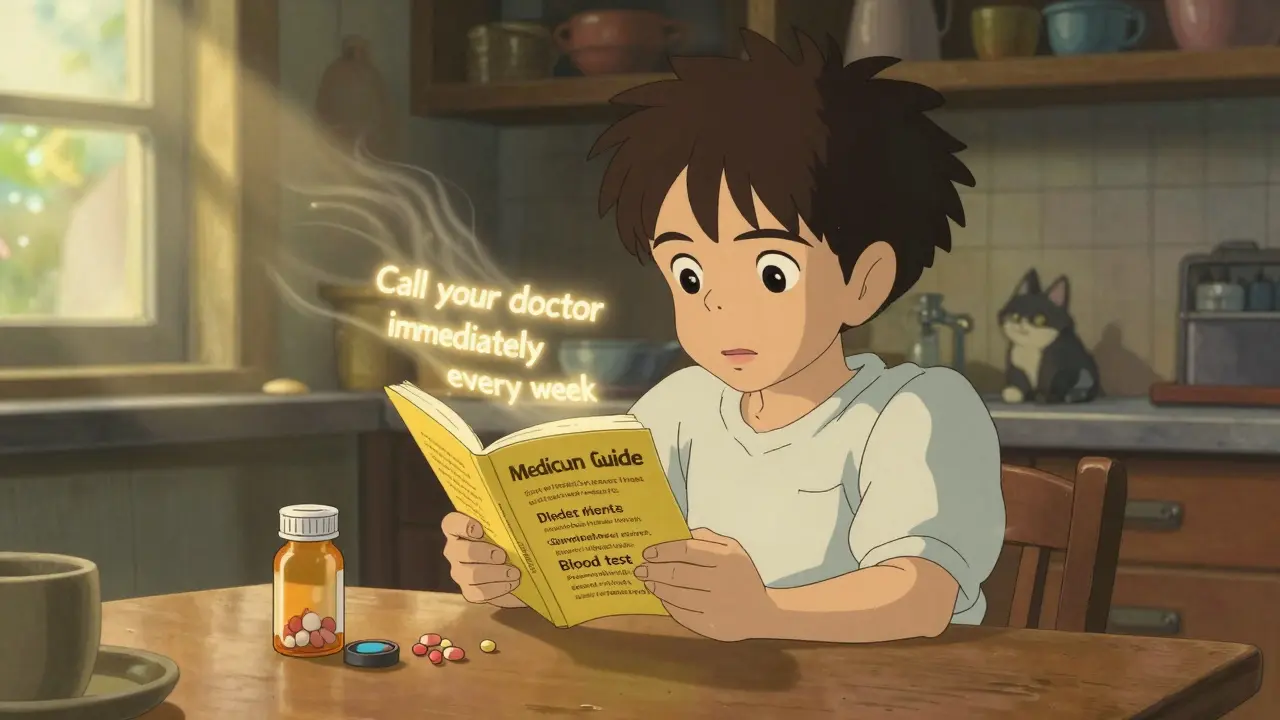
When you pick up a new prescription, the pharmacy gives you a small paper insert. It’s not just a reminder of your dose. It’s a medication guide-a legally required document designed to tell you about serious risks you might not hear from your doctor in a 7-minute visit. These guides aren’t optional. They’re the FDA’s way of making sure you know what could go wrong, and what you need to do to stay safe.
What Makes a Medication Guide Different?
Not every drug comes with one. Only medications with serious, preventable risks get a Medication Guide. That means drugs like blood thinners, antidepressants, cancer treatments, and immune suppressants. These aren’t the kind of pills where a side effect is just a headache or dry mouth. These are drugs that can cause liver damage, dangerous drops in blood cells, suicidal thoughts, or life-threatening bleeding. The FDA requires these guides to be written in plain language-at a 6th to 8th grade reading level. That means no medical jargon like "hematologic toxicity" or "hepatotoxicity." Instead, you’ll see phrases like: "Can cause serious liver damage" or "Your blood may drop too low, and you could get very sick." They also follow a strict format. Every guide has the same seven sections. You don’t need to read the whole thing. You need to know where to look.Where to Find the Critical Risk Information
Start with the first section: "What is the most important information I should know about [drug name]?" This is where the FDA puts the biggest red flags. This isn’t a suggestion. It’s a warning. If your drug is a JAK inhibitor like tofacitinib, it will say: "Can increase your risk of serious heart problems, cancer, blood clots, and death." No sugarcoating. No "may" or "possibly." Just the facts. Next, look for the section titled: "What are the possible or reasonably likely serious side effects of [drug name]?" This is where monitoring instructions live. This is the part that tells you when and how to get tested. For example:- Warfarin (Coumadin): "Your healthcare provider should check your INR at least once a month. If your dose changes, check it more often. Call your doctor right away if you notice unusual bruising or bleeding that won’t stop."
- Clozapine (Clozaril): "About 1 in 200 people taking this medicine may develop a dangerous drop in white blood cells. You must get a blood test every week for the first 6 months."
- SSRIs like sertraline: "Pay close attention to any changes, especially sudden changes, in mood, behavior, thoughts, or feelings. This is very important when you start the medicine or when the dose is changed."
How to Spot Monitoring Instructions That Matter
Most people miss the monitoring part because it’s buried in a paragraph. But here’s the trick: look for these seven phrases. They’re red flags:- "Get blood tests regularly"
- "Call your doctor immediately if..."
- "Do not stop taking without talking to your doctor"
- "Avoid sunlight exposure"
- "Do not drink alcohol"
- "May impair your ability to drive"
- "Keep all scheduled appointments"

Use the 3-2-1 Method to Stay on Track
Reading the guide once isn’t enough. Risks change. New warnings come out. The FDA requires manufacturers to update guides within 30 days of new safety data. In 2022, 92% of guides were updated-up from 85% the year before. Here’s how to keep up:- 3 minutes before your first dose: Read the guide. Focus on the "Most Important Information" and "Serious Side Effects" sections.
- 2 minutes before each refill: Flip through it again. Is anything new? Has the monitoring schedule changed?
- 1 minute during treatment: When you feel off-dizzy, tired, bruising easily-pull out the guide. Check the "Call your doctor immediately" list. Don’t wait.
Turn the Guide Into Your Personal Safety Plan
One pharmacist in Sydney, Sarah Chen, found that when she physically pointed to the monitoring section and said, "This takes less than 90 seconds to read," patient compliance with blood tests jumped from 45% to 82%. Why? Because people didn’t know where to look. Try this simple system:- Highlight in yellow: Any word like "test," "monitor," "check," or "measure."
- Circle in red: Time references-"weekly," "monthly," "before you start," "every 3 months."
- Underline in red: Symptoms that mean "call your doctor now."
What to Do If the Guide Isn’t Given to You
By law, the pharmacy must give you a Medication Guide every time you pick up the drug. But a 2022 audit found 41% of independent pharmacies failed to do this consistently. If you don’t get one, ask for it. Say: "I need the FDA Medication Guide for this prescription." If they say they don’t have it, ask them to call the manufacturer or print it from DailyMed (the NIH’s official database). You can also download it yourself at dailymed.nlm.nih.gov-just search by drug name. Don’t assume it’s not important because they didn’t hand it to you. If your drug has a Medication Guide, it’s because the risk is real. You deserve to know.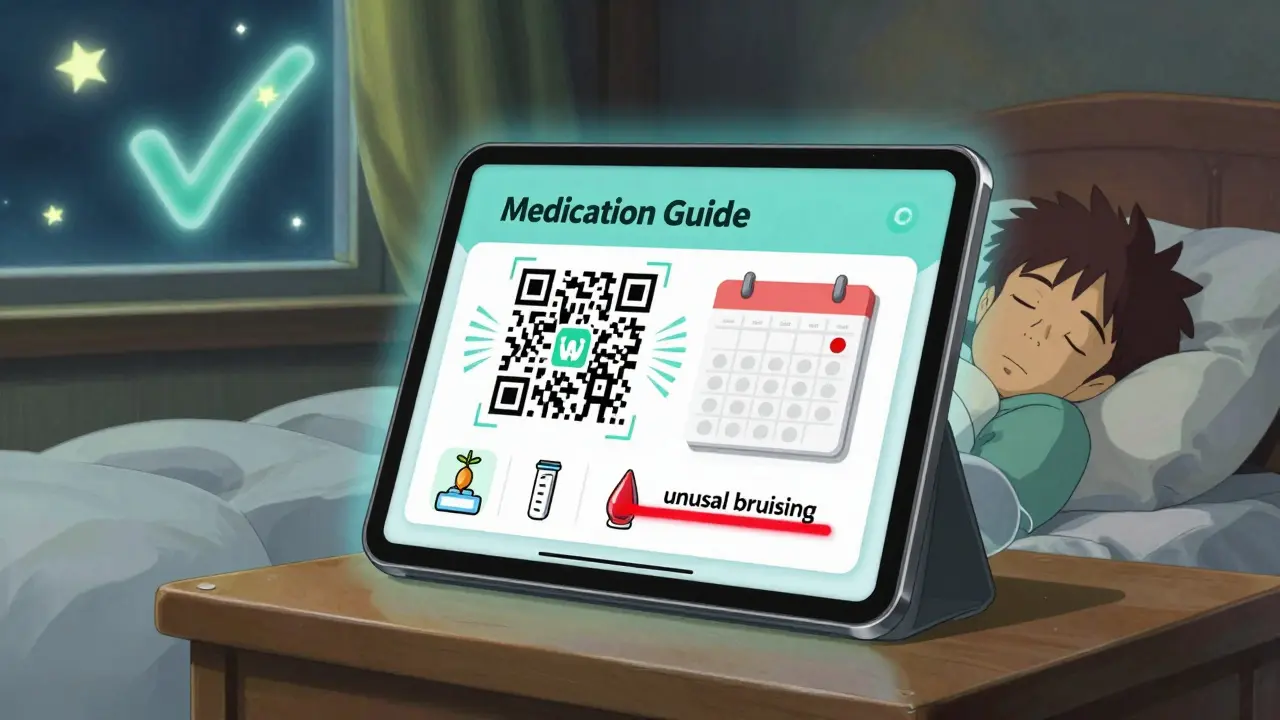
Why Some Guides Are Easier to Understand Than Others
Not all guides are created equal. Patient reviews on Drugs.com show that guides for drugs like Humira (adalimumab) score 4.7 out of 5 because they clearly say: "Get a TB test before starting. Then every 6 months." Simple. Direct. Cancer drug guides? They score 3.1 out of 5. Why? They’re full of vague terms like "potential hematologic toxicity" or "risk of immune-related adverse events." That’s not helpful. That’s confusing. Research from Harvard Medical School shows that when guides use numbers, patients understand better. "Causes dizziness in 25% of patients" is 47% more effective than "may cause dizziness." If your guide is unclear, ask your pharmacist: "Can you explain the monitoring part in plain terms?" They’re trained to do this. Don’t be shy.What’s Changing in 2025 and Beyond
The system is getting better. By 2025, all drugs with Risk Evaluation and Mitigation Strategies (REMS) will need a Medication Guide-that’s 127 drugs, up from 42. The FDA is testing QR codes on packaging that link directly to the latest guide. By 2026, they’ll require pictograms-simple icons-to show when to test or when to call for help. Some companies are even using AI. Pfizer’s pilot program now pulls your age, other meds, and lab history to highlight only the risks that matter to you. Early results show 63% better understanding. But here’s the catch: 40% of Americans still struggle to read health materials at even a basic level. No matter how good the guide looks, if you can’t understand it, it won’t protect you.Final Checklist: Your Medication Guide Action Plan
Before you take your next new prescription, use this checklist:- Did you get the Medication Guide? If not, ask for it.
- Did you read the "Most Important Information" section?
- Did you find and circle all monitoring instructions (blood tests, checkups, etc.)?
- Did you underline symptoms that need immediate attention?
- Did you write down the dates for tests and mark them on your calendar?
- Do you know what to do if you miss a test or feel worse?
Are Medication Guides the same as the information sheet that comes with my pill bottle?
No. The small sheet inside the bottle is usually a general patient leaflet. A Medication Guide is a separate, FDA-mandated document that only comes with drugs that have serious, preventable risks. It’s written in plain language and must be given to you every time you refill the prescription. Always ask for it if you’re not sure.
What should I do if I don’t understand a warning in the guide?
Don’t guess. Call your pharmacist or doctor. Say: "I’m trying to follow the guide, but I’m not sure what this means: [quote the exact sentence]." Pharmacists are trained to explain these documents. They’ve seen hundreds of them. There’s no such thing as a dumb question when it comes to your safety.
Can I skip the blood tests if I feel fine?
No. Many serious side effects don’t cause symptoms until it’s too late. For example, clozapine can cause a dangerous drop in white blood cells with no warning signs. The test is your early warning system. Skipping it is like driving without checking your brakes because the car feels fine. The guide says "do this" for a reason.
How often are Medication Guides updated?
Manufacturers must update guides within 30 days of any new safety information from the FDA. In 2022, 92% of guides were updated-up from 85% the year before. Always check your guide before each refill. If you’re unsure, download the latest version from DailyMed.nlm.nih.gov.
Why do some guides say "may cause" and others say "causes"?
"May cause" is vague and often used for less common side effects. "Causes" or "can cause" is used when the risk is well-documented and serious. The FDA encourages using clear, direct language. If a guide says "can cause liver damage," that means it’s been proven in studies-not just suspected. Pay attention to the wording. It’s intentional.
Can I rely on my doctor to explain all the risks?
Your doctor may not have time to cover every risk in a 7-minute visit. Medication Guides exist because even the best doctors can’t cover everything. The guide is your backup. It’s written by experts, reviewed by the FDA, and designed to be clear. Read it. Don’t assume your doctor told you everything.
Is there a digital version I can save on my phone?
Yes. The NIH’s DailyMed website has every approved Medication Guide in PDF format. You can download and save them. Some pharmacies also offer digital copies via their apps. Keep a folder on your phone labeled "Medication Guides" and update it every time you get a new prescription. That way, you always have it-even if you lose the paper copy.

Casper MacIntyre
Hello, my name is Casper MacIntyre and I am an expert in the field of pharmaceuticals. I have dedicated my life to understanding the intricacies of medications and their impact on various diseases. Through extensive research and experience, I have gained a wealth of knowledge that I enjoy sharing with others. I am passionate about writing and educating the public on medication, diseases, and their treatments. My goal is to make a positive impact on the lives of others through my work in this ever-evolving industry.
14 Comments
-
laura Drever
January 14, 2026 AT 08:02lol good luck reading that garbage. half the time the font’s smaller than my phone’s text size. who’s gonna read this?
-
Kimberly Mitchell
January 15, 2026 AT 08:13While the intent is commendable, the practical implementation remains deeply flawed. The FDA’s mandated plain language is often a performative gesture-replacing ‘hepatotoxicity’ with ‘liver damage’ doesn’t resolve the structural incoherence of the document architecture. The sequencing of risk stratification is inconsistent, and the lack of standardized risk quantification (e.g., NNT, NNH) renders the guides epistemologically inert for any clinically literate reader. The 6th–8th grade reading level assumption is a patronizing misstep that infantilizes the patient population without addressing the real issue: physician communication failure.
-
Jesse Ibarra
January 17, 2026 AT 01:50Oh wow. A whole essay on a paper insert? This is why America is collapsing. You’re telling me people can’t read a damn 2-page document without needing a 12-step program and a color-coded highlighter? Next they’ll be giving us a PowerPoint on how to open a pill bottle. This is the definition of over-medicalized paternalism. We’re not children. Stop treating us like we’re incapable of basic responsibility.
-
Priyanka Kumari
January 17, 2026 AT 23:34I work in a pharmacy in Mumbai and I can confirm-this works. We started handing out printed summaries of the key monitoring points in Hindi and Tamil alongside the guide. Patient adherence to blood tests jumped from 38% to 76% in six months. No fancy apps. Just clear, translated, bolded bullet points. If you can’t read English, the guide is useless. Language matters. Always ask for the translated version.
-
James Castner
January 19, 2026 AT 11:40There’s a deeper philosophical layer here that few are addressing: the Medication Guide is not merely a document-it is a ritual. It is the modern secular sacrament of informed consent, a tangible artifact that transforms passive compliance into active agency. In an age where algorithmic healthcare reduces human beings to data points, this small paper becomes a sacred counterweight-a reminder that your body is not a machine to be optimized, but a lived experience to be honored. To ignore it is to surrender your autonomy to the corporate-medical complex. And yet, paradoxically, the very act of reading it-of pausing, of reflecting, of circling the red warnings-reclaims your personhood. This is not about compliance. It is about sovereignty.
-
lucy cooke
January 20, 2026 AT 11:28How tragic. We’ve turned healthcare into a scavenger hunt for hidden warnings. What happened to trust? To the doctor-patient bond? Now we’re all paranoid, highlighting sentences like we’re decoding a spy novel. The real problem isn’t the guide-it’s that we’ve lost faith in medicine. And now we’re medicating our anxiety with checklists. I miss the days when you took your pills and trusted your doctor. Not that I’d ever admit that out loud.
-
jefferson fernandes
January 21, 2026 AT 10:53Look, I get it. Some people are overwhelmed. But here’s the truth: if you’re on a drug that requires a Medication Guide, you’re already in a high-risk category. This isn’t about being ‘responsible’-it’s about survival. If you don’t know your INR levels, or you skip your weekly blood draw for clozapine, you’re gambling with your life. And no, ‘I felt fine’ is not a valid medical argument. I’ve seen too many people die because they thought they were fine. Don’t be one of them. Print it. Stick it on your fridge. Set the alarms. Your future self will thank you.
-
Clay .Haeber
January 22, 2026 AT 06:53Oh sweet Jesus. I just spent 10 minutes reading this like it was the Declaration of Independence. Next thing you know, they’ll require a signed affidavit before you take Tylenol. ‘Dear FDA, I, Clay Haeber, solemnly swear I have read the Medication Guide for my ibuprofen and understand that ‘may cause stomach upset’ is not a suggestion, but a divine commandment.’ This is satire. It has to be. Right?
-
Robin Williams
January 24, 2026 AT 00:06the 3-2-1 method is fire. i do this with my dad’s blood pressure med. 3 min before first pill-read the red flags. 2 min before refill-check for updates. 1 min when i feel weird-pull out the guide. he’s been on warfarin for 5 years and never had a bleed. it’s not magic. it’s just paying attention. you don’t need a degree. you just need to not be lazy.
-
Acacia Hendrix
January 24, 2026 AT 20:19The empirical validity of the 3-2-1 method remains unverified in peer-reviewed literature. The cited Michigan study lacks methodological rigor-no control for confounding variables such as socioeconomic status, health literacy baseline, or adherence tracking methodology. The 68% reduction in adverse events is likely inflated by selection bias. Furthermore, the use of color-coding as an intervention has no established neurocognitive mechanism for improving recall in populations with executive dysfunction. Until we have RCTs with longitudinal follow-up, this is anecdotal advocacy masquerading as evidence-based practice.
-
Adam Rivera
January 25, 2026 AT 18:17Hey, I’m from Mexico and I just want to say-this is gold. My abuela took her meds for years without ever reading the guide. Last year she got sick from a drug interaction. We sat down, printed the guide from DailyMed, and I read it to her in Spanish. She cried. Said she felt seen. That paper didn’t just tell her what to do-it told her she mattered. Don’t underestimate how powerful that is.
-
sam abas
January 26, 2026 AT 20:30So let me get this straight-now we need to highlight, circle, underline, calendar, download, and cross-reference every single pill? What about the 80-year-old with arthritis who can’t hold a pen? Or the single mom working two jobs? This isn’t empowerment-it’s a guilt trip wrapped in bureaucracy. And don’t even get me started on the 41% of pharmacies that don’t give them out. Who’s gonna hold them accountable? The FDA? Ha. This is performative safety. Real safety is access. Not a damn highlighter.
-
Diana Campos Ortiz
January 27, 2026 AT 20:54thank you for this. i’ve been on antidepressants for 8 years and never read the guide until last month. found out i was supposed to get liver tests every 3 months. i’d missed 4. i called my doctor and we got them done. i’m alive because of this. you’re not being paranoid. you’re being smart.


Write a comment
More Articles

Cost-Saving Strategies While Maintaining Medication Safety
Learn how to cut medication costs without risking your health. Discover proven strategies like using generics, mail-order pharmacies, pharmacist-led care, and the PBS Safety Net to save money while staying safe.

Renal Dosing of Antibiotics: How to Avoid Toxicity in Kidney Disease
Proper antibiotic dosing in kidney disease prevents toxicity and treatment failure. Learn how creatinine clearance guides dosing, which antibiotics need adjustments, and why acute vs. chronic kidney injury changes everything.
The Cost of Rabeprazole Sodium: Is It Worth It?
As a blogger, I recently delved into the topic of the cost of Rabeprazole Sodium and whether it's worth its price. Rabeprazole Sodium is a proton pump inhibitor commonly prescribed to treat acid-related stomach issues, like GERD, but its cost has been a point of concern for some. After researching, I found that the benefits of this medication can outweigh the costs for many patients, as it can provide much-needed relief from painful symptoms. However, I also learned that there are generic alternatives available at a lower price point, which can be a more budget-friendly option. Ultimately, it's crucial for patients to discuss their needs and budget with their healthcare provider to find the best solution for their individual situation.
Vinaypriy Wane
January 14, 2026 AT 00:19Finally, someone who gets it. This isn’t just advice-it’s a survival manual. I’ve seen people skip blood tests for clozapine because they ‘felt fine.’ Then they end up in the ER with neutropenia. The guide isn’t optional. It’s the difference between living and dying. Stop treating it like junk mail.