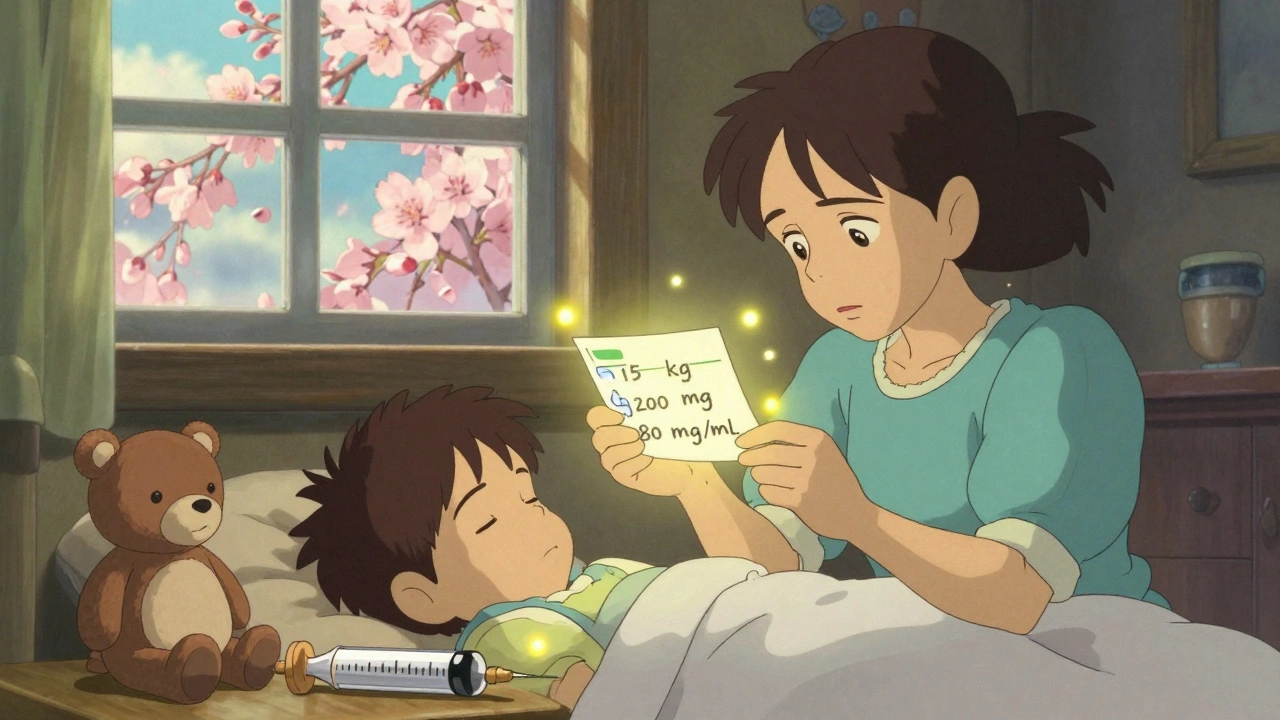
When your child gets a new prescription, the label might say 10 mL - but that’s not the dose. The real dose is 200 mg. Mixing up volume and medication amount is one of the most dangerous mistakes parents and even some providers make. Every year, thousands of children are at risk because the dose on the label doesn’t clearly show what’s safe for their weight. Confirming pediatric dosing isn’t just a step - it’s a lifesaving habit.
Why Pediatric Dosing Is Different
Children aren’t small adults. Their bodies process medicine differently. A dose that’s safe for a 70 kg adult could be deadly for a 12 kg toddler. That’s why pediatric dosing is always based on weight - usually in milligrams per kilogram (mg/kg). The American Society of Health-System Pharmacists (ASHP) says every child’s prescription must include this calculation. If it doesn’t, stop. Ask for it.In 2022, the Institute for Safe Medication Practices found that 56% of all pediatric medication errors were dosing mistakes. Most of these happened because the dose wasn’t checked against the child’s actual weight. A child weighing 15 kg needs a totally different amount than one weighing 25 kg - even if they’re both 4 years old. Age alone doesn’t tell you enough. Weight does.
What to Look for on the Prescription Label
A properly labeled pediatric prescription must show three things clearly:- The child’s weight in kilograms (kg)
- The exact dose in milligrams (mg), not milliliters (mL)
- The concentration of the liquid (e.g., 80 mg/mL or 40 mg/mL)
Many labels still say things like “Give 10 mL twice daily.” That’s not enough. You need to know: How many milligrams are in those 10 mL? If the concentration is 80 mg/mL, then 10 mL equals 800 mg. If it’s 40 mg/mL, it’s only 400 mg. That’s a 100% difference. One could be an overdose. The other might be too weak.
The FDA’s 2021 Drug Safety Communication requires all liquid pediatric medications to show both metric and non-metric measurements. But not all pharmacies follow it perfectly. Don’t assume. Always check.
How to Calculate the Dose Yourself
You don’t need to be a doctor to double-check the math. Here’s how to do it in three simple steps:- Convert weight to kilograms. If your child weighs 33 pounds, divide by 2.2. 33 ÷ 2.2 = 15 kg. Never guess. Use a scale that shows kg. If you only have pounds, use the exact ratio: 1 kg = 2.2 lb.
- Find the prescribed dose per kg. The doctor should write something like “40 mg/kg/day.” If they didn’t, ask. This number is the key.
- Multiply weight by dose per kg. 15 kg × 40 mg/kg = 600 mg per day.
Then divide by how many times a day to give it. If it’s twice daily, 600 mg ÷ 2 = 300 mg per dose.
Now check the label: Does the dose per administration match? If the bottle says 80 mg/mL, then 300 mg means 3.75 mL. But most syringes don’t measure 0.75 mL accurately. That’s why pharmacies should round to the nearest practical volume - like 3.8 mL or 4 mL - and note it on the label. If they don’t, ask if they can adjust it.
Watch Out for Concentration Confusion
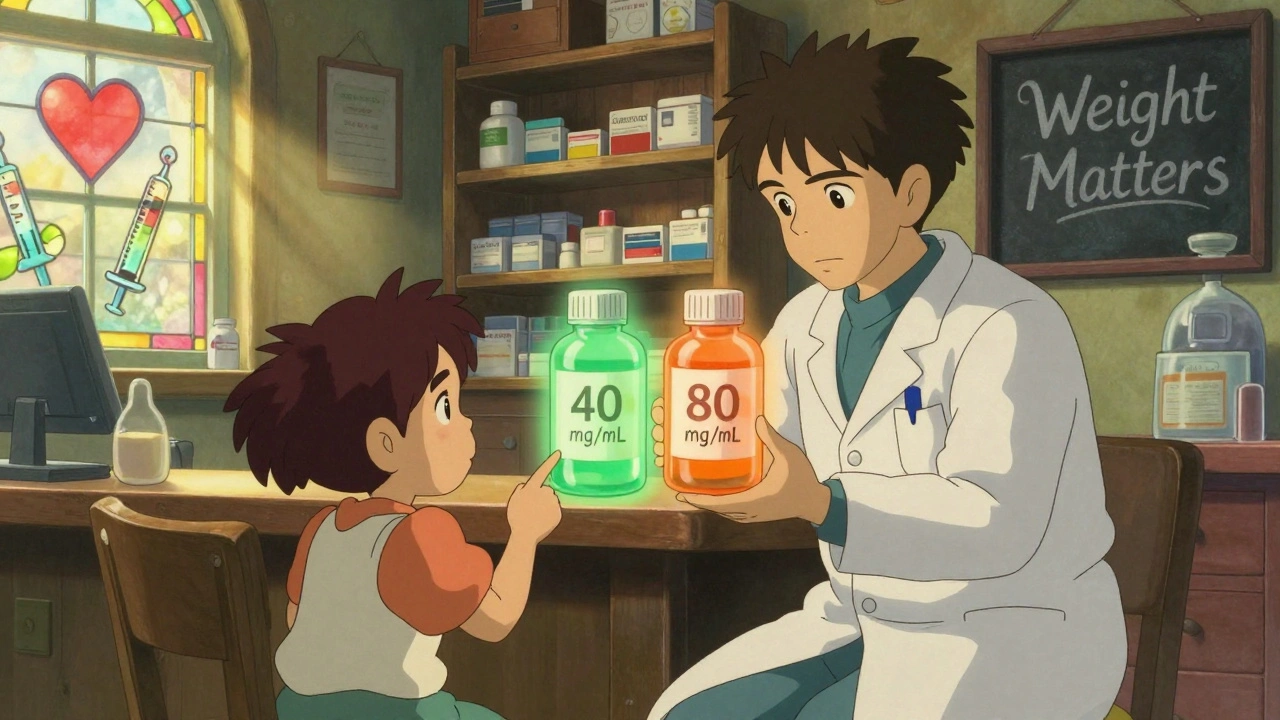
One of the most common errors? Mixing up concentrations. Amoxicillin-clavulanate, for example, comes in 80 mg/mL and 40 mg/mL versions. A parent might think “same medicine, same dose” - but it’s not. Giving 10 mL of the 80 mg/mL version when the prescription was for the 40 mg/mL version means you’re giving double the medication.A 2021 CDC report found that 37.2% of liquid medication errors in children under 2 were due to concentration confusion. Always read the label twice. Look for the “Concentration” line. If it’s not there, don’t fill the prescription. Call the pharmacy.
Some parents make the mistake of using kitchen spoons or old syringes. Don’t. Always use the dosing device that came with the medicine - it’s calibrated for that specific concentration. A teaspoon isn’t 5 mL. A tablespoon isn’t 15 mL. Only the syringe or cup provided is accurate.
How Pharmacists Verify Doses
In hospitals and children’s clinics, pharmacists follow a strict two-person verification process. One calculates the dose. A second person recalculates it independently. Then they compare. This isn’t optional - it’s standard. The ASHP’s 2021 guidelines say this is mandatory for all pediatric prescriptions.Even in community pharmacies, many now use software that flags unsafe doses. Systems like EPIC and Cerner automatically check the child’s weight against national dosing guidelines. If the dose is too high or too low, the system alerts the pharmacist. But this only works if the weight is entered correctly. If the nurse writes “33 lbs” instead of “15 kg,” the system might still approve it.
That’s why you, as a parent, must be the final checkpoint. Ask the pharmacist: “Can you show me how you calculated this?” Most will be happy to walk you through it. If they get annoyed, that’s a red flag.
What Parents Are Doing Right
A 2022 Reddit analysis of 1,247 parenting threads showed that parents who double-checked doses prevented errors in 68% of cases. One mother, u/AnxiousMom2023, noticed her 4-year-old’s amoxicillin label said “10 mL.” She knew the dose should be around 200 mg. She called the pharmacy and found out the concentration was 20 mg/mL - not 80 mg/mL. The original order had been miswritten. Her call prevented a 2.5x overdose.Another parent used the manufacturer’s dosing chart on the box. She had two bottles of acetaminophen: one labeled 160 mg/5 mL, the other 80 mg/0.8 mL. She checked the chart and realized the pharmacy gave her the wrong bottle. The dose looked right on the label - but the concentration was wrong. She returned it. That’s how safety works: someone asking questions.
What to Ask Before Leaving the Pharmacy
Use these three questions every time you pick up a pediatric prescription:- “What is the exact dose in milligrams?” Not mL. Not teaspoons. Milligrams.
- “Is this dose appropriate for my child’s current weight?” Show them the weight from your last doctor visit.
- “Can you show me how to measure this with the syringe you’re giving me?” Watch them measure it in front of you.
If they hesitate, say, “I want to make sure I get this right.” Most professionals will appreciate your caution.

Technology Is Helping - But Not Everywhere
In children’s hospitals, 86% now use standardized dosing protocols. In general hospitals, it’s only 43%. That’s a big gap. AI tools like DoseSpot’s Pediatric Safety Module now cross-check doses against 15,000+ guidelines with 99.2% accuracy. Smart pumps and electronic records can catch errors before they happen.But if you’re at a small clinic or a pharmacy without this tech, you’re the safety net. Don’t wait for technology to fix it. Do it yourself.
What’s Changing in 2024 and Beyond
As of January 1, 2024, the American Academy of Pediatrics requires all pediatric prescriptions to include the child’s weight in kilograms and the calculated dose in milligrams. No more guessing. No more assumptions.By 2025, hospitals with dosing error rates above 0.8% per 1,000 doses will face financial penalties under CMS’s new Quality Payment Program. That means more hospitals are investing in better systems. But change takes time. Until then, your vigilance saves lives.
Final Checklist Before Giving Medicine
Before you give your child any medicine, run through this quick list:- Is the child’s weight in kg on the label? (If not, ask for it.)
- Is the dose written in mg, not mL?
- Is the concentration (e.g., 80 mg/mL) clearly printed?
- Did you calculate the dose yourself using weight × mg/kg?
- Are you using the dosing device that came with the medicine?
- Did you confirm with the pharmacist that this dose matches your child’s weight?
If you answered yes to all six, you’ve done more than most. You’ve kept your child safe.
What should I do if the prescription doesn’t list my child’s weight in kilograms?
Call the prescribing doctor’s office immediately. A prescription without the child’s weight in kilograms is incomplete and unsafe. The doctor must update it. Never fill the prescription until you have the correct weight and dose in mg/kg.
Can I use a kitchen teaspoon to measure liquid medicine?
No. A kitchen teaspoon holds anywhere from 3 mL to 7 mL - it’s not accurate. Always use the syringe, dropper, or cup that came with the medicine. These are calibrated for the exact concentration of the drug. Using the wrong tool can lead to underdosing or overdose.
Why do some pharmacies give different concentrations of the same medicine?
Different concentrations are made to make dosing easier for different age groups. For example, a 40 mg/mL concentration is easier to measure for babies than an 80 mg/mL one. But you must know which one you have. Always check the concentration on the label and match it to the dose your doctor ordered.
What if the dose looks too small for my child’s size?
That’s normal. Children need much smaller doses than adults because their bodies are smaller. A 200 mg dose might seem tiny compared to a 500 mg adult pill, but for a 10 kg child, it’s correct. Never assume a dose is too low just because it looks small. Always verify with weight-based math.
Are there apps or tools that can help me check pediatric doses?
Yes. Apps like DoseMe, Medscape’s Pediatric Dosing Calculator, and the CDC’s Pediatric Dosing Tool let you enter weight and medication to get the correct dose. But don’t rely on them alone. Always cross-check with the label and pharmacist. These tools are helpers - not replacements for verification.

Casper MacIntyre
Hello, my name is Casper MacIntyre and I am an expert in the field of pharmaceuticals. I have dedicated my life to understanding the intricacies of medications and their impact on various diseases. Through extensive research and experience, I have gained a wealth of knowledge that I enjoy sharing with others. I am passionate about writing and educating the public on medication, diseases, and their treatments. My goal is to make a positive impact on the lives of others through my work in this ever-evolving industry.
8 Comments
-
Jake Deeds
December 4, 2025 AT 22:38Look, I get it - you’re trying to be helpful. But let’s be real: if you need a 12-step checklist to give your kid Tylenol, maybe you shouldn’t be parenting. I mean, I’ve given my daughter medicine since she was three weeks old without once measuring in mL or converting kg. She’s 11 now. Healthy. Smart. Doesn’t need a spreadsheet to survive. Some of us just… trust the doctor.
-
Jenny Rogers
December 6, 2025 AT 16:59While I appreciate the sentiment, this post fundamentally misunderstands the epistemological foundations of pharmaceutical safety. The reliance on weight-based dosing presupposes a Cartesian reductionism of the human organism - as if biological complexity can be distilled into a simple multiplication of kilograms and milligrams. The very act of quantifying pediatric dosing in this manner reflects a dangerous technocratic ideology that erodes the sacred trust between physician and patient. One must not confuse precision with truth.
-
Isabelle Bujold
December 7, 2025 AT 12:04I’m a pediatric nurse and I can’t tell you how many times I’ve seen parents panic because the label says ‘5 mL’ and they think it’s too much - only to find out they’re using a kitchen spoon and their kid weighs 22 lbs, not 25. The concentration thing? Huge. I had a mom come in last week with two bottles of amoxicillin - one 80 mg/mL, one 40 mg/mL - and she thought they were interchangeable because ‘it’s the same medicine.’ I sat with her for 20 minutes, showed her the math, and we called the prescriber. She cried. Said she’d been giving the wrong dose for three days. That’s why this post matters. It’s not fear-mongering. It’s prevention. And yes, use the syringe. No, your ‘measuring spoon’ isn’t calibrated. And no, your kid isn’t ‘just a little bigger’ - weight is weight. Write it down. Double-check. Do it again.
-
John Filby
December 8, 2025 AT 16:47Just wanted to say thanks for this - I used the CDC dosing tool last night after reading this and realized my kid’s prescription was for 80 mg/mL but the bottle said 40 mg/mL. Called the pharmacy at 10 PM and they were like ‘oh wow, yeah that’s a mistake’ and sent a new one. 🙏 I didn’t even know concentrations varied like that. Also, I’m using the syringe now. No more spoons. Ever.
-
Ashley Elliott
December 9, 2025 AT 16:33My sister’s a pharmacist in Ohio - she says 70% of the errors they catch are because parents ask the right questions. Not because the system works - because someone spoke up. I used to think asking ‘how did you calculate this?’ was rude… until my niece almost got a double dose because the label didn’t say ‘concentration.’ Now I ask every time. No shame. No awkwardness. Just safety. And honestly? Most pharmacists are relieved you asked. They’ve seen the worst.
-
Rachel Bonaparte
December 10, 2025 AT 04:32Let’s be honest - this whole system is rigged. The FDA doesn’t enforce the concentration labeling rules because Big Pharma wants you to buy multiple versions of the same drug. The ‘dosing syringes’ they give you? Made in China. No calibration standards. And the ‘pharmacist verification’? Half of them are overworked, underpaid, and on their 14th script of the hour. Meanwhile, the CDC’s stats? Manipulated. They don’t count the kids who die quietly at home because no one asked. This post? It’s a Band-Aid. The real solution? Ban all liquid pediatric meds. Go back to pills. Or better yet - don’t give medicine unless you’re in a hospital. Because if you’re trusting a label printed by a $12/hour tech, you’re already playing Russian roulette.
-
George Graham
December 10, 2025 AT 22:03I’ve been a dad for 12 years and I’ve learned one thing: if you’re unsure, pause. Don’t give it. Call someone. Even if it’s 2 a.m. I once called a pharmacy at midnight because the label said ‘give 5 mL’ but I couldn’t find the concentration. The pharmacist answered - she was tired, but she walked me through it. We found the error. My son’s fine. That’s the thing - you don’t have to be an expert. You just have to care enough to ask. And you’re not being ‘overprotective’ - you’re being responsible. That’s parenting.


Write a comment
More Articles

180-Day Exclusivity: How Patent Law Shapes Generic Drug Market Entry
Explore how 180-day exclusivity under the Hatch-Waxman Act incentivizes generic drug companies to challenge patents and impact market pricing.
Understanding the contraindications of brinzolamide use
As a copywriter, I've learned that understanding the contraindications of brinzolamide use is crucial for patient safety. Brinzolamide is an eye medication used to treat glaucoma, but it's not suitable for everyone. Some people may have an allergy to the drug or its ingredients, which could cause severe reactions. Additionally, those with kidney problems or certain other medical conditions should avoid using brinzolamide. It's important to consult a healthcare professional before starting any new medication to ensure it's the right choice for you.

The Ultimate Guide to Buying Nolvadex Online: Uses, Dosage, and Side Effects
Navigating the complexities of buying Nolvadex online can be challenging. This guide offers a comprehensive look at Nolvadex, a medication primarily used in the treatment of breast cancer. It delves into the medical uses, dosage recommendations, side effects, and potential drug interactions of Nolvadex and its main substance, Tamoxifen. Additionally, it provides tips on how to safely purchase Nolvadex online, ensuring readers are well-informed and equipped to make educated decisions regarding their health.
val kendra
December 4, 2025 AT 14:12Just got my kid’s amoxicillin today and saw the label said ‘10 mL’ - I immediately checked the concentration. It was 40 mg/mL, not 80. Called the pharmacy, they fixed it before I left. Don’t assume. Always check the mg/mL. It’s not extra work - it’s survival.