
MH Dantrolene Calculator
Calculate Dantrolene Dose for Malignant Hyperthermia
Malignant hyperthermia (MH) requires immediate dantrolene treatment. This tool calculates the amount of dantrolene needed based on patient weight. For best outcomes, treatment must begin within 20 minutes of symptom onset.
- • Survival rate > 95% if treated within 20 minutes
- • Survival drops to ~50% if delayed > 40 minutes
- • Only dantrolene stops the calcium leak causing MH
- • 29% of cases occur in people with no family history
Treatment Results
Imagine being put to sleep for surgery, only to wake up in a medical emergency you never saw coming. Your body starts overheating, your heart races out of control, your muscles lock up, and your blood turns acidic. This isn’t science fiction. It’s malignant hyperthermia - a rare but deadly reaction to common anesthesia drugs that can strike without warning, even in healthy people with no family history.
What Exactly Is Malignant Hyperthermia?
Malignant hyperthermia (MH) is a genetic disorder that causes your skeletal muscles to go into a runaway metabolic state when exposed to certain anesthetics. It’s not an allergy. It’s not an overdose. It’s a flaw in how your muscle cells handle calcium. Normally, calcium is stored safely inside muscle cells and released only when needed for movement. In people with MH, a mutation in the RYR1 gene - found in about 70% of cases - makes the calcium channel stick open. The result? Muscle cells fire nonstop, burning through oxygen, producing massive amounts of heat, and releasing toxic byproducts into the bloodstream. This reaction doesn’t happen every time someone gets anesthesia. It only happens in people who carry the genetic mutation. And here’s the scary part: you might not know you have it until it’s too late. About 29% of MH cases occur in people with no known family history. That means even if your parents and grandparents had smooth surgeries, you could still be at risk.What Anesthesia Drugs Trigger MH?
Not all anesthetics are dangerous. The triggers are specific:- Volatile anesthetic gases: sevoflurane, desflurane, isoflurane - these are the gases you breathe through a mask during surgery.
- Succinylcholine: a muscle relaxant often used to help insert the breathing tube during induction.
Early Warning Signs You Can’t Ignore
The key to surviving MH is catching it early. The longer you wait, the higher the chance of death. Here’s what clinicians look for:- Unexplained fast heart rate: over 120 beats per minute in adults.
- Rising carbon dioxide: end-tidal CO2 (EtCO2) climbing above 55 mmHg - this is often the earliest lab sign.
- Muscle rigidity: especially in the jaw (masseter spasm) right after succinylcholine is given.
- Rapid temperature rise: core body temperature hitting 104°F (40°C) or higher.
- Dark urine: a sign of muscle breakdown (rhabdomyolysis) releasing myoglobin into the blood.
How MH Is Treated - The Clock Is Ticking
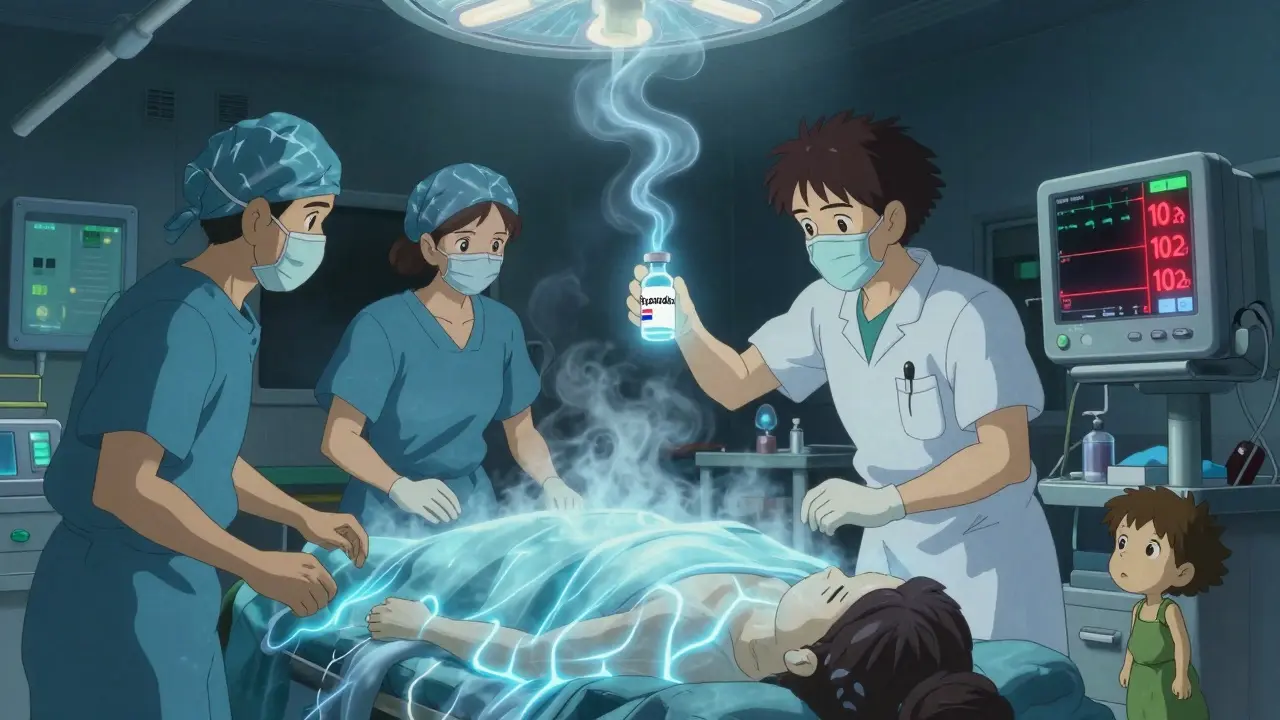
If MH is suspected, time is everything. The protocol is simple, but it must be done fast:- Stop the trigger drugs immediately. Turn off the volatile gases. Cancel succinylcholine.
- Give dantrolene. This is the only drug that stops the calcium flood. Start with 2.5 mg per kg of body weight, given IV. Repeat every 5-10 minutes until symptoms fade. Most adults need 10 mg/kg total - that’s 36 vials of dantrolene.
- Hyperventilate with 100% oxygen. This helps flush out CO2 and cool the body.
- Cool the patient. Ice packs on neck, armpits, groin. Cold IV fluids. Sometimes even extracorporeal circulation.
- Treat complications: sodium bicarbonate for acidosis, insulin and glucose for high potassium, mannitol and furosemide to protect kidneys from muscle breakdown products.
Survival Rates: Why Speed Saves Lives
Decades ago, MH killed 80% of people who had it. Today, that number is down to about 5%. Why? Because of dantrolene and better protocols. The data is clear:- If dantrolene is given within 20 minutes of symptom onset, survival is nearly 100%.
- If treatment is delayed beyond 40 minutes, mortality jumps to 50%.
Why Most People Never Know They’re at Risk
Most patients don’t get tested for MH before surgery. Why? Because it’s rare. And because testing isn’t routine. The gold standard test is the in vitro contracture test (IVCT), which involves taking a muscle biopsy and exposing it to triggering agents in a lab. It’s expensive, invasive, and only available at a handful of centers worldwide. Genetic testing for RYR1 mutations is more accessible now - costing $1,200 to $2,500 - but it only catches about 95% of known mutations. A negative test doesn’t guarantee safety. A 2022 survey by the Malignant Hyperthermia Association found that 68% of survivors had never heard of MH before their own crisis. That’s terrifying. And it’s why anesthesiologists now screen for red flags: a family history of unexplained anesthesia deaths, a history of heat stroke or muscle cramps after exercise, or even unexplained rhabdomyolysis after a workout.
What Hospitals Must Do - And What They Often Don’t
In the U.S., the FDA now requires all facilities performing general anesthesia to have an MH emergency kit on hand. That means 6,200 hospitals and 9,400 outpatient surgery centers must stock at least 36 vials of dantrolene - a total cost of around $144,000 per facility. But compliance is uneven. Academic medical centers have 100% adherence. Rural hospitals? Only 63%. Some report stockouts. Some don’t train staff annually. Some don’t even have a written protocol. The American Society of Anesthesiologists mandates annual MH simulation drills. Residents need at least three practice scenarios to reliably recognize early signs. Too many teams still miss the first clue - rising CO2 - because they’re focused on the patient’s blood pressure or bleeding.The Future: What’s Coming Next
There’s hope on the horizon. In 2024, the FDA is expected to approve an intranasal form of dantrolene - something paramedics could use in ambulances or ERs before the patient even reaches the OR. That could cut response time even further. Researchers are also testing new drugs like S107, which stabilize the ryanodine receptor and might prevent the calcium leak before it starts. Long-term, gene editing with CRISPR could one day fix the RYR1 mutation in embryos or even adults - early trials are planned for 2027. Meanwhile, anesthesia machines are getting smarter. Epic Systems rolled out a new algorithm in 2024 that watches for three key signs at once: high CO2, fast heart rate, and rising temperature. If all three appear, the system flashes a red alert: “SUSPECTED MH - ACTIVATE PROTOCOL.”What You Should Do If You’re Facing Surgery
If you’re scheduled for surgery:- Ask: “Do you have dantrolene on site? How quickly can it be given?”
- Ask: “Have you ever treated a case of malignant hyperthermia?”
- Share any family history of anesthesia complications, unexplained deaths during surgery, or heat-related muscle breakdown.
- If you’ve had severe muscle cramps after exercise or unexplained rhabdomyolysis, tell your anesthesiologist - it could be a clue.
Can malignant hyperthermia happen to healthy people with no family history?
Yes. About 29% of malignant hyperthermia cases occur in people with no known family history of the condition. The genetic mutation can appear spontaneously, and many carriers never show symptoms until exposed to triggering anesthetics during surgery. This is why routine screening isn’t always effective - and why all operating rooms must be prepared for MH regardless of patient history.
Is dantrolene the only treatment for malignant hyperthermia?
Yes, dantrolene is the only drug that directly stops the calcium leak in muscle cells that causes MH. Other treatments - like cooling, oxygen, bicarbonate, and insulin - manage symptoms and complications, but they don’t address the root cause. Without dantrolene, MH will progress to multi-organ failure and death. That’s why every hospital performing general anesthesia must have it immediately available.
How do I know if I’m at risk for malignant hyperthermia?
You’re at higher risk if you have a family member who died unexpectedly during anesthesia, had unexplained heat stroke, or experienced severe muscle cramps or breakdown after exercise. Genetic testing for RYR1 mutations is available, but it doesn’t catch every case. The most important step is telling your anesthesiologist about any red flags - even if you’re not sure they matter. Better safe than sorry.
Can I have surgery if I’ve had malignant hyperthermia before?
Yes - but only with a non-triggering anesthetic plan. Safe alternatives include total intravenous anesthesia (TIVA) using propofol and remifentanil, regional anesthesia like spinal or epidural, or local blocks. You must wear a medical alert bracelet and inform every provider, including dentists and ambulatory surgery centers. With proper planning, you can have safe surgeries for the rest of your life.
Why do some hospitals run out of dantrolene?
Dantrolene is expensive - each vial costs around $4,000 - and has a short shelf life (21 months for Ryanodex). Rural and low-volume hospitals often struggle to justify the $144,000 cost of a full emergency cart, especially if they only do a few surgeries per week. Some have shared stock between facilities, but delays in transport can be fatal. Regulatory mandates are improving access, but gaps remain, especially outside major cities.

Casper MacIntyre
Hello, my name is Casper MacIntyre and I am an expert in the field of pharmaceuticals. I have dedicated my life to understanding the intricacies of medications and their impact on various diseases. Through extensive research and experience, I have gained a wealth of knowledge that I enjoy sharing with others. I am passionate about writing and educating the public on medication, diseases, and their treatments. My goal is to make a positive impact on the lives of others through my work in this ever-evolving industry.
13 Comments
-
Dawson Taylor
January 26, 2026 AT 03:43The statistical decline in mortality-from 80% to 5%-is a testament to the power of protocol, not luck. The true innovation lies not in the drug, but in the discipline of preparedness.
-
charley lopez
January 26, 2026 AT 20:16The pathophysiology of RYR1-mediated calcium dysregulation is well-characterized, yet clinical implementation remains inconsistent across care settings. The disparity in MH cart availability between academic and rural facilities reflects systemic underinvestment in high-impact, low-probability interventions.
-
Sue Stone
January 28, 2026 AT 13:36My dad had a scary moment during a knee surgery back in '98. They said it was just a reaction, but now I wonder… was it MH? I’m gonna call his old surgeon.
-
Anna Pryde-Smith
January 28, 2026 AT 20:42THIS IS A MASSIVE COVER-UP. Hospitals are letting people die because they don’t want to spend $144K on a cart they might never use. It’s not about cost-it’s about greed. Someone’s kid could be next, and they’ll blame ‘rare’ instead of negligence.
-
Stacy Thomes
January 29, 2026 AT 00:20IF YOU’RE HAVING SURGERY, ASK THIS QUESTION TODAY. DANTROLENE. NOW. DON’T WAIT. YOUR LIFE DEPENDS ON IT. SHARE THIS. PLEASE.
-
dana torgersen
January 30, 2026 AT 19:44i mean… like… what if the gene just… pops up? like outta nowhere? i had a cousin who died during tonsillectomy and no one knew why… maybe it was this?? i think we should all get tested… but it’s so expensive… and what if the test is wrong??
-
Andrew Smirnykh
January 31, 2026 AT 10:00In Japan, we use regional anesthesia more frequently for elective procedures, which naturally avoids MH triggers. Perhaps cultural and systemic differences in anesthetic practice offer protective advantages. This deserves cross-cultural study.
-
Kerry Evans
February 1, 2026 AT 23:46People who don’t get tested are irresponsible. If you have a family member who died under anesthesia, you have a moral obligation to get screened. Not doing so isn’t just ignorance-it’s endangering others. You’re not special. You’re a statistic waiting to happen.
-
Kerry Moore
February 2, 2026 AT 00:44Thank you for the comprehensive overview. The emphasis on early CO2 elevation as the primary clinical indicator is critical. This reinforces the need for continuous capnography in all general anesthetic cases, regardless of perceived risk.
-
Vanessa Barber
February 2, 2026 AT 11:38So… what if I just don’t want surgery? Like… ever? Is that the real solution?
-
Sallie Jane Barnes
February 2, 2026 AT 18:41While the financial burden on rural facilities is significant, the ethical imperative to preserve life outweighs fiscal constraints. Institutional policy must prioritize human safety over budgetary convenience. This is non-negotiable.
-
Laura Rice
February 3, 2026 AT 05:21my aunt had MH and they saved her with ice packs and like… 50 vials of that stuff? she’s fine now but she wears a medical alert bracelet and tells EVERYONE. like, my dentist knows. my yoga teacher knows. it’s wild how much you learn when you almost die. you just… never forget.


Write a comment
More Articles

Eicosapentaenoic Acid: The Secret Ingredient for Boosting Your Overall Health and Well-being
Eicosapentaenoic Acid (EPA) has recently caught my attention as a secret ingredient that can significantly improve our overall health and well-being. Found in fish oil, this omega-3 fatty acid is known to reduce inflammation, lower the risk of heart disease, and even improve mental health. I've noticed that incorporating EPA-rich foods, like salmon and mackerel, into my diet has made a positive impact on my energy levels and mood. Additionally, taking fish oil supplements has been a convenient way to ensure I'm getting enough EPA. I highly recommend looking into EPA as a natural way to boost your health and well-being.


Susannah Green
January 24, 2026 AT 07:17Wow. I had no idea MH could hit someone with zero family history. My cousin had a surgery last year and they almost lost him because the OR team didn’t recognize the CO2 spike until it was too late. They had to scramble for dantrolene-thank god they had it. But why is this still not standard pre-op info?!