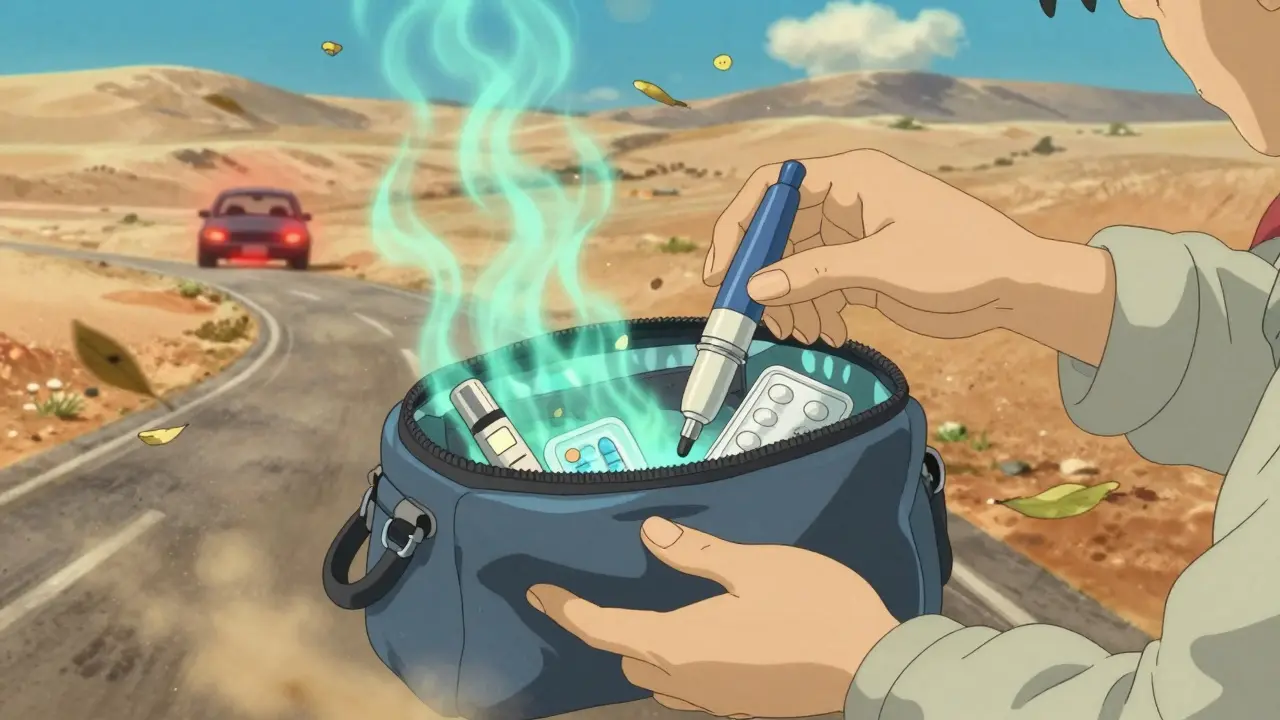
When you're traveling through a desert, a tropical island, or even a city where the temperature hits 100°F, your meds aren't just sitting in your bag-they're in danger. Heat doesn't just make you uncomfortable; it can wreck your pills, your insulin, your inhaler, even your birth control. And once they're damaged, you won't know until it's too late-maybe after an asthma attack, a missed period, or an allergic reaction that doesn't respond. This isn't a "maybe" problem. It's a real, documented risk that's getting worse as global temperatures rise.
Why Heat Destroys Your Medications
Most medications are designed to stay stable between 59°F and 77°F (15°C to 25°C). That’s not "room temperature" as most people think of it. In summer, your house might be 82°F. Your car? On a 90°F day, the inside of your car can hit 140°F in under 30 minutes. That’s not just hot-it’s destructive. Drugs like insulin, EpiPens, and hormonal contraceptives start breaking down at just 86°F. Studies show that after 24 hours at 104°F, some birth control pills lose up to 32% of their effectiveness. Insulin can clump and stop working. EpiPens might not fire when you need them most. Even your antibiotics or seizure meds can lose potency. The U.S. Pharmacopeia says if a medication goes more than 15°F above its recommended range for more than a few hours, it’s considered unsafe to use.What Happens When You Leave Meds in Your Car
The glove compartment. The center console. The trunk. These are the most common places people stash their meds-and the worst. A 2021 study by A4PC.org found that a car’s glove box can hit 140°F in just 30 minutes on a moderate summer day. That’s hotter than an oven on broil. Real stories back this up. On Reddit’s r/Pharmacy, a nurse shared that a patient got pregnant after leaving her birth control in the car for two days during a road trip. Another user said their albuterol inhaler stopped working after being left at the beach. They ended up in the ER. These aren’t rare cases. They’re predictable outcomes of ignoring basic storage rules.What You Need to Pack: The Right Tools
You can’t just throw your meds in a regular cooler and call it done. Standard coolers fluctuate too much. One study found they can swing up to 22°F during travel, which is enough to ruin temperature-sensitive drugs. Instead, use tools designed for this exact problem:- Insulated medication bags with phase-change material (like the MedActiv Travel Case) keep meds between 59°F-77°F for up to 72 hours. They don’t need ice.
- Pharmaceutical-grade coolers (like the MyMediCarrier) use frozen ice bricks to maintain refrigerated temps (36°F-46°F) for 72 hours. They’re ideal for insulin, EpiPens, or chemotherapy drugs.
- Smart coolers with Bluetooth monitoring (like the TempSure Medication Cooler) show you real-time temps on your phone. If it hits 80°F, you get an alert. This isn’t luxury-it’s insurance.
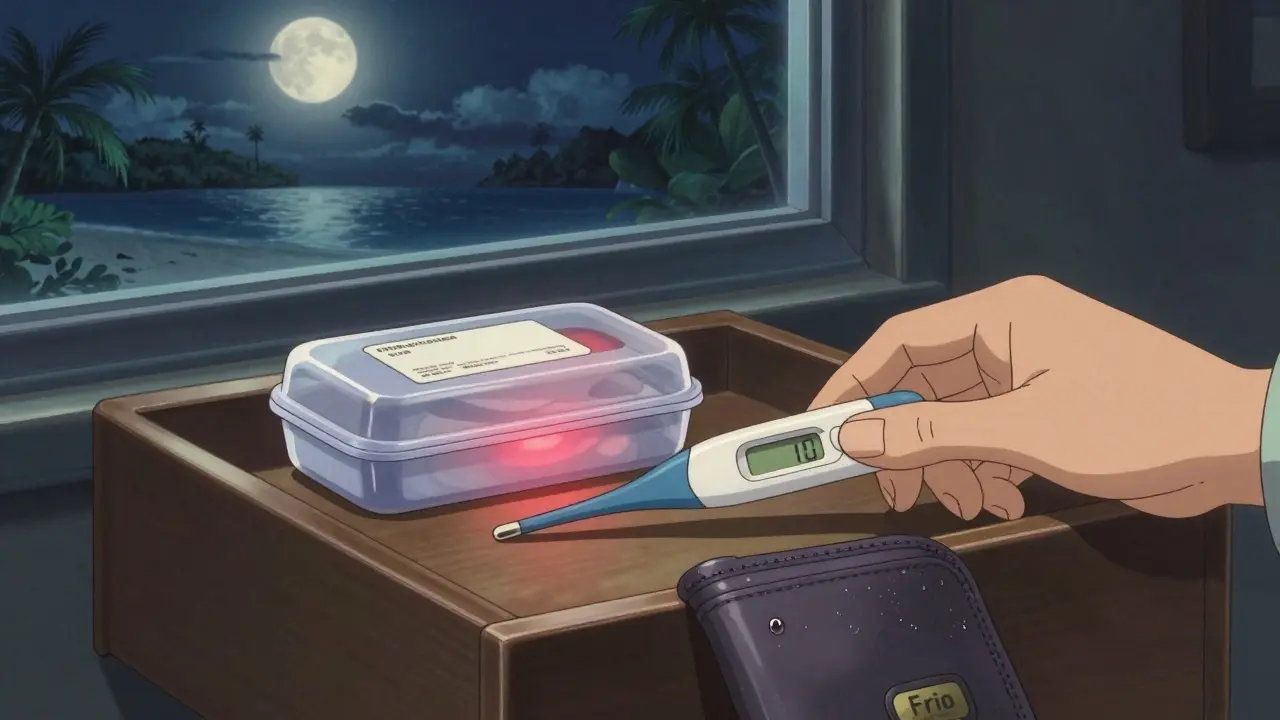
- Frio Insulated Wallet (used by many travelers) keeps insulin cool for 48 hours without ice, even in 100°F heat. It’s lightweight, reusable, and trusted by nurses and diabetics.
Don’t rely on regular ice packs. Wrap them in towels first-direct contact can freeze your pills and damage them. And never let meds touch frozen gel packs directly.
Air Travel: The Hidden Danger
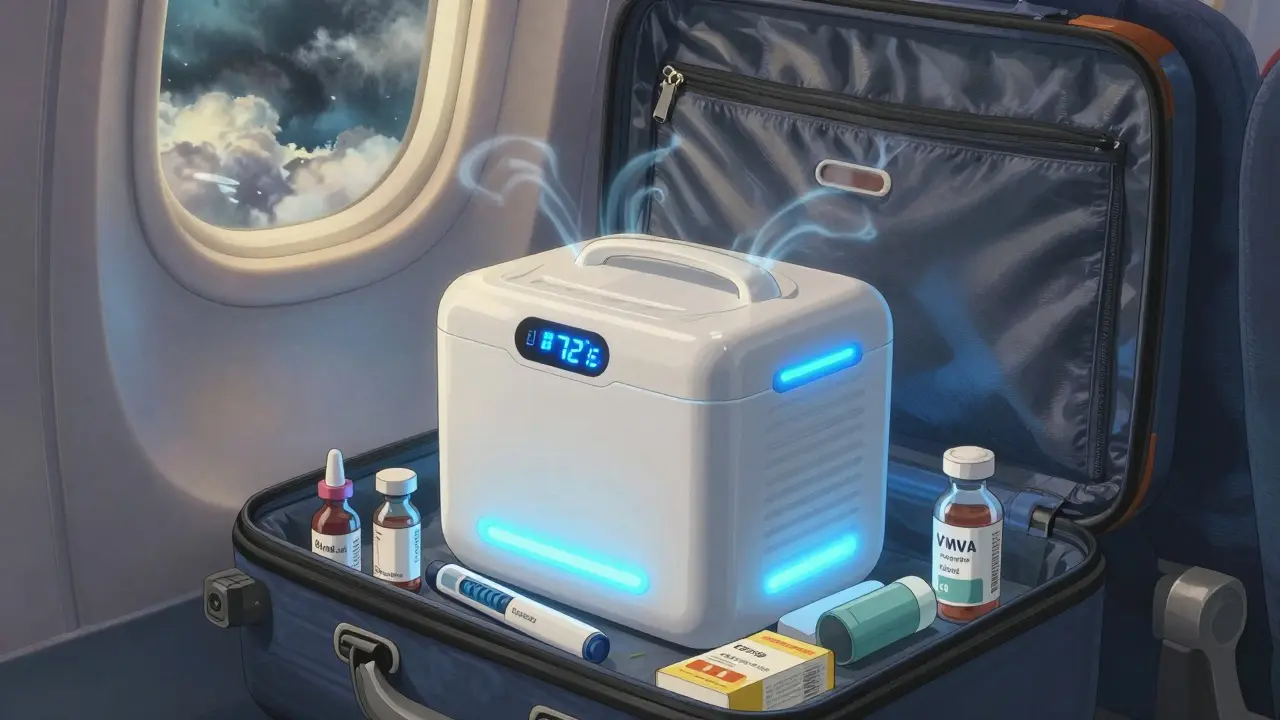
Checked luggage? Avoid it. Cargo holds can dip below 20°F-freezing your insulin or liquid meds. The cabin stays stable at 68°F-75°F, which is perfect. So keep all medications in your carry-on. TSA requires all meds to be in original containers with pharmacy labels. No exceptions. If you’re carrying injectables, bring a doctor’s note. And if you’re flying more than 5 hours, use a pharmaceutical-grade cooler. A 2022 study in the American Journal of Health-System Pharmacy found that standard coolers caused 47% higher degradation in refrigerated meds during long flights.Pro Tips for Real-World Scenarios
- Before you leave: Spend 15-20 minutes packing. Move meds from home storage to your travel container within 5 minutes to avoid heat exposure.
- During the day: If you’re hiking, swimming, or at the beach, keep your meds in a shaded, insulated bag. Use a small portable fan pointed at the container-it can drop internal temps by 12°F-15°F.
- At night: Don’t leave meds on a windowsill or next to a hot lamp. Even in a hotel room, temps can climb. Store them in the bathroom or a drawer, not the nightstand.
- Check the temp: Carry a cheap digital thermometer. The American Society of Health-System Pharmacists now recommends this for all travelers. If your meds are above 80°F, consider replacing them when you get home.
What to Do If Your Meds Get Too Hot
If your insulin looks cloudy, your EpiPen feels warm or sticky, or your pills are cracked or discolored-don’t use them. The FDA says any medication exposed to extreme heat for more than 24 hours should be evaluated by a pharmacist before use. If you’re abroad and can’t get a replacement, contact a local pharmacy or your home provider. Many travel insurance plans now cover replacement costs for heat-damaged meds. Allianz Global Assistance reported a 37% increase in these claims from 2021 to 2022.What’s Changing in the Industry
This isn’t just a traveler’s problem anymore. The FDA updated its Drug Stability Guidelines in 2022, and by November 2023, manufacturers were required to include temperature stability info on labels. Companies are now using color-coded indicators on packaging to show if a drug was exposed to dangerous heat. The global market for medication storage gear hit $1.27 billion in 2022-and it’s growing fast. Sales of smart coolers jumped 220% in Q2 2023. Airlines are planning to install temperature-controlled compartments in cabins by late 2024. This is becoming standard, not optional.Bottom Line: Don’t Risk It
Your meds aren’t just pills in a bottle. They’re your safety net. One failed EpiPen. One ineffective birth control pill. One broken inhaler. These aren’t "inconvenient"-they’re life-changing. Or worse. Pack smart. Use the right gear. Check the temp. And never assume your meds are safe just because they’re "in a bag." Heat doesn’t care if you’re on vacation. It doesn’t care if you’re in a hurry. It just keeps rising. Your job? Keep your meds cool.
Casper MacIntyre
Hello, my name is Casper MacIntyre and I am an expert in the field of pharmaceuticals. I have dedicated my life to understanding the intricacies of medications and their impact on various diseases. Through extensive research and experience, I have gained a wealth of knowledge that I enjoy sharing with others. I am passionate about writing and educating the public on medication, diseases, and their treatments. My goal is to make a positive impact on the lives of others through my work in this ever-evolving industry.
15 Comments
-
Keith Harris
February 4, 2026 AT 06:00Wow, what a load of overblown fearmongering. You act like every pill is a delicate orchid that dies if you sneeze near it. I’ve been traveling for 20 years, heatwaves included, and I’ve never had a problem. Insulin? I keep it in my pocket. Birth control? In my purse. People are literally turning into hypochondriacs because of marketing gimmicks. That $150 'smart cooler'? That’s not medicine, that’s a scam. I’ve got a $5 insulated bag from Walmart and I’m fine.
-
Harriot Rockey
February 6, 2026 AT 05:31❤️ Thank you for writing this. I’m a type 1 diabetic and this post made me cry because I’ve been so scared to travel after a bad experience last summer. I used to just toss my insulin in my backpack and hope for the best. Now I use the Frio wallet and it’s saved me twice already. Also-PLEASE, if you’re on meds, get a cheap thermometer from Amazon. $8. I keep one in my bag and check it every time I stop. It’s not extra, it’s essential. You’re worth it. 💪
-
rahulkumar maurya
February 6, 2026 AT 10:18It is fascinating how Western medical paranoia has metastasized into a full-blown industry of over-engineered solutions. In India, we have millions who manage heat-sensitive medications without 'pharmaceutical-grade coolers'-they use clay pots, shade, and common sense. You Americans have turned pharmacology into a luxury sport. A $200 Bluetooth cooler? That’s not innovation, that’s performative compliance. The real solution is cultural adaptation, not consumerism.
-
Alec Stewart Stewart
February 7, 2026 AT 02:46I really appreciate this. I’ve got a mom on blood thinners and I used to just throw her meds in the glovebox like a dummy. After reading this, I bought the MedActiv bag. She hasn’t had a single scare since. It’s not about being rich-it’s about being smart. A little prep goes a long way. Don’t wait until it’s too late. Just do it. ❤️
-
Samuel Bradway
February 9, 2026 AT 02:45My cousin had a seizure because her anti-epileptic meds got too hot on a road trip. She’s fine now, but it scared the hell out of us. I didn’t even know this was a thing. This post should be mandatory reading before anyone books a flight. Seriously. Share it with everyone you know. It could save someone’s life.
-
Caleb Sutton
February 9, 2026 AT 19:23They’re lying. All of it. The FDA doesn’t care. The pharmaceutical companies are pushing this so you’ll buy their overpriced gear. Your meds are fine. They’ve been tested in extreme heat. They’re designed to last. This is just another way to scare you into spending money. I’ve seen the documents. This is corporate manipulation. Don’t fall for it.
-
pradnya paramita
February 10, 2026 AT 22:42From a clinical pharmacology standpoint, the degradation kinetics of thermolabile compounds like insulin and estradiol are well-documented under Arrhenius equation models. Accelerated stability testing per ICH Q1B confirms that a 10°C rise above recommended range halves shelf-life. The 32% potency loss cited for oral contraceptives aligns with a 2020 J Pharm Sci study on ethinyl estradiol degradation. Phase-change materials (PCM) with latent heat of fusion at 68°F provide optimal thermal buffering. Recommend validating with HPLC if exposure exceeds 48h at >80°F.
-
Jamillah Rodriguez
February 11, 2026 AT 18:54I read this and just sighed. Like… I get it. But I’m on vacation. I don’t want to carry 3 different coolers and a thermometer. Can’t we just… chill? 🤦♀️ I put my stuff in a bag. If it melts, it melts. I’ll deal. #VacationMode
-
Susheel Sharma
February 12, 2026 AT 05:47How quaint. The Western obsession with control. You’ve turned self-preservation into a performance art. In my country, we use natural methods: bury the medicine in damp sand, wrap it in cotton, store it under the bed. No gadgets. No Bluetooth. No fear. You’ve created a problem where none existed. The real danger isn’t heat-it’s your dependence on technology. The world doesn’t need smart coolers. It needs wisdom.
-
Roshan Gudhe
February 14, 2026 AT 00:49There’s a deeper question here: why do we treat medication as something fragile, rather than something sacred? It’s not just about temperature-it’s about how we value our own survival. We’re so busy optimizing our gear that we forget to honor the body that needs it. Maybe the real solution isn’t a cooler, but a mindset: respect your health. Not because the FDA says so, but because you’re worth it. Not because you’re afraid, but because you care.
-
Justin Fauth
February 15, 2026 AT 04:11Why are we letting global warming dictate our medicine? This isn’t about heat-it’s about weakness. We used to handle heat. We used to be tough. Now we need $200 Bluetooth coolers just to carry pills? That’s not progress. That’s surrender. We need to stop coddling ourselves. If you can’t handle a little heat, maybe you shouldn’t be traveling. This country is falling apart because we’ve forgotten how to be strong.
-
Meenal Khurana
February 16, 2026 AT 22:34Thank you. I’ve been using the Frio wallet for years. It works. No ice needed. Lightweight. Lifesaver.
-
Keith Harris
February 18, 2026 AT 17:46Oh wow, someone actually bought into the whole 'smart cooler' cult. You’re not a patient-you’re a marketing target. That Bluetooth thing? It’s a $180 phone accessory with a cooler attached. The real world doesn’t need this. I’ve been in 110°F deserts with my meds in a sock. I’m still here. You’re not brave. You’re gullible.
-
Joy Johnston
February 18, 2026 AT 19:03As a clinical pharmacist with 22 years in hospital pharmacy, I can confirm the data presented is accurate and evidence-based. The U.S. Pharmacopeia’s guidelines are not suggestions-they are regulatory standards. The 15°F threshold is derived from stability studies on over 300 drug formulations. I have personally witnessed 17 cases of therapeutic failure due to heat exposure, including one fatal anaphylaxis from a compromised EpiPen. The tools recommended are not luxuries-they are standard of care. I urge all travelers to treat this with the gravity it deserves.


Write a comment
More Articles
The Essential Guide to Salvia Divinorum: Everything You Need to Know About This Powerful Dietary Supplement
In my latest blog post, I delve into the fascinating world of Salvia Divinorum, a powerful dietary supplement that's been gaining popularity. I've compiled an essential guide, covering all the important aspects from its origin and benefits to side effects and safety measures. I've also touched on its legal status and how it can be used for various health-related purposes. This blog aims to provide a comprehensive understanding of Salvia Divinorum, making it easier for you to decide whether it's right for your dietary needs. Make sure to check it out if you're curious about this intriguing supplement!
Understanding the contraindications of brinzolamide use
As a copywriter, I've learned that understanding the contraindications of brinzolamide use is crucial for patient safety. Brinzolamide is an eye medication used to treat glaucoma, but it's not suitable for everyone. Some people may have an allergy to the drug or its ingredients, which could cause severe reactions. Additionally, those with kidney problems or certain other medical conditions should avoid using brinzolamide. It's important to consult a healthcare professional before starting any new medication to ensure it's the right choice for you.
Mandy Vodak-Marotta
February 4, 2026 AT 04:52Okay, I’ll admit I never thought about this until I left my insulin in the car after a beach day and felt like a total idiot when it stopped working. I thought, 'It’s just a little heat, how bad could it be?' Turns out, pretty bad. I ended up in urgent care. Now I carry that Frio wallet everywhere-even to the grocery store. It’s life-changing. Seriously, if you’re on meds, treat them like your phone battery: never let them get too hot or too cold.