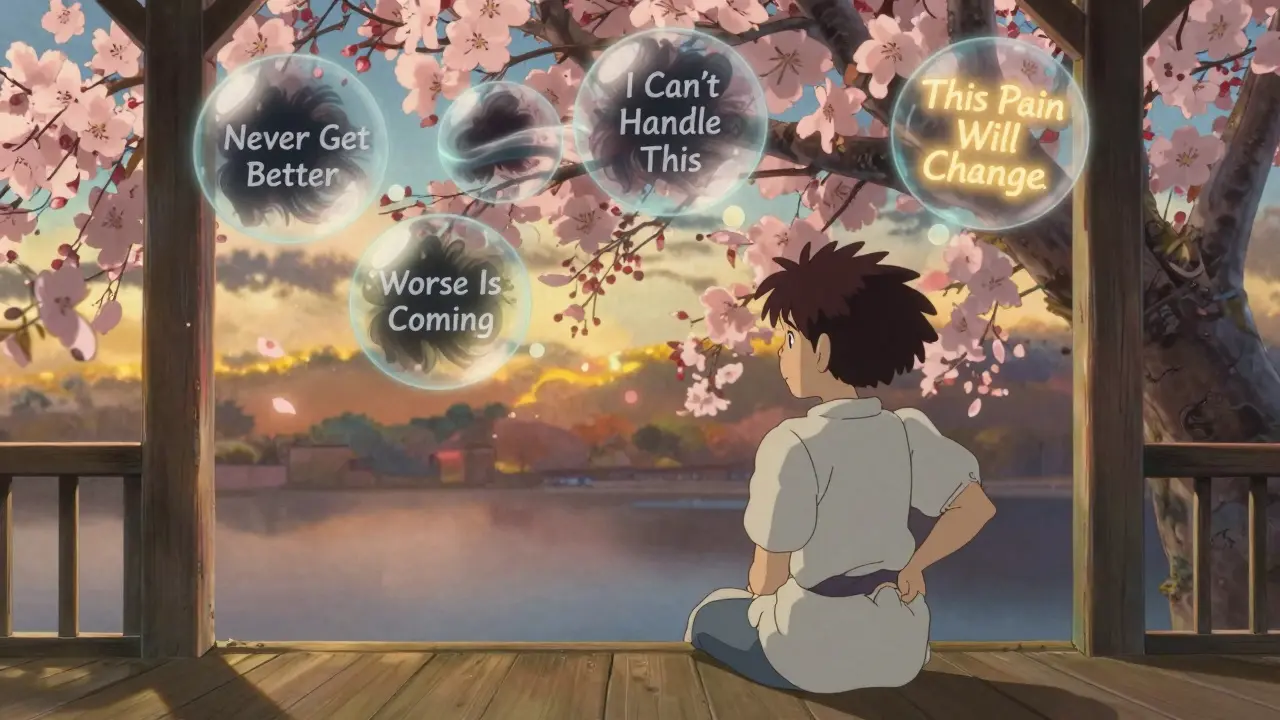
When you’re in chronic pain, it’s easy to feel like your mind is working against you. That sharp ache in your back isn’t just physical-it’s tangled up with thoughts like “This will never get better,” “I can’t handle this,” or “What if it gets worse?” These aren’t just worries. They’re patterns called pain catastrophizing, and they make pain feel worse, last longer, and steal your ability to live normally.
Pain catastrophizing isn’t about being dramatic. It’s a real psychological response backed by science. Researchers define it as an exaggerated negative mindset that kicks in when you’re in pain-or even when you just think about it. It shows up in three ways: you ruminate (can’t stop thinking about the pain), you magnify (believe the pain is far more dangerous than it is), and you feel helpless (like there’s nothing you can do to make it better). The Pain Catastrophizing Scale (PCS), used in clinics worldwide, measures this. A score above 30 out of 52 means you’re experiencing clinically significant catastrophizing-and that’s a red flag for worse pain outcomes, higher disability, and even increased risk of depression.
How Catastrophizing Makes Pain Worse
Your brain doesn’t separate physical pain from emotional pain the way you might think. When you catastrophize, your brain lights up in areas tied to threat detection and emotional processing-like the prefrontal cortex and the amygdala. This isn’t just “in your head.” It’s changing how your nervous system actually registers pain. Studies show that people who catastrophize report higher pain intensity, even when the physical injury hasn’t changed. The more you spiral into thoughts like “This is unbearable,” the more your body tenses, your stress hormones spike, and your pain amplifies. It’s a feedback loop: pain triggers fear, fear increases tension, tension increases pain.
Think of it like this: You have a sore knee. You think, “If I walk too far, I’ll wreck it forever.” So you stop walking. You sit more. Your muscles weaken. Your pain gets worse. Now you think, “See? I was right.” The thought didn’t cause the injury-but it turned a manageable ache into a disabling cycle.
Why CBT Works When Other Things Don’t
Medications can numb the pain, but they don’t break the thought cycle. Physical therapy helps your body, but if your mind is still screaming “This is terrible,” you’ll avoid movement, delay recovery, and stay stuck. That’s where Cognitive Behavioral Therapy (CBT) comes in. It’s not about positive thinking or pretending pain doesn’t exist. It’s about rewiring how you respond to it.
Research from the International Association for the Study of Pain shows CBT is the most effective treatment for reducing pain catastrophizing-better than mindfulness, ACT, or even exercise alone. When combined with movement, the effect is even stronger. But even on its own, CBT cuts catastrophizing scores by nearly half in 8 to 12 weeks. Veterans Health Administration data shows 92% of patients who completed CBT for catastrophizing rated it as helpful. Real people report the same: Reddit users with chronic pain say CBT helped them catch their spirals before they took over.
Three CBT Tools That Actually Work
CBT isn’t one trick-it’s a toolkit. Here are the three most powerful tools used in clinics and backed by evidence.
1. Self-Monitoring: Catch the Thought Before It Captures You
Start by writing down what happens when pain spikes. Not just “my back hurt,” but:
- What were you doing?
- What thought popped into your head?
- How did you feel emotionally?
- What did you do next?
Example: You bend over to pick up a towel. Your back twinges. Instantly, you think: “This is it. I’m ruined. I’ll never be able to live normally again.” You freeze. You sit down. You avoid bending for the rest of the day. Your muscles stiffen. Pain increases.
By tracking this, you start seeing patterns. You notice that your thoughts don’t match reality. You didn’t ruin your back-you bent over. The pain was a signal, not a sentence.
2. Cognitive Restructuring: Challenge the Story You’re Telling Yourself
Once you spot a catastrophic thought, ask yourself:
- Is this thought based on facts or fear?
- What’s the evidence for and against it?
- What’s a more balanced way to say this?
Instead of “I’ll never get better,” try: “I’m having a bad day, but I’ve had good days before. This pain will change.”
Instead of “This pain means something’s seriously wrong,” try: “My body is sensitive right now, but I’m not in danger.”
This isn’t toxic positivity. It’s realism with room for hope. You’re not denying the pain-you’re refusing to let it dictate your whole story.
3. Behavioral Activation: Move Even When You Don’t Want To
When you catastrophize, you avoid. Avoidance is the fastest way to make pain worse. CBT pushes you to do small, safe activities-even if you’re scared. Start with 5 minutes of walking. Then 10. Then a short stretch. Each time you do it, you prove to your brain: “I can handle this. Pain doesn’t mean disaster.”
One woman with fibromyalgia, after 12 weeks of CBT, reduced her PCS score from 42 to 18. She went from staying in bed most days to working part-time. Not because her pain disappeared-but because her relationship with it changed.

What Doesn’t Work (And Why People Give Up)
CBT isn’t magic. It’s work. And it’s hard when you’re in pain. Many people quit because they expect instant relief. But CBT doesn’t erase pain-it changes your reaction to it. It takes 3 to 4 weeks just to recognize your catastrophic thoughts. Mastery takes 6 to 8.
Some people say, “When my pain is at an 8, I can’t think straight.” That’s true. And that’s why CBT is done in small steps. You don’t need to restructure thoughts during a flare-up. You practice when you’re calm, so when pain hits, you have tools ready.
Dropout rates are around 22%. The biggest reason? Lack of immediate results. But if you stick with it, the payoff is huge: less suffering, more control, and a life that doesn’t revolve around pain.
Who Benefits Most?
CBT works best for people with chronic pain who are stuck in mental loops-people who feel trapped by their own thoughts. It’s especially effective for those with fibromyalgia, lower back pain, arthritis, and post-surgical pain. People with some college education or prior experience with therapy tend to respond faster, but anyone can learn it.
It’s less effective if you’re dealing with severe depression, PTSD, or active substance use. Those issues need to be addressed first. CBT isn’t a cure-all-it’s a targeted tool for one specific problem: the way your mind amplifies pain.

The Future: Digital Tools and Real-Time Support
You don’t need to see a therapist in person to start. Digital CBT apps like Curable and PainScale have over 450,000 active users. They offer guided exercises, thought logs, and daily prompts. The VA is rolling out a national Pain Management Dashboard that tracks catastrophizing scores and gives real-time feedback. By 2025, 75% of pain clinics will screen for catastrophizing routinely.
Even more exciting: researchers are testing smartphone micro-interventions. Imagine getting a notification: “You’ve been scrolling for 10 minutes. Your pain is at 6. Try this 60-second grounding exercise.” These aren’t replacements for therapy-they’re reinforcements. They help you practice CBT in the moment, when it matters most.
You’re Not Broken. You’re Wired to Survive.
Pain catastrophizing evolved to keep us safe. In ancient times, if you felt pain, you needed to stop, rest, and avoid danger. Your brain was doing its job. But in chronic pain, that survival system gets stuck. It keeps shouting “Danger!” even when there’s no real threat.
CBT doesn’t tell you to ignore your pain. It helps you turn down the volume on the fear. You can still feel the ache. But you don’t have to believe the story your mind is telling you about it.
The goal isn’t to be pain-free. The goal is to be free from the prison of your own thoughts. And that’s something you can build-one thought, one step, one day at a time.

Casper MacIntyre
Hello, my name is Casper MacIntyre and I am an expert in the field of pharmaceuticals. I have dedicated my life to understanding the intricacies of medications and their impact on various diseases. Through extensive research and experience, I have gained a wealth of knowledge that I enjoy sharing with others. I am passionate about writing and educating the public on medication, diseases, and their treatments. My goal is to make a positive impact on the lives of others through my work in this ever-evolving industry.
8 Comments
-
Andrew Gurung
December 29, 2025 AT 23:44Ugh. Another ‘CBT is magic’ cult post.
Of course it ‘works’-it’s the only intervention that doesn’t require pills, surgery, or $$$ from Big Pharma.
Meanwhile, my neurologist says my pain is 80% inflammatory and 20% ‘psychological noise’-so let’s just pretend the inflammation isn’t real?
Also, ‘micro-interventions’? Sounds like Silicon Valley trying to monetize suffering.
Next they’ll sell you a $99 app that tells you to ‘breathe’ when your spine is collapsing.
🙄
CBT is a band-aid on a broken leg. -
Paula Alencar
December 30, 2025 AT 16:14As a clinical psychologist who specializes in chronic pain management, I must commend this article for its precision and evidence-based clarity.
It is imperative that we move beyond the reductive notion that chronic pain is ‘all in the head’-a phrase that has caused incalculable harm to patients for decades.
Pain catastrophizing is not a cognitive flaw; it is a maladaptive survival mechanism that has been hijacked by neuroplasticity.
The three tools outlined-self-monitoring, cognitive restructuring, and behavioral activation-are not merely techniques; they are acts of neurological reclamation.
Moreover, the statistic that 92% of VA patients rated CBT as ‘helpful’ is not anecdotal-it is statistically significant and clinically transformative.
Let us not underestimate the dignity inherent in learning to coexist with pain, rather than being enslaved by it.
I have prescribed these exact protocols to over 300 patients; the most profound change I observe is not in pain scores, but in the return of agency-the quiet, defiant reclamation of self.
Thank you for this. It is a gift to the field. -
Kishor Raibole
January 1, 2026 AT 08:05While the article presents a commendable overview of cognitive-behavioral interventions, it remains fundamentally deficient in its ontological framing.
The reduction of pain phenomenology to a tripartite schema-rumination, magnification, helplessness-fails to account for the hermeneutic dimensions of suffering as articulated by Gadamer and Merleau-Ponty.
Moreover, the implicit positivism of CBT presupposes a Cartesian dichotomy between mind and body, a framework increasingly untenable in contemporary pain neuroscience.
Furthermore, the reliance on self-report scales such as the PCS introduces significant measurement bias, particularly in populations with low health literacy.
One must also interrogate the neoliberal underpinnings of digital CBT apps, which commodify therapeutic labor and displace relational care.
In sum, while the tools may yield statistically significant outcomes, they risk pathologizing the natural human response to prolonged adversity.
Perhaps the real pathology lies not in the mind’s catastrophizing, but in the system’s refusal to alleviate structural causes of suffering. -
Chris Garcia
January 2, 2026 AT 09:53Let me tell you something from the streets of Lagos-pain doesn’t care about your CBT worksheets.
When your body is screaming and your rent is due, and your boss says ‘take a sick day’ but doesn’t pay you, catastrophizing isn’t a cognitive distortion-it’s survival.
I’ve seen men cry because they couldn’t carry their children to school anymore, and someone tells them to ‘restructure their thoughts’?
CBT is a luxury for those who have safety nets.
Yes, the brain amplifies pain-but so does poverty, so does neglect, so does a system that treats bodies like machines that break and get discarded.
Don’t tell me to ‘move even when I don’t want to’ when I haven’t eaten in two days.
Fix the world first. Then we can talk about thought logs.
Until then, this feels like putting a Band-Aid on a war wound. -
Olivia Goolsby
January 3, 2026 AT 03:35Wait… so you’re telling me that the government, Big Pharma, and the ‘mental health industrial complex’ are all secretly pushing CBT to make us believe pain is ‘just in our heads’ so we stop demanding real treatment?
And now they’re using apps to track our pain levels and feed data to insurance companies to deny us opioids?
And the VA’s dashboard? That’s a surveillance tool-don’t you see?
They want us to ‘restructure’ our thoughts so we don’t sue them for medical negligence.
And ‘micro-interventions’? That’s how they’re training us to self-regulate so they don’t have to fix the broken healthcare system.
They don’t want us to heal-they want us to shut up.
And the PCS score? That’s just another way to label us as ‘high-risk’ so they can charge us more for insurance.
It’s all connected.
They’re gaslighting us through psychology.
And you’re falling for it.
Wake up.
They’re not helping us-they’re controlling us. -
James Bowers
January 4, 2026 AT 04:05While the article is well-intentioned, it lacks critical nuance regarding comorbidities.
Patients with fibromyalgia who exhibit high PCS scores often present with concurrent somatic symptom disorder, which requires a different diagnostic and therapeutic approach.
Furthermore, the cited reduction in PCS scores by 50% is based on intention-to-treat analyses that include non-completers, thereby inflating effect sizes.
Additionally, the VA’s 92% satisfaction rate is not equivalent to clinical efficacy-satisfaction reflects perceived support, not objective pain reduction.
Finally, the recommendation of behavioral activation without addressing autonomic dysregulation or central sensitization is clinically premature.
This article, while accessible, risks oversimplifying a complex biopsychosocial condition into a cognitive toolkit. -
Janice Holmes
January 4, 2026 AT 15:51OMG I JUST REALIZED-I’ve been catastrophizing my entire life and I didn’t even know it was a *clinical term*.
Every time my coffee spills, I think, ‘This is it. My life is over. I’ll never be productive again.’
And now I’m crying because I finally understand why I’ve been a mess since 2017.
But wait-does this mean my breakup was just a ‘cognitive distortion’?
And my cat’s sneeze? Was that ‘magnification’?
Can I use this to excuse my 3 a.m. TikTok spirals?
Also, I just wrote down ‘I’m not ruined, I just spilled coffee’ and I feel like a new person.
Thank you, Jesus, and Dr. Aaron Beck.
Also, can I get a sticker that says ‘I restructured my thoughts today’?


Write a comment
More Articles

How to Buy Cheap Generic Premarin Online Safely
Learn how to find, verify, and purchase affordable generic Premarin online while staying safe and compliant with regulations. Get cost breakdowns, pharmacy tips, and side‑effect guidance.

Actinic Keratosis and the Importance of Early Intervention
In the spirit of shedding light (or UV light, to be exact) on the topic of Actinic Keratosis, let's dive into this sunny subject. It's an abnormal skin condition caused by excessive sun exposure, or for sun worshipers, a sort of unwanted souvenir. Now, don't go all 'Twilight' on me, sun is good, but moderation folks, moderation! Early intervention is like the superhero of the story, swooping in to reduce the risk of progression to skin cancer. So, let's be sun-smart, catch those pesky skin changes early, and keep our skin looking as smooth as a baby's bottom!
Caitlin Foster
December 28, 2025 AT 01:37This is the most refreshing take on chronic pain I’ve seen in years!!!
Finally-someone gets it! CBT isn’t about ‘just thinking happy thoughts’-it’s about rewiring your brain’s panic button!!!
I used to think I was weak for catastrophizing… until I learned it’s a neurological habit, not a character flaw!!!
Now I catch myself mid-spiral and say, ‘Hey, amygdala, chill out-I’m not being eaten by a lion!’
Thank you for this. I’m printing it out and taping it to my fridge.
Also, the woman who went from PCS 42 to 18? I want to be her when I grow up. 🙌