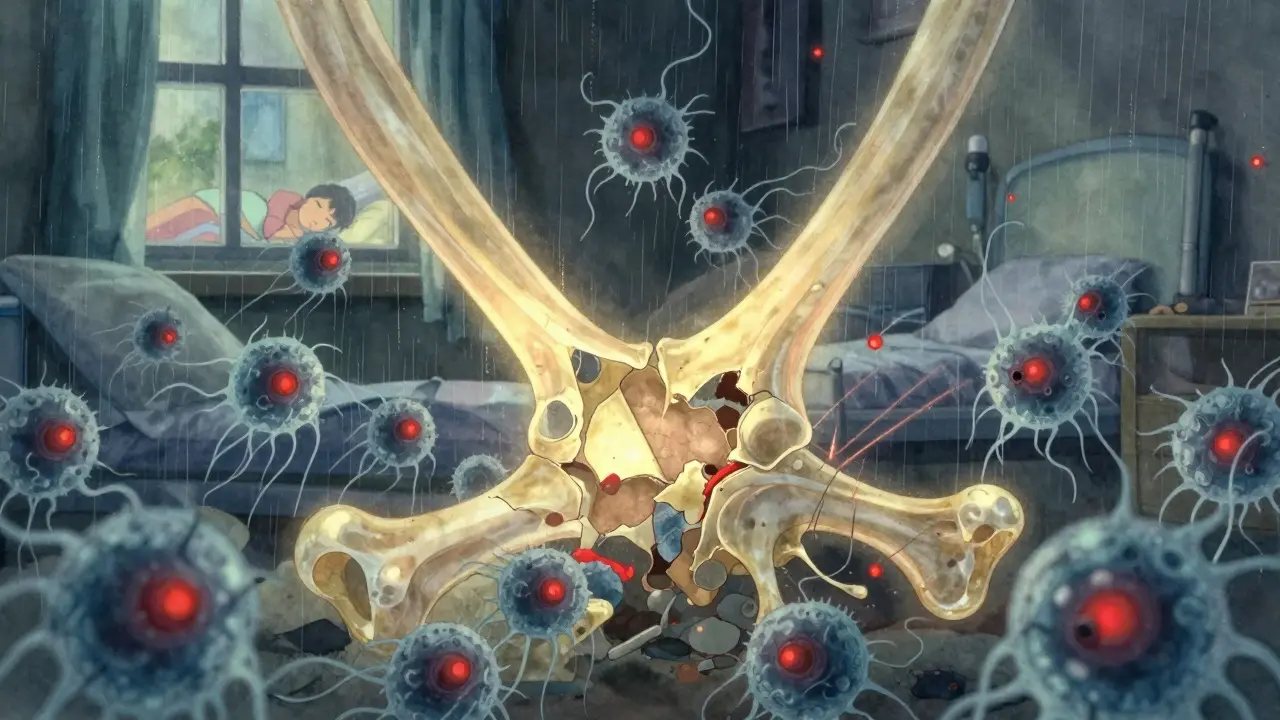
When someone is diagnosed with multiple myeloma, the focus often turns to blood tests, chemotherapy, and survival rates. But one of the most painful, disabling, and overlooked parts of the disease is what’s happening inside the bones. Over 80% of patients develop serious bone damage long before they even feel it. These aren’t just weak spots-they’re holes in the skeleton, caused by cancer cells that hijack the body’s own bone-building system. And for decades, treatment only tried to slow the damage. Now, a new wave of drugs is finally starting to rebuild what’s been lost.
The Silent Destruction Inside Your Bones
Multiple myeloma starts when abnormal plasma cells multiply in the bone marrow. But the real damage happens in the surrounding bone. Unlike other cancers that spread to bones, myeloma doesn’t just invade-it actively destroys. The bone lesions look like tiny holes on X-rays, often described as "punched-out." They’re not caused by the tumor pressing on bone. They’re caused by the tumor turning bone cells against each other.
Healthy bone is constantly being remodeled. Old bone is broken down by osteoclasts, and new bone is built by osteoblasts. In myeloma, this balance shatters. Osteoclasts go into overdrive. Osteoblasts shut down. The result? Bone disappears faster than it can be replaced. This isn’t just about fractures. It’s about chronic pain, mobility loss, and hospital stays. About 30% of patients develop hypercalcemia-dangerously high calcium levels from crumbling bone. One in four will have a broken bone without any injury. One in ten will face spinal cord compression, a medical emergency that can lead to paralysis.
What makes this worse is that the bone destruction feeds the cancer. When bone breaks down, it releases growth factors that help myeloma cells thrive. It’s a vicious cycle: more cancer → more bone damage → more cancer. Researchers call this the "vicious cycle of myeloma bone disease." And for years, doctors only treated the cancer, not the bone.
How Myeloma Turns Bone Against Itself
The science behind this destruction is complex, but the key players are clear. Myeloma cells don’t work alone. They hijack the bone marrow’s natural signaling system. One major pathway is RANKL/RANK/OPG. Think of RANKL as a switch that turns on bone-eating cells. OPG is the brake. In healthy people, they’re balanced. In myeloma, RANKL skyrockets-up to five times higher-while OPG drops. The brake fails. The switch stays on.
Then there’s DKK1 and sclerostin. These are proteins secreted by myeloma cells that shut down osteoblasts. DKK1 blocks the Wnt pathway, which is like the blueprint for building bone. Patients with DKK1 levels above 48.3 pmol/L have over three times more bone lesions than those with lower levels. Sclerostin, another blocker, averages 28.7 pmol/L in myeloma patients versus 19.3 in healthy people. That’s not a small difference-it’s a full shutdown of bone repair.
Even osteocytes, the most common bone cells, get pulled into the fight. These cells, which make up 95% of all bone cells, start sending signals that ramp up RANKL. It’s like the entire bone structure turns against itself. And because these changes happen right where the cancer sits, the damage is local, aggressive, and hard to predict without imaging.
Current Treatments: Slowing the Damage
For years, the only tools doctors had were bisphosphonates and denosumab. Both work by blocking osteoclasts. Zoledronic acid and pamidronate are IV infusions given monthly. Denosumab is a shot under the skin, also monthly. Both reduce skeletal-related events by 15-18% compared to no treatment. That sounds modest, but for patients, it means fewer fractures, less pain, and fewer hospitalizations.
But they have limits. Bisphosphonates can hurt the kidneys. About 22% of patients need dose changes because their creatinine clearance drops below 60 mL/min. Denosumab avoids kidney issues but carries a risk of osteonecrosis of the jaw (MRONJ). Around 42% of patients on long-term therapy develop this, requiring dental work or surgery. Hypocalcemia is another problem-18.5% of patients drop their calcium too low.
Patients often choose between the two based on convenience and cost. Denosumab is easier-no IV, no clinic visits. But at $1,800 per dose, it’s 12 times more expensive than generic zoledronic acid. In the U.S., 78% use denosumab. In Europe, it’s 42%. In Asia, bisphosphonates still dominate at 89%. Access isn’t just a medical issue-it’s an economic one.
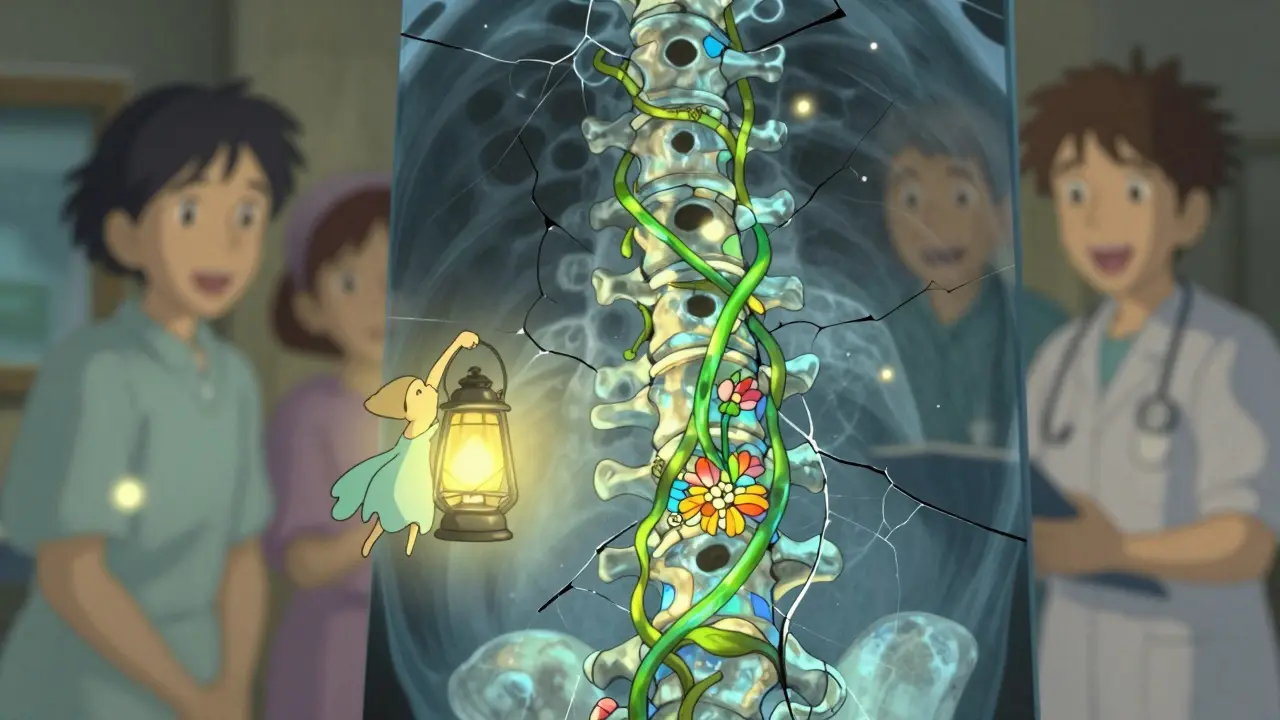
The New Wave: Drugs That Heal Bone
The real breakthrough isn’t just stopping bone loss-it’s rebuilding it. And that’s where novel agents come in.
Anti-sclerostin antibodies like romosozumab and blosozumab are the most promising. Sclerostin blocks bone formation. Blocking it lets osteoblasts work again. In the 2021 STRUCTURE trial, 49 myeloma patients on romosozumab saw a 53% increase in bone mineral density at the spine in just 12 months. Pain scores dropped 35%. This isn’t slowing damage-it’s reversing it.
Anti-DKK1 therapies like DKN-01 are also showing results. In a 2020 trial with 32 patients, bone resorption markers fell by 38%. That means less breakdown. But more importantly, early signs suggest bone formation is starting to catch up.
Even drugs targeting the Notch pathway, like nirogacestat, are showing promise in labs. In mice, they cut osteolytic lesions by 62%. Human trials are just beginning, but the mechanism makes sense: Notch3 and Notch4 are overactive in myeloma cells, and blocking them reduces RANKL.
These aren’t just lab curiosities. The FDA approved a new low-dose zoledronic acid (Zometa-LD) in April 2023 to reduce kidney strain. And the phase III BONE-HEAL trial, now enrolling 450 patients, is testing romosozumab as a standard add-on therapy. If results hold, this could become routine within two years.
What Patients Are Saying
On the Myeloma Crowd Reddit, a thread from February 2023 had 147 comments. The top complaint? "I’m still in pain, even after six months of zoledronic acid." Sixty-eight percent said their bone pain didn’t improve. Many shared stories of broken hips, spine surgeries, or dental problems from MRONJ.
But those in clinical trials are seeing real change. One participant in the romosozumab trial said, "I walked into my daughter’s graduation without a cane for the first time in three years." Another said, "My back pain dropped from an 8 to a 3. I’m sleeping through the night."
Still, access is uneven. Most novel agents are only available in trials. Romosozumab isn’t approved for myeloma yet. DKN-01 is still in phase II. Cost and availability are barriers. In Australia, where I live, patients can get denosumab, but anti-sclerostin drugs aren’t funded yet. Waiting lists for trials are long.

The Future: Healing, Not Just Managing
The next frontier isn’t just one drug. It’s combinations. What if you pair a drug that blocks bone destruction (like denosumab) with one that rebuilds it (like romosozumab)? Early data suggests this could be powerful. Some researchers are even looking at bispecific antibodies that target both myeloma cells and bone signals at once.
RNA therapies are also on the horizon. Alnylam’s ALN-DKK1, which silences the DKK1 gene, reduced DKK1 by 65% in preclinical models. That’s a direct hit on the root cause.
But the biggest shift is in timing. The European Hematology Association updated its guidelines in June 2023 to say: start bone protection on day one. Not after a fracture. Not after pain starts. Right at diagnosis. Because once bone is gone, it’s hard to get back.
By 2030, experts predict we’ll move from preventing bone damage to actively healing it. That’s not science fiction. It’s the next step in myeloma care. The goal isn’t just to extend life-it’s to give patients back their mobility, their independence, and their ability to live without pain.
What You Need to Know Now
If you or someone you care about has multiple myeloma, here’s what to ask your doctor:
- Have you done a whole-body low-dose CT or PET-CT scan? This finds bone lesions early.
- Are you on a bone-modifying agent? If not, why?
- What are your DKK1 and sclerostin levels? These help predict bone damage risk.
- Have you had a dental checkup in the last 30 days? MRONJ risk starts immediately.
- Are you eligible for a clinical trial? Anti-sclerostin drugs aren’t widely available yet-but they might be soon.
And if you’re in a region where these drugs aren’t covered, ask about patient assistance programs. Myeloma Beacon and the International Myeloma Foundation both offer free guides and support. Bone health isn’t a side note-it’s central to survival.
Is bone damage in multiple myeloma reversible?
Traditionally, bone damage from myeloma was considered permanent. Current treatments like bisphosphonates and denosumab stop further loss but don’t rebuild bone. However, new drugs like romosozumab, which targets sclerostin, have shown in clinical trials that bone mineral density can increase by over 50% in 12 months. This suggests that with the right agents, bone healing is possible. The BONE-HEAL trial is currently testing this in 450 patients, and early results are promising.
Why do some myeloma patients get fractures without injury?
Myeloma cells cause localized bone destruction by overactivating osteoclasts and shutting down osteoblasts. This creates weak, porous areas in the bone that look like holes on scans. These areas are so fragile that even normal movements-like coughing, bending, or stepping off a curb-can cause a fracture. This is called a pathological fracture and occurs in 28-38% of patients. It’s not trauma-it’s disease.
What’s the difference between denosumab and zoledronic acid?
Both drugs reduce skeletal-related events, but they work differently. Zoledronic acid is a bisphosphonate given as an IV infusion monthly. It can harm kidney function, especially in patients with pre-existing issues. Denosumab is a subcutaneous injection that blocks RANKL directly. It doesn’t affect kidneys but carries a higher risk of osteonecrosis of the jaw and low calcium. Denosumab is more convenient but much more expensive-about $1,800 per dose versus $150 for generic zoledronic acid.
Can novel agents like romosozumab be used alongside chemotherapy?
Yes. In fact, most clinical trials combine novel bone agents with standard myeloma treatments. Romosozumab and DKN-01 are being tested alongside proteasome inhibitors, immunomodulatory drugs, and monoclonal antibodies. The idea is to attack the cancer while simultaneously repairing bone. Early results show no major safety conflicts, and patients often report better quality of life. However, these combinations are still experimental and not yet approved for routine use.
Why isn’t romosozumab widely available for myeloma patients yet?
Romosozumab is currently approved only for osteoporosis in postmenopausal women, not for myeloma. While it showed strong results in myeloma trials, regulatory approval takes time. The phase III BONE-HEAL trial, which includes 450 patients, is ongoing and expected to complete in 2027. Until then, it’s only available through clinical trials. Insurance companies also don’t cover it for myeloma because it’s not officially approved for that use. But with positive data, approval could come as early as 2028.

Casper MacIntyre
Hello, my name is Casper MacIntyre and I am an expert in the field of pharmaceuticals. I have dedicated my life to understanding the intricacies of medications and their impact on various diseases. Through extensive research and experience, I have gained a wealth of knowledge that I enjoy sharing with others. I am passionate about writing and educating the public on medication, diseases, and their treatments. My goal is to make a positive impact on the lives of others through my work in this ever-evolving industry.
15 Comments
-
David Robinson
March 20, 2026 AT 13:00Let me cut through the fluff. They're selling hope like it's a supplement. Romosozumab? Approved for osteoporosis in old ladies, not myeloma patients. The FDA hasn't approved it for this use, and until they do, it's a $$$ gamble. Insurance won't cover it. Trials? Yeah, sure, but only if you live near a major hospital and can afford to take time off work. Meanwhile, people are still getting crushed by fractures because the system won't act until it's too late.
-
gemeika hernandez
March 22, 2026 AT 08:12I had myeloma. I got the denosumab shots. My jaw started dying. I had to get 6 teeth pulled. They told me it was "rare." Then I read online that 42% of people get it. That’s not rare. That’s negligence. Why didn’t they warn me? Why is this still happening? I’m not even mad anymore. Just tired.
-
Laura Gabel
March 23, 2026 AT 20:49I'm from the US and I can confirm: denosumab is everywhere. But guess what? It's not better. It's just more expensive. My dad switched from zoledronic acid to denosumab because "it's easier." He ended up with hypocalcemia and had to go to the ER. No one told him to take calcium supplements. Doctors just assume you know. You don't.
-
Amadi Kenneth
March 25, 2026 AT 10:28You think this is about science? Nah. Big Pharma is hiding the real cure. The bone rebuilds itself naturally if you stop the inflammation. They don't want you to know that. They make billions off monthly injections. Why? Because you have to keep coming back. The real answer? Low-dose naltrexone. It resets the immune system. But you won't hear about it on CNN. Why? Because it costs $20 a month. And they can't patent it. This is all a money scheme. You're being played.
-
Michelle Jackson
March 26, 2026 AT 01:46I'm sorry but I'm just not buying this "healing bone" nonsense. If it were that easy, why haven't we seen massive recovery in patients after 5 years? My aunt had myeloma for 7 years. She's still in a wheelchair. All this talk about "53% increase in bone density" sounds like a press release. Where are the long-term studies? I'm not saying it's fake-I'm saying it's oversold.
-
Andrew Mamone
March 26, 2026 AT 03:23I love how this post breaks down the science without drowning in jargon. Seriously, the DKK1 and sclerostin explanation? Perfect. I'm a nurse in oncology, and I’ve seen patients cry because they could finally hug their grandkids without pain. These drugs aren't perfect, but they're the first real step toward healing, not just managing. I'm hopeful. 🙏
-
Kathy Underhill
March 27, 2026 AT 23:34The most important thing here isn't the drugs. It's timing. Starting bone protection on day one changes everything. Too many patients wait until they break a hip. By then, the damage is structural, not just chemical. We need to shift from reactive to proactive care. That’s the real breakthrough-not the molecule, but the mindset.
-
Nicole Blain
March 29, 2026 AT 22:15I just read this before my mom’s oncology appointment. She’s been on denosumab for 2 years. I’m going to ask if they’ve checked her sclerostin levels. I never even knew that was a thing. Thanks for this. I feel less helpless now.
-
MALYN RICABLANCA
March 30, 2026 AT 09:17OH MY GOD. I CAN’T BELIEVE THIS IS REAL. SO MY MOM’S BONES AREN’T JUST WEAK-THEY’RE BEING TORN APART BY HER OWN BODY? AND THEY’RE NOT EVEN TELLING US ABOUT THE DKK1? I’VE BEEN READING ABOUT THIS FOR WEEKS AND NO ONE ELSE SEEMS TO KNOW?! I JUST CALLED MY DOCTOR AND HE SAID "WE DON’T TEST FOR THAT." I’M CRYING. THIS IS A CRIME. WE NEED A PROTEST. I’M STARTING A PETITION. #BONEJUSTICE
-
Sanjana Rajan
March 31, 2026 AT 04:43Ugh. Another one of those "science is great" posts. But what about the people who can’t afford denosumab? Or who live in rural areas? Or who have no insurance? You talk about trials like they’re a solution. They’re not. They’re a privilege. Real healthcare doesn’t wait for phase III trials. It helps people now. Stop pretending.
-
Prathamesh Ghodke
April 1, 2026 AT 03:23I'm from India. We use zoledronic acid because it's cheap. But I've seen patients get jaw necrosis too-even with the generic. The system here is broken. No one monitors calcium. No one checks bone density. We just give the shot and hope. This article? It's a wake-up call. We need better training. Not just new drugs.
-
Stephen Habegger
April 1, 2026 AT 03:52I just got diagnosed last month. I read this and felt like someone finally got it. I'm scared. But I'm also hopeful. Thanks for laying it out like this. I'm going to ask my doc about the BONE-HEAL trial. I don't care if I'm in a study-I just want to walk again.
-
Justin Archuletta
April 2, 2026 AT 15:17I’ve been on zoledronic acid for 3 years. My pain is better, but I still can’t bend over. I’m 52. I want to play with my kids. I want to hike. Is there ANYTHING else I can do? Like, besides the trial stuff? Please tell me I’m not stuck like this forever.
-
Nilesh Khedekar
April 3, 2026 AT 18:02I know what’s really going on. The pharmaceutical companies are working with the government to keep these new drugs out of reach. They don’t want people healing. They want people dependent. I saw a video where a guy in Germany got bone regeneration using a supplement. They took it down. They’re scared. This isn’t science-it’s control.


Write a comment
More Articles

Chloromycetin: Uses, Dosage, Side Effects & Safety Guide
A clear, up‑to‑date guide on Chloromycetin covering what it is, how it works, proper dosing, common side effects, safety tips and FAQs for patients and caregivers.
jared baker
March 20, 2026 AT 10:44This is one of the clearest breakdowns of myeloma bone disease I've ever read. Seriously, most people don't realize it's not just about killing cancer cells-it's about fixing the bone environment too. The RANKL/OPG imbalance explanation? Spot on. I've seen patients go from wheelchairs to walking again after starting romosozumab. It's not magic, but it's real.