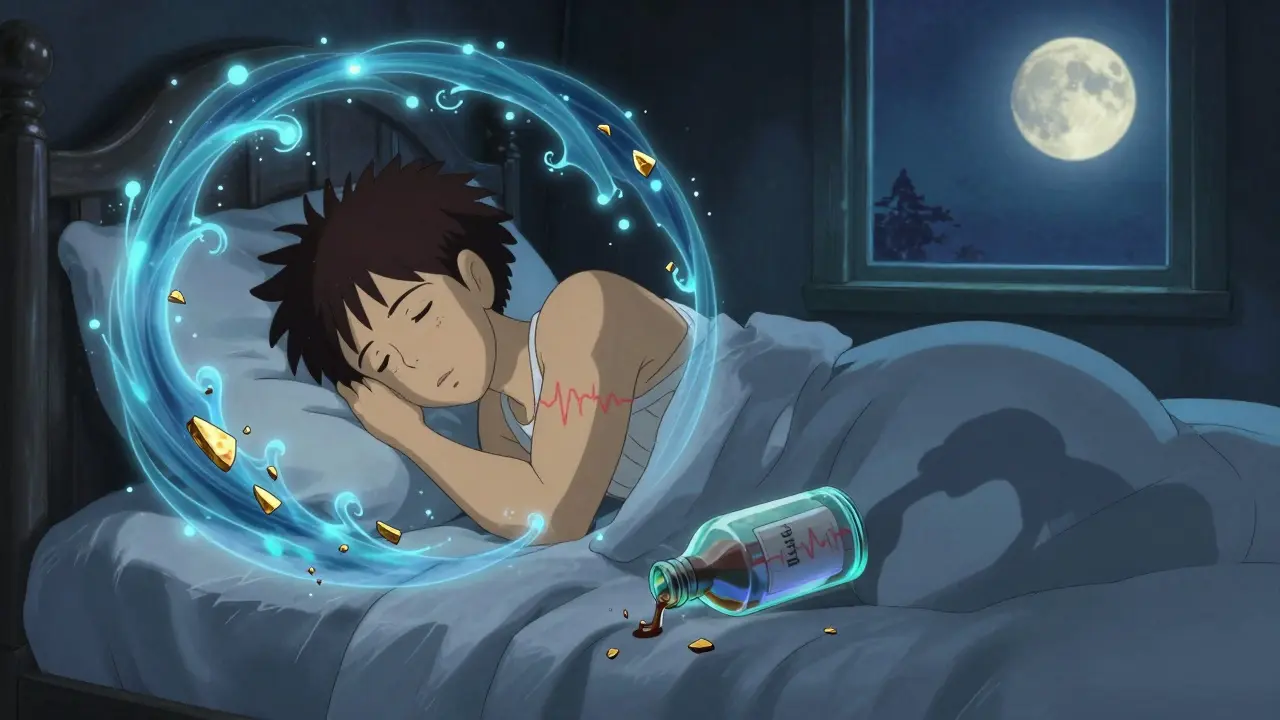
Many people believe that a nightcap helps them fall asleep faster and sleep more soundly. But if you’ve ever woken up at 3 a.m. heart pounding, tossing and turning, or felt foggy and irritable the next morning - even after what felt like a full night’s rest - you’re not imagining it. Alcohol doesn’t improve sleep. It sabotages it. And the damage doesn’t stop when you wake up.
How Alcohol Tricks Your Brain Into Thinking It’s Sleeping
When you drink alcohol before bed, it acts like a sedative. It slows down brain activity, makes you feel drowsy, and cuts your sleep onset time. That’s why people reach for it when they’re stressed or can’t fall asleep. But here’s the catch: alcohol doesn’t give you real sleep. It gives you shallow, unnatural sleep.
Studies show that within 30 to 60 minutes of drinking, alcohol boosts deep sleep (N3) - the stage your body uses to repair tissues and strengthen the immune system. This is why you might feel like you’re sleeping deeply right after drinking. But as your body metabolizes alcohol - roughly one standard drink per hour - that deep sleep stage crashes. By the second half of the night, your brain scrambles to make up for lost time. You enter REM sleep faster and harder than normal, but not in a healthy way. Instead of restful dreaming, you get fragmented, intense dreams, nightmares, or sudden awakenings.
A 2023 study in Alcoholism: Clinical and Experimental Research found that even moderate alcohol consumption - about 1.0 gram per kilogram of body weight for men (roughly 5 drinks for a 75kg person) - reduced total sleep time by nearly 20 minutes and dropped sleep efficiency by over 4%. That means more time spent awake in bed, even if you think you slept through the night.
Why Your Sleep Gets Shattered After Midnight
Alcohol disrupts the natural rhythm of your sleep cycles. Normally, you cycle through deep sleep early in the night and REM sleep later. Alcohol flips this. It suppresses REM sleep during the first half, then causes a rebound effect - a surge of REM activity - in the second half. This isn’t restorative. It’s chaotic.
Polysomnography (sleep lab studies) shows that after drinking, people experience up to a 50% reduction in REM sleep early on, followed by a 20-30% spike later. This rollercoaster leaves your brain overstimulated and your body stressed. Your heart rate climbs by an average of 6.7 beats per minute, your breathing becomes irregular, and your body never fully settles into recovery mode.
And here’s the kicker: the more you drink, the worse it gets. A 2022 meta-analysis in the Chest Journal found that each additional drink before bed increases the risk of obstructive sleep apnea by 20%. Why? Alcohol relaxes the muscles in your throat. When those muscles sag, your airway narrows or closes. You stop breathing - briefly - then gasp awake. This happens dozens of times a night, often without you realizing it.
People with existing sleep apnea are especially vulnerable. The American Thoracic Society warns that even one drink within three hours of bedtime can drop blood oxygen levels by 3-5% during apnea events. That’s not just disruptive - it’s dangerous for your heart and brain.
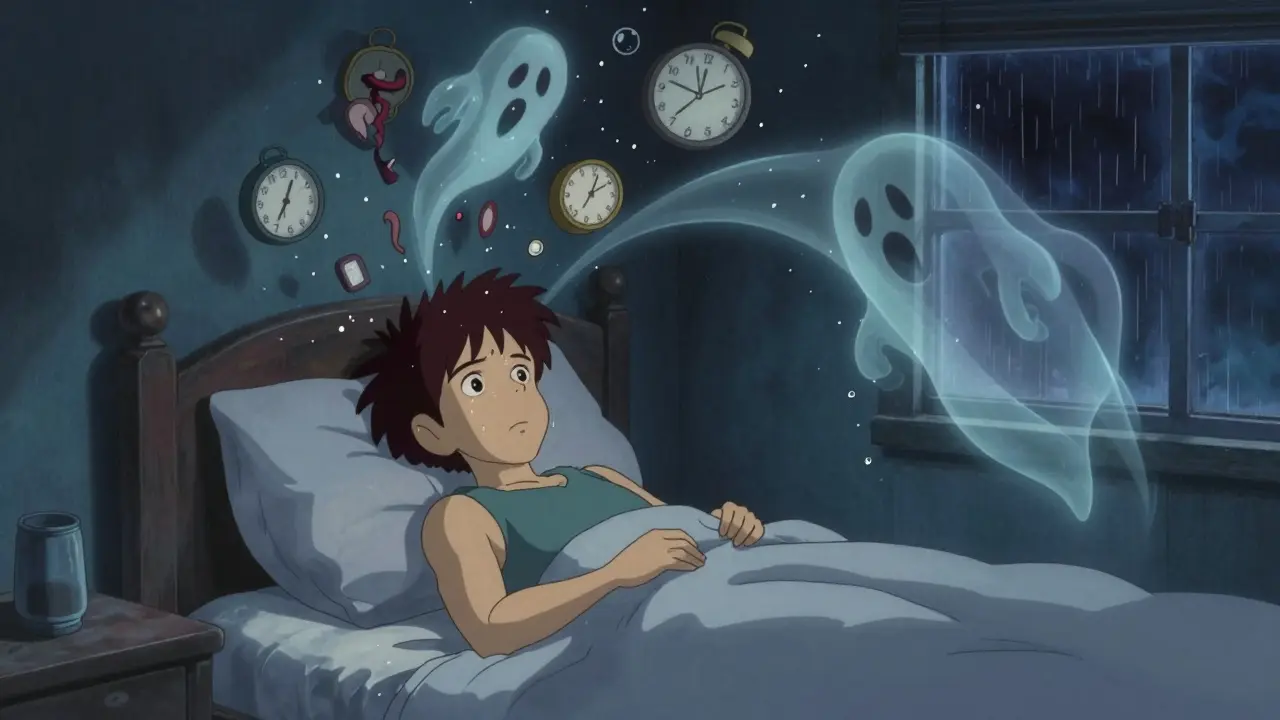
The Hidden Cost: Next-Day Brain Fog and Emotional Chaos
You might think, “I slept 7 hours. I’m fine.” But your brain didn’t get the rest it needed. Even if total sleep time looks normal, the quality is broken.
A 2022 study in the Journal of Clinical Sleep Medicine found that alcohol consumption the night before led to a 15.3% drop in slow-wave sleep - the deepest, most restorative stage. The result? Cognitive processing speed dropped by 12.7%. Working memory shrank by 9.4%. Reaction times slowed. Decision-making suffered. And none of this was obvious to the people who experienced it.
Emotionally, the damage is even more striking. Researchers at the University of Pittsburgh Medical Center found that after drinking, people showed 31.2% more emotional reactivity to negative stimuli the next day. A minor annoyance - a delayed train, a rude comment - felt like a personal attack. That’s because REM sleep helps regulate emotions. When alcohol steals your REM, your brain loses its ability to process stress and calm down.
And here’s the cycle: when you wake up feeling wired, irritable, or exhausted, you might reach for coffee - or another drink. “I need something to calm me down,” you think. But that’s the trap. Alcohol doesn’t fix sleep deprivation - it causes it. And over time, this loop can fuel dependence.
Long-Term Damage: Insomnia, Cognitive Decline, and Recovery
It’s not just about one bad night. Regular alcohol use before bed rewires your sleep system.
A 36-year longitudinal twin study published in Sleep Advances found that heavy drinkers were up to 3.4 times more likely to report poor sleep quality than non-drinkers. Even after adjusting for genetics, the link held strong. And it gets worse with age.
Older adults who regularly drink before bed experience cognitive decline 23% faster than those who don’t, according to data from the American Academy of Neurology. Why? Because sleep is when your brain clears out toxins like beta-amyloid - the same protein linked to Alzheimer’s. When alcohol fragments your sleep, that cleanup process stalls.
And if you’re trying to quit? Sleep problems are one of the biggest reasons people relapse. The National Institute on Alcohol Abuse and Alcoholism reports that 50-70% of people in early recovery struggle with severe insomnia. It can take 3 to 6 months for sleep architecture to return to normal after stopping alcohol - longer than most people expect.
A 2023 review in Sleep Medicine Reviews showed that people who drink before bed are 38% more likely to develop chronic insomnia than those who don’t. That’s not a small risk. That’s a major contributor to long-term health decline.
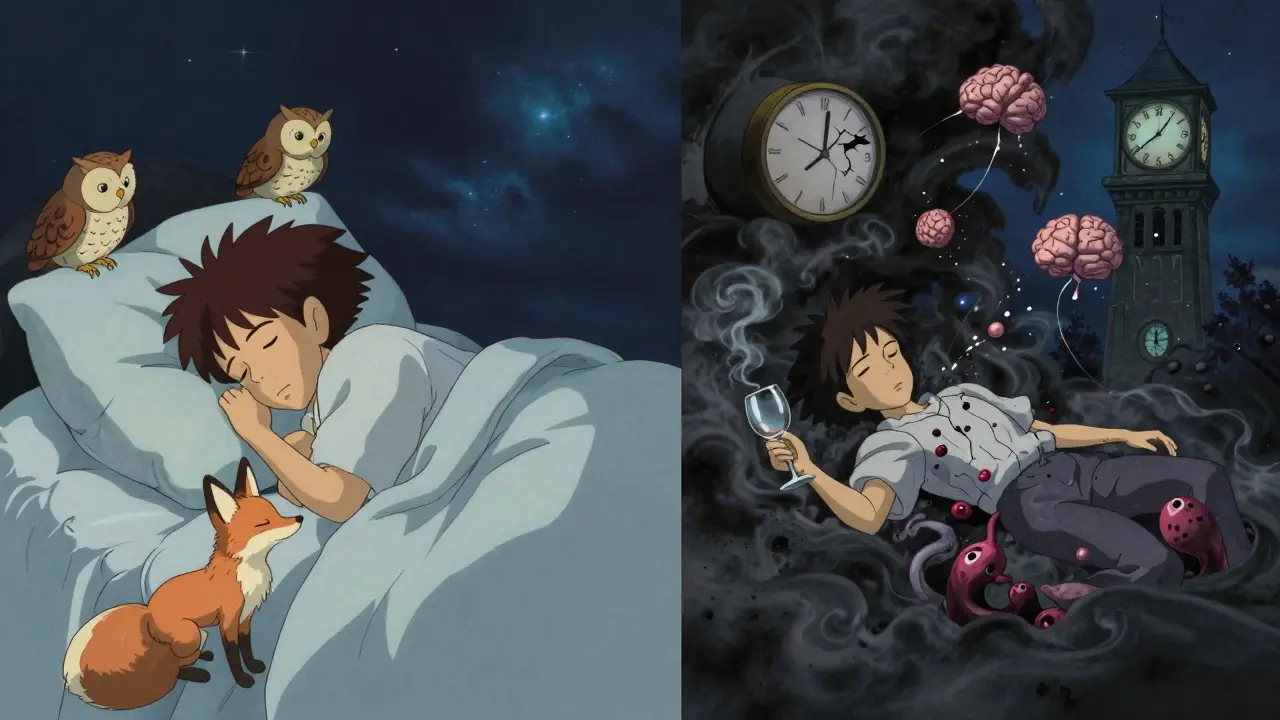
Myth Busting: Is a Nightcap Ever Okay?
You’ve heard the advice: “One glass of wine won’t hurt.” But the science says otherwise.
A 2023 meta-analysis in Addiction Biology reviewed over 100 studies and found no dose of alcohol that improved sleep quality. Not one. Even one standard drink - a 150ml glass of wine - reduced REM sleep by 9.3% and increased sleep fragmentation by 11.7%.
The European Sleep Research Society summed it up bluntly: “All levels of alcohol consumption before bedtime negatively impact sleep architecture.”
And if you think tolerance helps - that after a few days of drinking, your sleep returns to normal - you’re wrong. While your body may stop feeling drowsy after 3-7 days, your sleep quality doesn’t recover. The deep sleep boost fades. The REM suppression stays. The fragmentation continues. You’re just used to feeling tired.
What Should You Do Instead?
If you’re using alcohol to fall asleep, you’re treating a symptom - not the cause. Instead of reaching for a drink, try these proven alternatives:
- Keep a consistent bedtime - even on weekends
- Avoid screens 90 minutes before bed
- Get natural light in the morning to reset your circadian rhythm
- Try magnesium or glycine supplements - both have evidence for improving sleep quality
- Practice 4-7-8 breathing: inhale for 4 seconds, hold for 7, exhale for 8
- Limit caffeine after 2 p.m.
If you’re struggling with insomnia or sleep apnea, talk to a sleep specialist. You don’t need to suffer - or drink - to get rest.
Does alcohol help you fall asleep faster?
Yes, alcohol can reduce sleep latency - the time it takes to fall asleep - especially in moderate doses. But this isn’t true sleep. It’s sedation. The sleep you get afterward is shallow, fragmented, and lacks restorative REM and slow-wave stages. The trade-off isn’t worth it.
Can one drink before bed cause sleep apnea?
Even one standard drink can increase the risk of obstructive sleep apnea by 20%. Alcohol relaxes throat muscles, making the airway more likely to collapse. If you already have sleep apnea, that one drink can double the number of breathing interruptions during the night and drop your blood oxygen levels.
Why do I wake up sweating or with a racing heart after drinking?
As alcohol leaves your system, your nervous system goes into overdrive. Your body tries to compensate for the earlier sedation by releasing stress hormones like adrenaline. This raises your heart rate, triggers sweating, and causes sudden awakenings - often around 3 a.m. This is part of the rebound effect.
How long does it take for sleep to recover after quitting alcohol?
For most people, sleep architecture begins to normalize within 2-4 weeks. But full recovery - especially REM sleep patterns and deep sleep quality - can take 3 to 6 months. Insomnia during early recovery is common and doesn’t mean you’re failing. It’s part of the healing process.
Does alcohol affect men and women differently?
Yes. Women metabolize alcohol slower than men due to differences in body water and enzyme levels. A 0.85 g/kg dose (roughly 4 drinks) affects women more than a 1.0 g/kg dose in men. Studies show women experience greater sleep fragmentation and more severe REM suppression after the same amount of alcohol.

Casper MacIntyre
Hello, my name is Casper MacIntyre and I am an expert in the field of pharmaceuticals. I have dedicated my life to understanding the intricacies of medications and their impact on various diseases. Through extensive research and experience, I have gained a wealth of knowledge that I enjoy sharing with others. I am passionate about writing and educating the public on medication, diseases, and their treatments. My goal is to make a positive impact on the lives of others through my work in this ever-evolving industry.
10 Comments
-
Jinesh Jain
March 17, 2026 AT 04:31Interesting read. I’ve noticed I feel more tired the next day after drinking, even if I fall asleep quickly. I never connected it to REM disruption. Maybe I’ll try the 4-7-8 breathing. No caffeine after 2 p.m. already working for me.
-
douglas martinez
March 18, 2026 AT 05:41This is one of the most clinically accurate summaries I’ve read on alcohol’s impact on sleep architecture. The data is unequivocal. Even low-dose consumption impairs sleep homeostasis. I recommend patients eliminate alcohol entirely if they’re seeking restorative sleep. The physiological disruption is too profound to justify any perceived benefit.
-
Sabrina Sanches
March 18, 2026 AT 20:15I used to drink wine every night to unwind and now I realize I was just sabotaging my brain. I didn’t even know I was waking up 5 times a night. My husband told me I snore like a chainsaw. I tried magnesium last week. I slept like a baby. No more wine. Ever. 😌
-
Shruti Chaturvedi
March 19, 2026 AT 05:02This makes so much sense. I’ve been trying to sleep better and stopped drinking a month ago. My dreams are weirder but I feel calmer. I didn’t know alcohol was stealing my deep sleep. I’m glad I quit. My energy is back. Simple things help.
-
Katherine Rodriguez
March 20, 2026 AT 12:29Wake up at 3 a.m. heart pounding? Yeah that’s just your body telling you you’re a weak American who can’t handle a little stress. Back in my day we drank whiskey and slept like logs. Now everyone needs a sleep app and a weighted blanket. You’re not broken. You’re just soft.
-
Devin Ersoy
March 21, 2026 AT 02:51Let’s be real - alcohol doesn’t ruin sleep. Capitalism ruins sleep. The 9-to-5 grind, the algorithmic anxiety, the infinite scroll of doom. Alcohol is just the glittery Band-Aid on a hemorrhaging soul. You think your REM is fragmented? Bro, your soul’s got a fractured femur. Try therapy before you try glycine. Or better yet - quit your job.
-
Scott Smith
March 21, 2026 AT 16:04I’ve been off alcohol for 18 months now. The first two weeks were brutal - insomnia, anxiety, nightmares. But by month three, I started waking up without needing coffee. My focus improved. My mood stabilized. This article nails it. The recovery timeline is real. It’s not easy, but it’s worth it.
-
Sally Lloyd
March 22, 2026 AT 17:50I’ve been wondering… is this study funded by Big Sleep? You know, the companies selling melatonin, weighted blankets, and $300 smart mattresses? They have a vested interest in making people believe alcohol is the villain. What if the real issue is electromagnetic pollution from cell towers disrupting melatonin? Or maybe it’s the fluoride in the water? Just saying.
-
Emma Deasy
March 23, 2026 AT 07:14I must say, this article, with its meticulously curated scientific citations and clinically precise terminology, represents a triumph of modern neurobehavioral research. The empirical evidence presented here is not merely suggestive - it is, in fact, overwhelming. The profound disruption of REM architecture, the insidious suppression of slow-wave cycles, the deleterious cascade of autonomic dysregulation - all of it conspires to create a nocturnal catastrophe of epic, almost Shakespearean proportions. I, for one, have ceased all alcohol consumption with the solemnity of a monk renouncing worldly pleasures. My dreams are now pure. My rest, sacred.


Write a comment
More Articles
Are Expired Medications Safe to Take or Should You Replace Them
Expired medications aren't always dangerous, but they're rarely reliable. Learn which pills are safe to use after expiration, which ones could harm you, and how to store or dispose of them properly.

Managing Medication Storage in Hot Climates While Traveling
Heat can ruin your medications-insulin, EpiPens, birth control, and more-during travel. Learn how to store them safely in hot climates with proven tools, real-world tips, and expert-backed strategies to avoid dangerous, life-threatening failures.
Cosmetic Procedures and Anticoagulants: What You Need to Know About Bruising and Bleeding Risks
Learn how blood thinners affect bruising and bleeding during cosmetic procedures. Discover which medications are safe to continue, when to pause them, and why stopping them can be more dangerous than the surgery itself.
Tim Schulz
March 16, 2026 AT 04:57Oh honey, you just described my entire Tuesday night 🥴🍷 One minute I’m cuddled up with my wine like it’s my emotional support beverage, next thing I know I’m wide awake at 3 a.m. heart pounding like I’m in a horror movie trailer. And don’t even get me started on the ‘I slept 8 hours!’ delusion. Bro. I looked like a zombie who lost a fight with a blender. 🤡