
Every year, thousands of young children accidentally swallow pills, liquids, or powders they shouldn’t. In 2022 alone, over 12,800 incidents were reported in the U.S. where kids got into medicines despite safety caps. Most of these weren’t due to broken containers - they happened because the cap wasn’t closed properly after the last use. That’s the harsh truth about child-resistant packaging: it’s not magic. It’s a tool. And like any tool, it only works if used right.
What Exactly Is Child-Resistant Packaging?
Child-resistant packaging, or CR packaging, isn’t designed to be child-proof. That’s a common misunderstanding. No container can guarantee a determined toddler won’t get in. Instead, CR packaging is built to make it hard enough for kids under five to open within a reasonable time - usually 10 minutes or more. The goal isn’t perfection. It’s buying time. Time for an adult to notice, intervene, or call poison control. This standard came from the Poison Prevention Packaging Act (PPPA) of 1970. Back then, over 5,000 children died from accidental poisonings in just six years. The law gave the U.S. Consumer Product Safety Commission (CPSC) the power to force manufacturers to make medicine bottles harder for kids to open. Today, that rule covers prescription drugs, many over-the-counter pills, pesticides, cleaning products, and even nicotine e-liquid containers.How Do These Caps Actually Work?
The most common type is the push-and-turn cap. You press down while twisting - two separate motions at once. A child might twist, or push, but rarely both together. Other designs include squeeze-and-turn caps, where you have to compress the sides while turning, or interlocking caps with internal locks that only release when the right pressure and motion are applied. These caps aren’t just random plastic. They’re made from high-density polyethylene (HDPE) or polypropylene, engineered to last through 50+ openings without losing grip. The threading inside is precise. Too loose, and a kid can twist it off. Too tight, and a senior with arthritis can’t open it. That’s the tightrope manufacturers walk. Testing is brutal. For child resistance, 50 kids aged 42 to 51 months are given 10 minutes to open the bottle. At least 85% must fail. Then, those who couldn’t open it are given five more minutes - still, most must fail. For seniors, 100 adults aged 50 to 70 must open and re-close the bottle in under five minutes. At least 90% must succeed. If it doesn’t pass both tests, it doesn’t go on the shelf.Not All Medications Are Treated the Same
Solid pills like ibuprofen or antibiotics? Easy. Over 97% of these use standard CR screw-top vials that pass with flying colors. Liquid medications? Much harder. Nearly 39% of non-compliant packaging incidents involve liquids. Why? Because spills are dangerous, and the caps need to seal tightly while still being tough to open. Some manufacturers use special child-resistant droppers or tamper-evident seals, but many still fall short. Nasal sprays are the worst offenders. The CPSC says spray pumps themselves aren’t child-resistant - even if they’re crimped to the bottle. The whole system needs to be redesigned. Only about 22% of nasal spray products meet CR standards without major changes. That’s why some newer models now come with an outer protective cap that requires a push-and-turn motion before the spray even activates. Blister packs are another option. But regular blister packs? Not good enough. The foil must be thick enough to require at least 15 pounds of force to peel. That’s like pressing down with your whole palm. Some newer designs use perforated tabs that tear away only after a firm pull - a motion most toddlers can’t manage.Who Struggles the Most With These Caps?
Seniors. People with arthritis. Those with shaky hands or limited grip strength. A 2022 survey by the Arthritis Foundation found 68% of people with hand impairments had trouble opening CR medicine bottles. The average force needed? More than 5 pounds. That’s the limit experts say should be the max for senior-friendly access. You’ll hear stories from nurses and pharmacists: “My 78-year-old patient gave up and left the cap off.” “She just stores her pills in a pill organizer because she can’t open the bottle.” That’s not safe. It defeats the whole purpose. That’s why newer designs are focusing on senior-friendly (SF) features. Aptar Pharma’s Mini+cr system, for example, lets seniors open it with 92% success while keeping children out 92% of the time. Amazon reviews for Easy-Open systems from brands like Blisterpak show 4.2 out of 5 stars - mostly from adult children buying for aging parents. “Finally, a cap my mom can open without help,” one user wrote.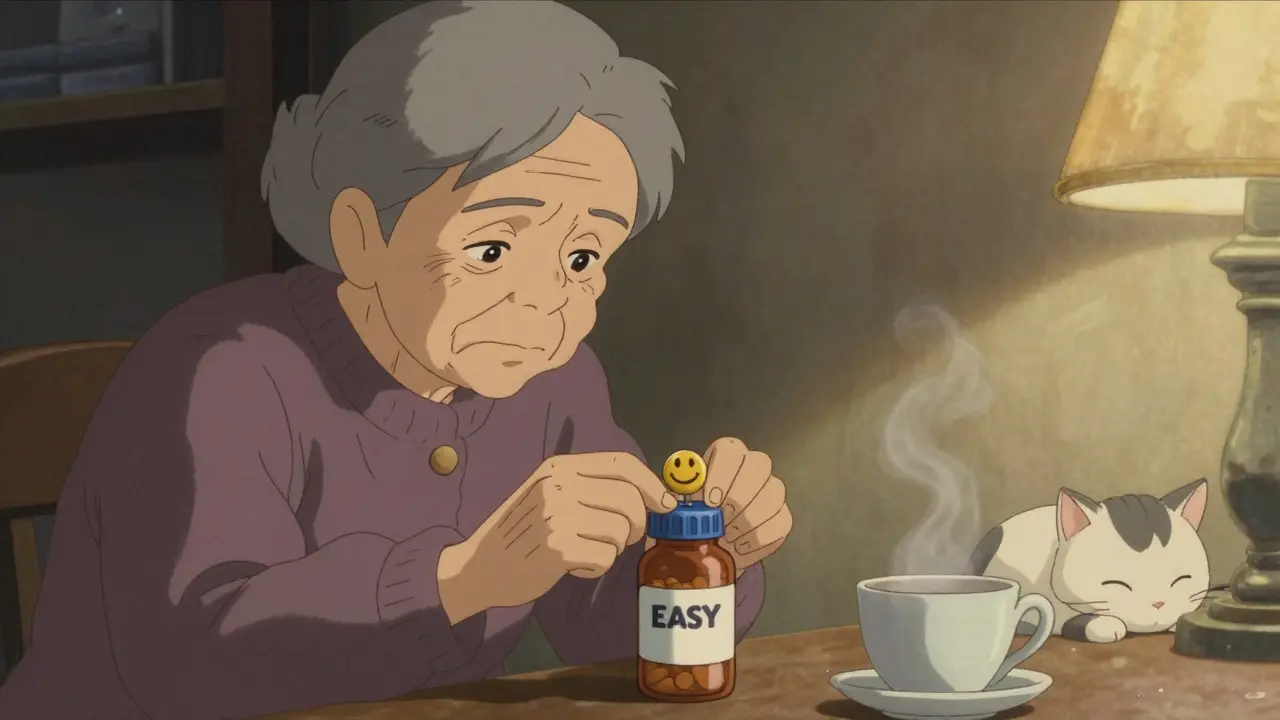
Why Do Kids Still Get Into Medicine?
The biggest reason? Improper reclosing. Over 73% of reported incidents happen because the cap was put back on wrong. Maybe it was only half-twisted. Maybe the parent thought, “It’s closed enough.” Or maybe the cap got damaged after a few uses and no longer clicks properly. Another 18.5% happen because the container was cracked, chewed, or broken - often by a curious child who kept trying. One parent told the CPSC their toddler opened a bottle by smashing it against the edge of the counter. That’s not the cap’s fault. That’s a lack of storage. And here’s the kicker: CR packaging effectiveness drops by about 15% after the first opening. That’s from CPSC testing. Every time you open it, the mechanism wears a little. The plastic flexes. The threads loosen. That’s why experts say: never leave a bottle sitting open on the counter. Always re-close it properly. And check it every few days to make sure it still clicks.What About Other Countries?
The U.S. isn’t alone. The European Union follows EN ISO 8317:2023, which is very similar to CPSC standards. Brazil made CR packaging mandatory for all medications in 2021. India followed in 2022. Australia, while not legally requiring it for all OTC drugs, strongly recommends it and most major pharmacies use CR caps by default. The global market for this packaging is growing fast. It was worth $2.83 billion in 2022. By 2028, it’s expected to hit $4.87 billion. Why? Aging populations. Stricter rules. And new threats - like concentrated cannabis edibles. In 2023, the CPSC proposed requiring CR packaging for any edible with more than 2mg of THC per serving. That’s a big shift.What’s Next for Medication Safety?
The future isn’t just about harder caps. It’s about smarter ones. In early 2023, Aptar Pharma launched SmartDose - the first FDA-cleared connected CR cap. It uses Bluetooth to track when the bottle was opened. If a child gets into it, the app sends an alert to the caregiver’s phone. It also reminds users when it’s time to take their meds. Pharmaceutical companies are now designing packaging that does three things: keeps kids out, helps seniors in, and tracks usage. One survey found 78% of developers plan to add these features to their packaging within the next three years. But the real challenge remains: balancing safety with accessibility. You can’t make a cap so easy for seniors that a toddler can open it. And you can’t make it so hard for seniors that they stop taking their medicine.
What You Can Do Today
- Always re-close the cap properly. Listen for the click. If it doesn’t click, it’s not closed. - Store meds up high and out of sight. Not on the counter. Not in the bathroom cabinet. Not in a purse. Use a locked cabinet or high shelf. - Ask for senior-friendly packaging. If you or a loved one struggles to open bottles, ask your pharmacist for an easy-open version. Many pharmacies keep these on hand. - Don’t rely on CR caps alone. They’re a layer of protection, not a wall. Combine them with safe storage and supervision. - Check for damage. If the cap is cracked, warped, or doesn’t twist smoothly, replace it. Don’t risk it.Frequently Asked Questions
Are child-resistant caps really effective?
Yes, but only when used correctly. Since the 1970s, CR packaging has helped reduce pediatric poisoning deaths by 45%. It prevents an estimated 900,000 accidental ingestions each year. But effectiveness drops after the first opening, and 73% of incidents happen because the cap wasn’t closed properly. It’s not foolproof - it’s a safety layer.
Can I get non-child-resistant medicine if I need to?
Yes, but only with your doctor’s or pharmacist’s approval and signed consent. If you have arthritis, tremors, or limited hand strength, you can request non-CR packaging. The pharmacy must document your understanding of the risks. Never remove a CR cap and leave pills in an open container - even for a day.
Why do some medicine bottles still have easy-open caps?
Not all medications require CR packaging. Only those with specific active ingredients - like acetaminophen, ibuprofen, aspirin, or imidazoline - are regulated. Some OTC products, especially those with low concentrations, aren’t required to use CR caps. Always check the label. If it says “child-resistant packaging” on the box, it’s required. If not, assume it’s not protected.
Do nasal spray pumps need child-resistant caps?
Yes, but not the pump itself. The CPSC requires that either the spray mechanism or the outer cap be child-resistant. Many nasal sprays now come with a plastic over-cap that must be pushed down and twisted before the spray can be used. If your nasal spray doesn’t have this, ask your pharmacist for a CR version.
What should I do if my child opens a medicine bottle?
Call Poison Control immediately - even if you think they didn’t swallow anything. In Australia, dial 13 11 26. In the U.S., call 1-800-222-1222. Don’t wait for symptoms. Don’t try to make them vomit. Keep the bottle and any remaining pills for medical staff. Time matters more than you think.
Final Thought
Child-resistant packaging saves lives. But it’s not a substitute for vigilance. The best safety system is one that combines smart design with smart habits. Close the cap. Lock it away. Check it often. And if you’re struggling to open it yourself - ask for help. There’s no shame in needing an easier cap. What matters is that the medicine stays where it belongs: in the hands of the person who needs it.
Casper MacIntyre
Hello, my name is Casper MacIntyre and I am an expert in the field of pharmaceuticals. I have dedicated my life to understanding the intricacies of medications and their impact on various diseases. Through extensive research and experience, I have gained a wealth of knowledge that I enjoy sharing with others. I am passionate about writing and educating the public on medication, diseases, and their treatments. My goal is to make a positive impact on the lives of others through my work in this ever-evolving industry.
More Articles

How Alcohol and Caffeine Influence Your Heart Rhythm
Explore how alcohol and caffeine each affect heart rhythm, the risks of combining them, signs of arrhythmias, and practical tips for a healthy beat.
Medication List Templates: Free Printable and Digital Options for Better Safety
Free printable and digital medication list templates help prevent dangerous drug interactions and improve communication with healthcare providers. Simple, updated lists save lives - especially for seniors and caregivers.