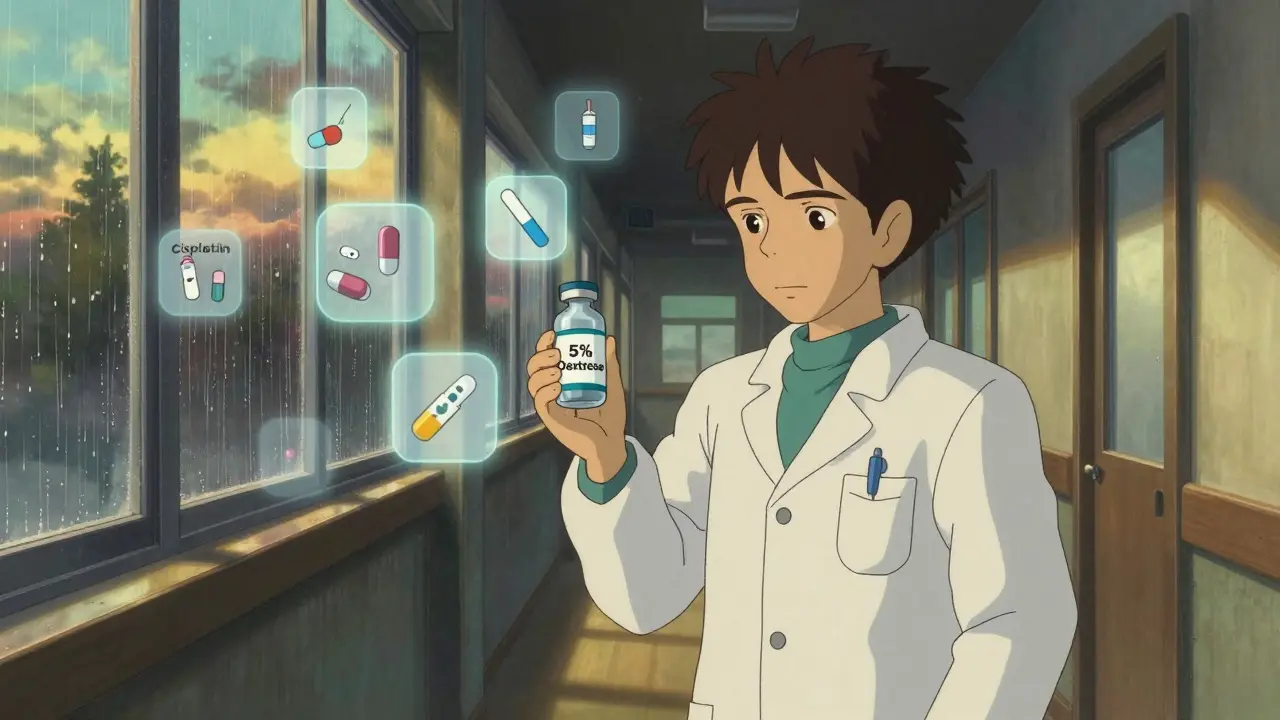
Right now, hundreds of essential medications are hard to find in U.S. hospitals and pharmacies. It’s not a temporary glitch-it’s a persistent crisis that’s been building for years. As of January 2026, there are still over 260 active drug shortages, according to the American Society of Health-System Pharmacists (ASHP). These aren’t obscure drugs. They’re the ones doctors rely on to treat cancer, infections, heart failure, and even dehydration. When these medications disappear, patients suffer delays, substitutions with less effective options, or worse-treatment gets canceled entirely.
What Drugs Are in Shortest Supply?
The most critical shortages are in sterile injectables, especially those used in emergency and critical care. Here’s what’s hardest to get right now:
- 5% Dextrose Injection (small volume bags) - This is used to deliver IV medications and hydrate patients. The shortage started in February 2022 and isn’t expected to fully resolve until August 2025, but supply remains tight into early 2026.
- 50% Dextrose Injection - Used to treat severe low blood sugar. This shortage began in December 2021 and won’t end until September 2025. Hospitals are rationing it, and some ERs are switching to oral glucose gel when possible.
- Cisplatin - A key chemotherapy drug for testicular, ovarian, and lung cancers. A 2022 FDA shutdown of a major Indian manufacturing plant cut supply by half. Rationing is now standard, with priority given to patients who respond best to it.
- Vancomycin - One of the last-resort antibiotics for serious bacterial infections. Shortages have spiked since late 2024 due to production delays and rising demand from resistant infections.
- Epinephrine auto-injectors - Used for anaphylaxis. While not completely gone, supply chains are strained, leading to inconsistent availability in pharmacies.
- Levothyroxine - The most common thyroid hormone replacement. A 2024 manufacturing hiccup in Europe caused ripple effects that still echo today.
- GLP-1 agonists (e.g., semaglutide, tirzepatide) - These weight-loss and diabetes drugs have seen demand surge 35% annually since 2020. Manufacturers can’t keep up, and prescriptions are being limited to 30-day fills.
These aren’t random. They cluster in specific categories: 28% of shortages are in central nervous system drugs (like ADHD meds and antipsychotics), 22% are antimicrobials, and 19% are IV fluids and electrolytes. If you’re on any of these, your doctor may already be adjusting your plan.
Why Are These Drugs So Hard to Find?
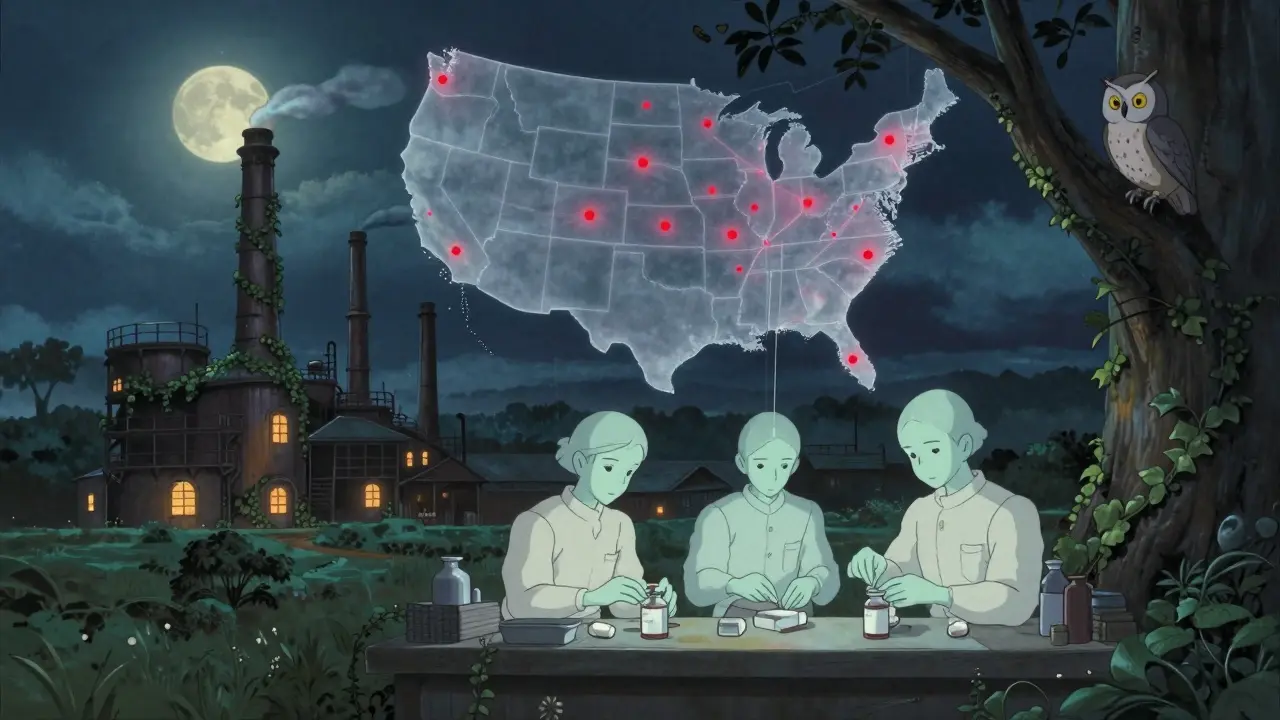
It’s not one problem-it’s a chain of failures. About 80% of the active ingredients in U.S. drugs come from just two countries: India (45%) and China (25%). These facilities often operate on razor-thin margins, especially for generics. When a single factory fails an FDA inspection, it can knock out half the country’s supply of a drug overnight.
Take cisplatin. One Indian plant made about half of the U.S. supply. When inspectors found poor quality control in 2022, production stopped. No backup. No alternative. Just silence. That’s the norm now.
Then there’s demand. Drugs like semaglutide (Ozempic, Wegovy) went from niche to mainstream in under three years. Manufacturers didn’t scale up fast enough. Now, pharmacies are rationing refills. Even basic IV fluids like saline are in short supply because they’re cheap to make-so companies don’t invest in extra capacity. Why build more when you’re only making pennies per bag?
The FDA tries to help. In 2025, they launched a new reporting portal where hospitals and pharmacists can flag shortages before they hit the public database. In the first three months, they got over 1,200 reports and intervened in 87% of them. But they can’t force companies to make more. They can’t require stockpiles. They can’t stop manufacturers from quitting a low-margin product.
Who’s Getting Hurt?
It’s not just patients. Healthcare workers are drowning in the fallout.
A 2024 AMA survey found that 78% of doctors had to delay treatments because a drug wasn’t available. Nearly half had to switch patients to less effective alternatives. One oncologist in Ohio told the New England Journal of Medicine that she had to tell a 32-year-old with ovarian cancer they couldn’t start cisplatin because the hospital only had enough for three patients that week.
Pharmacists are spending 10+ hours a week just tracking down drugs. Sixty-seven percent say they’ve made a medication error because they had to substitute something unfamiliar. A patient gets the wrong dose. A drug interacts badly. A child gets a syrup instead of an injection because the IV version is gone.
And patients? A 2024 survey by Patients for Affordable Drugs found that 31% of cancer patients experienced treatment delays due to shortages. The average delay? Nearly 15 days. For someone with aggressive cancer, that’s not just inconvenient-it’s life-or-death.
What’s Being Done?
Some fixes are already in motion. In 2025, 47 states let pharmacists substitute equivalent drugs during shortages. But only 19 states let them do it without calling the doctor first. That means extra phone calls, delays, and confusion.
New York is testing a public online map that shows which pharmacies still have scarce drugs in stock. Hawaii’s Medicaid program now allows drugs approved in Canada or the EU if they’re equivalent and safe-something the FDA has never officially endorsed before.
At the federal level, the Drug Shortage Prevention Act now requires manufacturers to report production problems earlier. But enforcement is weak. No penalties. No fines. Just a form.
ECRI, a healthcare safety group, recommends hospitals keep a 30-day emergency stockpile of critical drugs. But only 28% of hospitals can afford it. The cost of storing IV fluids, chemotherapy, and antibiotics for months? Thousands per month. Most just don’t have the budget.
What Can You Do?
If you’re taking a medication that’s in short supply, here’s what to do:
- Don’t panic. Your doctor or pharmacist is already aware. They’re working on alternatives.
- Ask if there’s a therapeutically equivalent substitute. For example, if cisplatin isn’t available, carboplatin may be an option. It’s not the same, but it’s still effective for many cancers.
- Check the ASHP Drug Shortages Database. It’s free, updated daily, and lists what’s scarce, why, and when it might improve.
- Don’t stockpile. Hoarding makes shortages worse. If you take extra pills, someone else might go without.
- Call your pharmacy ahead. Don’t assume they have it. Ask if they’ve received a shipment or if they’re on a waitlist.
For chronic conditions like thyroid disease or diabetes, ask your provider about switching to a brand-name version if generics are unavailable. They’re more expensive, but they’re also less likely to be affected by supply chain issues.
What’s Next?
The problem isn’t getting better. The Congressional Budget Office predicts drug shortages will stay above 250 through 2027. If new tariffs on Chinese and Indian pharmaceuticals go through, that number could jump to 350.
Real solutions need money. The U.S. Pharmacopeia is pushing for three changes: tax credits for companies making active ingredients in the U.S., mandatory national stockpiles of top-priority drugs, and a real-time early warning system that connects manufacturers, distributors, and hospitals.
Until then, the system keeps patching itself. A hospital finds a new supplier. A pharmacist finds a substitute. A patient waits. And every day, someone’s treatment is delayed because a pill or injection can’t be made where it’s supposed to be.
This isn’t a glitch. It’s the system working as designed-for profit, not patients.
What are the most common drugs in shortage right now?
As of early 2026, the most commonly scarce medications include 5% and 50% Dextrose injections, cisplatin (a chemotherapy drug), vancomycin (an antibiotic), epinephrine auto-injectors, levothyroxine (for thyroid conditions), and GLP-1 agonists like semaglutide and tirzepatide. These shortages are driven by manufacturing issues, supply chain disruptions, and surging demand.
Why are generic drugs more likely to be in shortage than brand-name drugs?
Generic drugs make up 90% of prescriptions but only 20% of pharmaceutical revenue. Manufacturers earn just 5-8% profit margins on generics, compared to 30-40% for brand-name drugs. With so little profit, companies don’t invest in backup production lines, quality upgrades, or domestic manufacturing. When a factory fails inspection or runs into supply issues, there’s no backup-and no incentive to fix it quickly.
Can I get a substitute if my medication is out of stock?
Yes, in many cases. Forty-seven states allow pharmacists to substitute a therapeutically equivalent drug during a shortage. But only 19 states let them do it without calling your doctor first. Always ask your pharmacist if a safe alternative exists. For example, if cisplatin isn’t available, carboplatin may be used instead for certain cancers. Never take a substitute without checking with your provider.
Are drug shortages getting worse?
The number of active shortages has dipped slightly since the peak of 323 in early 2024, but the underlying causes are getting worse. Most shortages now stem from long-term issues: overreliance on foreign manufacturing, low profit margins for generics, and rising demand for drugs like GLP-1 agonists. Without major policy changes, experts predict shortages will remain above 250 through at least 2027.
Where can I check if my medication is in shortage?
The American Society of Health-System Pharmacists (ASHP) maintains a free, publicly accessible Drug Shortages Database updated daily. It lists which drugs are in short supply, why, how long the shortage has lasted, and when it’s expected to end. You can search by drug name or category at ashp.org/drugshortages.

Casper MacIntyre
Hello, my name is Casper MacIntyre and I am an expert in the field of pharmaceuticals. I have dedicated my life to understanding the intricacies of medications and their impact on various diseases. Through extensive research and experience, I have gained a wealth of knowledge that I enjoy sharing with others. I am passionate about writing and educating the public on medication, diseases, and their treatments. My goal is to make a positive impact on the lives of others through my work in this ever-evolving industry.
12 Comments
-
Wendy Claughton
January 18, 2026 AT 20:16I’ve been on levothyroxine for 12 years. Last month, my pharmacy had to give me a different generic-same active ingredient, but the fillers made me feel like I was drowning in slow motion. Took three weeks to stabilize. My doctor just shrugged. ‘We’ve all been there.’
Why is my life a supply chain puzzle?
And why does no one in Congress care until it’s their mom on dialysis? -
Stacey Marsengill
January 20, 2026 AT 01:08Of course it’s worse now. The FDA let China and India run the show because ‘free trade’ sounded nice on a PowerPoint. Now we’re begging for epinephrine like it’s gold.
And don’t even get me started on how the same companies that make these drugs also own the clinics that prescribe them. It’s a pyramid scheme with syringes. -
kenneth pillet
January 21, 2026 AT 20:54Vancomycin shortage hit my uncle hard. C. diff nearly killed him. They had to use fidaxomicin-3x the price, same odds. Pharmacist said they’ve been rationing since October. No one’s talking about how this kills people slower than opioids.
Just saying. -
Danny Gray
January 22, 2026 AT 07:13Wait-so we’re mad about drug shortages… but we’re fine with paying $500 for a single shot of semaglutide?
Isn’t that the same system?
It’s not broken. It’s working exactly as intended: make people desperate, then sell them the rope.
Also, ‘therapeutic equivalence’ is a legal fiction. Ever tried swapping a generic for a brand and not feel like your brain melted?
Just sayin’. -
Aysha Siera
January 23, 2026 AT 03:29Did you know the FDA gets 20% of its funding from pharma? That’s why they ‘approve’ factories with rat nests and no water filters.
And the Indian plants? Owned by American hedge funds. They shut down cisplatin to jack up prices.
It’s all planned.
Wake up. -
Zoe Brooks
January 24, 2026 AT 20:37My mom’s on levothyroxine too. We’ve been calling pharmacies every Monday like it’s a lottery. Last week, she got a 10-day supply from a warehouse in Nebraska. Took three calls. Two voicemails. One sobbing conversation with a pharmacist who said, ‘I’m so sorry. I’ve been doing this for 22 years and I’ve never seen it this bad.’
We’re not broken. We’re just tired. -
Robert Cassidy
January 25, 2026 AT 15:32Let’s be real: if we just stopped making generics and forced everyone to use brand-name drugs, we wouldn’t have shortages. Companies would invest. They’d hire Americans. They’d build factories here.
But no-let’s keep paying $0.03 for a pill so billionaires can buy private islands.
It’s not capitalism. It’s cruelty with a balance sheet. -
Tyler Myers
January 27, 2026 AT 13:06GLP-1s are the problem. Everyone wants to lose weight so they can feel better. But that’s not healthcare. That’s a trend. And now we’re stealing chemo drugs to feed influencers on TikTok.
They should ban these drugs for non-diabetics. Let people eat salad.
And stop pretending this is about ‘access.’ It’s about greed wrapped in wellness. -
Kristin Dailey
January 29, 2026 AT 01:04China and India are stealing our medicine. We need tariffs. We need factories. We need to stop outsourcing our health to dictators and corrupt labs.
Build it here. Pay Americans. Or we’re all dead in 5 years. -
Pat Dean
January 30, 2026 AT 04:12My brother’s a nurse. He says they’ve started writing ‘DO NOT SUBSTITUTE’ on every script. Even for saline. Because last week, someone got the wrong fluid. Died in the ER. No one told the family until the autopsy.
They’re not shortages. They’re murder by bureaucracy. -
Naomi Keyes
January 31, 2026 AT 18:05As a former hospital pharmacist, I can confirm: the ASHP database is accurate, but it’s useless without enforcement. Manufacturers report delays ‘voluntarily.’ There are zero penalties. No audits. No consequences.
Meanwhile, pharmacists are forced to substitute untested generics, and patients are told to ‘trust the system.’
That’s not healthcare. That’s a moral hazard with a pharmacy label.
And yes-I’ve cried in the supply closet. More than once.


Write a comment
More Articles

The Future of Carbamazepine: New Research and Developments
As a blogger, I'm excited to share with you the latest updates on the future of Carbamazepine, a medication commonly used to treat epilepsy and other neurological disorders. New research and developments are paving the way for improved treatment options and better patient outcomes. Scientists are exploring novel formulations and delivery methods, which could potentially increase the drug's effectiveness and minimize side effects. Additionally, ongoing studies are investigating the genetic factors influencing individual responses to Carbamazepine, potentially leading to personalized treatment plans. Stay tuned for more updates on this exciting frontier in neurological treatment!

Jodi Harding
January 18, 2026 AT 00:12They’re not shortages-they’re scheduled failures. Pharma doesn’t want you to have cheap meds. They want you dependent on $1000/month GLP-1s while you beg for insulin.
They profit from chaos.