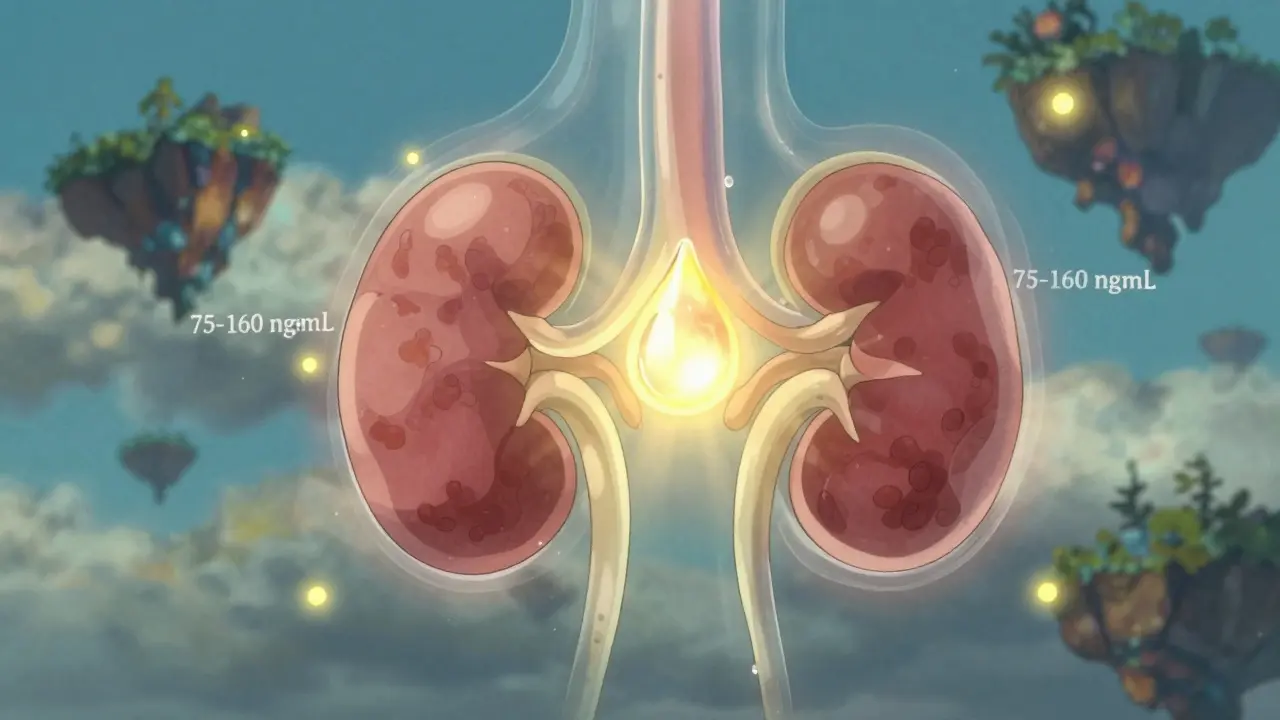
Cyclosporine Level Monitor
Cyclosporine Level Checker
Check if your cyclosporine level is within safe range for your transplant stage
Result
Why This Matters
Cyclosporine toxicity can cause irreversible kidney damage. Maintaining levels within the target range reduces risk by up to 70%. Always follow your transplant team's advice for dose adjustments.
When someone gets a kidney, heart, or liver transplant, cyclosporine is often the drug that keeps their body from rejecting the new organ. But here’s the catch: cyclosporine can damage the very kidneys it’s meant to protect. This isn’t just a side effect-it’s the main reason some transplants fail. And it’s not rare. Studies show 30 to 50% of long-term kidney transplant failures are tied to how cyclosporine affects the kidneys. The good news? You can prevent most of this damage-if you know exactly how to monitor it.
Why Cyclosporine Harms the Kidneys
Cyclosporine doesn’t just sit there. It tightens the blood vessels inside the kidneys, reducing blood flow. Think of it like squeezing a garden hose-less water gets through, and the kidneys start to struggle. This isn’t just a temporary blip. Over time, it causes real structural damage: thickening of tiny arteries, changes in kidney tubules, and even scarring. The higher the drug level, the worse it gets. And unlike some side effects, this one doesn’t always show up in symptoms until it’s too late.
What makes it worse is that cyclosporine’s window for safety is razor-thin. Too little, and the body attacks the transplant. Too much, and the kidneys start shutting down. The difference between saving the organ and wrecking it can be as small as 50 ng/mL. That’s why you can’t just guess the dose. You have to measure it.
How to Measure Cyclosporine Levels
There are three main ways to measure cyclosporine in the blood: immunoassays, HPLC, and LC-MS/MS. Most labs used to rely on immunoassays-they’re fast and cheap. But they’re flawed. These tests can’t tell the difference between cyclosporine and its metabolites. And those metabolites? They’re inactive. But the test thinks they’re the real drug. So you get a reading that looks high, when it’s not. That leads to unnecessary dose cuts, which then raises the risk of rejection.
Today, the gold standard is LC-MS/MS-liquid chromatography-tandem mass spectrometry. It’s accurate to 99.2%. It doesn’t get fooled by metabolites. It can detect levels as low as 5 ng/mL. And since 2021, 92% of U.S. transplant centers have switched to it. The cost is higher, sure. But the payoff? Fewer mistakes, fewer rejected organs, and less kidney damage.
Here’s what matters: blood must be drawn at the right time. The old way was to check the trough level-just before the next dose. But research shows that’s not enough. The C2 level-two hours after the dose-is a much better predictor of how much drug the body actually absorbed. One study found C2 monitoring cut nephrotoxicity by over 22%. That’s not a small win. That’s life-changing for transplant patients.
What the Numbers Mean
There’s no one-size-fits-all target. It depends on the organ, the time since transplant, and even your genes. For kidney transplants:
- Week 1: 200-400 ng/mL
- Week 2 to 6 months: 125-275 ng/mL
- 7 to 12 months: 100-150 ng/mL
- After 1 year: 75-160 ng/mL
For heart and liver transplants, the ranges are similar to the later stages of kidney transplants. But here’s the twist: some people metabolize cyclosporine faster than others because of their CYP3A5 gene. If you’re an extensive metabolizer, you might need 30-40% more drug just to reach the same level as someone else. That’s why personalized dosing isn’t just fancy-it’s necessary.

What Else to Monitor Alongside Cyclosporine
Looking at the drug level alone isn’t enough. You need to see how the kidneys are responding. That means checking:
- Serum creatinine-aim for under 1.5 mg/dL. A steady rise is a red flag.
- BUN-to-creatinine ratio-keep it under 20:1. Higher numbers suggest reduced kidney blood flow.
- Magnesium-cyclosporine drains magnesium. Levels below 1.7 mg/dL mean trouble.
- Blood pressure-target under 130/80 mmHg. High BP + cyclosporine = double damage.
Uric acid? It can rise, but it’s not a reliable marker. Stick to the big four. And don’t forget: cyclosporine interacts with a lot of other drugs. Ketoconazole can spike cyclosporine levels by 50%. Rifampin can crash them by 60%. Even grapefruit juice can mess with it. If a patient starts or stops another medication, check the cyclosporine level within 3-5 days.
How Often Should You Test?
Monitoring isn’t a one-time thing. It’s a rhythm.
- First month after transplant: twice a week
- Months 2-6: weekly
- Months 7-12: every two weeks
- After one year: monthly, unless something changes
And if the dose changes? Wait 4-6 weeks before checking again. Cyclosporine takes time to reach steady state. Testing too soon gives you false data. Also, use EDTA tubes-not serum tubes. Serum tubes can falsely inflate levels by 15-20%. That’s enough to send someone down the wrong path.

Can the Damage Be Reversed?
Yes. And that’s the most important thing to know. If caught early, kidney damage from cyclosporine can improve. Studies show that within three months of lowering the dose, kidney function often gets better. Blood pressure drops. Creatinine levels fall. Magnesium rebounds. The key is catching it before scarring sets in. That’s why regular monitoring isn’t bureaucracy-it’s prevention.
What’s Next for Monitoring?
AI is coming. Clinical trials are testing algorithms that use 17 different factors-dose, timing, genetics, diet, other meds-to predict the perfect cyclosporine dose. One model got it right 89.7% of the time. That could mean fewer blood draws and less guesswork.
Point-of-care devices are also in development. Imagine a machine in your transplant clinic that gives you a full blood level result in 15 minutes. Phase 3 trials are underway, with FDA approval expected by late 2025. That’s not science fiction. It’s the next step.
For now, the rules are simple: use LC-MS/MS, check C2 levels, monitor creatinine and magnesium, adjust for drugs and genes, and never assume. Cyclosporine is still vital. But it’s a scalpel, not a sledgehammer. Handle it right, and it saves lives. Handle it wrong, and it takes them.
Can cyclosporine nephrotoxicity be completely avoided?
No, it can’t be completely avoided, but it can be significantly reduced. With proper monitoring using LC-MS/MS, targeting C2 levels, managing drug interactions, and adjusting for genetic differences, up to 70% of severe kidney damage can be prevented. The goal isn’t zero risk-it’s minimizing risk while keeping the transplant alive.
Why is LC-MS/MS better than immunoassays for cyclosporine testing?
LC-MS/MS can distinguish between cyclosporine and its metabolites, which other tests can’t. Immunoassays often overestimate the actual drug level by 10-15%, leading to unnecessary dose reductions and higher rejection rates. LC-MS/MS has 99.2% specificity and detects levels as low as 5 ng/mL, making it the most accurate method available today.
Does everyone need C2 monitoring, or just high-risk patients?
All transplant patients on cyclosporine benefit from C2 monitoring, not just high-risk ones. Studies show C2 levels correlate more strongly with total drug exposure than trough levels. Centers using C2 monitoring report 18-22% fewer cases of nephrotoxicity. It’s now considered the standard of care in most major transplant centers.
How long does it take for kidney function to improve after lowering cyclosporine?
Improvement can begin within weeks, but significant recovery usually takes 2-3 months. Creatinine levels often drop, blood pressure improves, and magnesium levels rebound. The earlier you reduce the dose after detecting early signs of toxicity, the better the outcome. Delaying action increases the chance of permanent scarring.
Can diet or other medications affect cyclosporine levels?
Yes, significantly. Grapefruit juice, ketoconazole, and diltiazem can raise cyclosporine levels by 30-50%. Rifampin, phenytoin, and St. John’s wort can lower them by 40-60%. Even changes in fat intake can alter absorption. Any new medication or supplement should trigger a cyclosporine level check within 5 days.

Casper MacIntyre
Hello, my name is Casper MacIntyre and I am an expert in the field of pharmaceuticals. I have dedicated my life to understanding the intricacies of medications and their impact on various diseases. Through extensive research and experience, I have gained a wealth of knowledge that I enjoy sharing with others. I am passionate about writing and educating the public on medication, diseases, and their treatments. My goal is to make a positive impact on the lives of others through my work in this ever-evolving industry.
14 Comments
-
Lillian Knezek
February 24, 2026 AT 10:47I know they say LC-MS/MS is the gold standard... but what if the lab is lying? 😏 I read somewhere that some labs still use immunoassays and just ‘adjust’ the numbers to look better. And who’s auditing them? The FDA? HA. Big Pharma owns the testing industry. They want you on high doses so you need more meds for side effects. It’s all a pyramid scheme. 🤔💉
-
Christopher Brown
February 26, 2026 AT 10:21If you’re still using trough levels, you’re endangering lives. LC-MS/MS and C2 aren’t optional-they’re mandatory. Any center not using them should lose accreditation. This isn’t debate. It’s standard of care. Period.
-
Sanjaykumar Rabari
February 28, 2026 AT 05:14In India we have no access to LC-MS/MS. We use what we have. You Americans act like your way is the only way. But many of us save lives with basic tools. You think your tech is better? Maybe. But we don’t have your money. We have our will.
-
Joseph Cantu
March 1, 2026 AT 07:25They never tell you the truth about cyclosporine. The drug was never meant to be safe-it was meant to be profitable. The metabolites? They’re not just inactive. They’re toxic byproducts the manufacturers knew about for decades. And yet? They lobbied to keep immunoassays in use. Why? Because every time a patient gets rejected or their kidney fails, they sell another drug. This isn’t medicine. It’s a racket. And the ‘guidelines’? Just PR.
-
Cory L
March 2, 2026 AT 13:29I’m a transplant nurse. Saw this play out 3 times last year. One guy’s creatinine spiked. They cut his dose. Rejection. He went back on dialysis. Then they switched him to LC-MS/MS. Found out his level was actually low. Gave him a tiny boost. He’s back to hiking now. C2 monitoring? Game changer. Not magic. Just science. Do it.
-
Bhaskar Anand
March 3, 2026 AT 07:24You people talk about LC-MS/MS like it’s a miracle. But in India, we don’t have the luxury of fancy machines. We have 20 patients per lab tech. We use what works. And guess what? We still save lives. You’re not saving lives-you’re just making yourselves feel superior. Stop preaching. Start listening.
-
William James
March 4, 2026 AT 18:35i just want to say-thank you for writing this. really. i had a cousin who went through all this and no one explained it to us. we thought the doctors were just being ‘careful’ when they kept changing her dose. turns out they were flying blind. the part about magnesium? i had no idea. i’ll make sure my family knows. also… i think i spelled ‘cyclosporine’ wrong. oops. 🙈
-
David McKie
March 4, 2026 AT 20:10The truth? Most of these ‘guidelines’ are written by people who’ve never held a patient’s hand during rejection. They live in ivory towers with their LC-MS/MS machines and their 99.2% accuracy stats. Meanwhile, real clinicians in rural hospitals are using dipsticks and prayer. And somehow? They’re still getting results. Don’t confuse precision with compassion.
-
Southern Indiana Paleontology Institute
March 5, 2026 AT 16:38grapefruit juice? really? you’re telling me a fruit can mess with a life saving drug? that’s wild. my cousin took it with his meds and ended up in the er. now he drinks orange juice. and he’s fine. so maybe we should just ban grapefruit. problem solved. 🍊🚫
-
Anil bhardwaj
March 7, 2026 AT 03:14I read this at 3 a.m. after my dad’s last lab result. His creatinine was 1.6. I was scared. Then I read your post. Calmed me down. Thanks for the clarity. Not everyone gets this. You did.
-
lela izzani
March 8, 2026 AT 09:47I’m a nephrologist. This is accurate, practical, and desperately needed. I wish every resident had to read this before their first transplant rotation. The magnesium point? Critical. So many miss it. And the EDTA tube note? That’s a silent killer in ERs. Thank you for the specifics. This is how medicine should be communicated.
-
Joanna Reyes
March 9, 2026 AT 12:12I’ve been on cyclosporine for 11 years now. Kidney transplant at 23. I’ve had my levels checked hundreds of times. I can tell you this: the shift to C2 monitoring changed everything. I went from almost losing my kidney at year 3 to thriving now. The numbers don’t lie. But what I didn’t know until now? That my CYP3A5 gene made me an extensive metabolizer. My doctor never told me. I had to dig it up myself. Why wasn’t that part of my care plan? It’s not just about the drug-it’s about knowing who you are. Genetic identity matters. And we deserve to know.
-
Nerina Devi
March 9, 2026 AT 17:25In India, we say: ‘Jab tak zinda hai, tab tak ummeed hai.’ As long as you’re alive, there’s hope. This post gave me hope. Not just for patients, but for doctors too. We’re not gods. We’re humans trying to do our best. Thank you for reminding us that even a small change-like switching to LC-MS/MS or checking C2-can mean the difference between a life and a loss. You didn’t just write a guide. You wrote a prayer.


Write a comment
More Articles

Senior Oral Health Prophylaxis: Essential Tips for Keeping Teeth & Gums Healthy
Learn practical, age‑specific steps to keep seniors' teeth and gums healthy, from daily routines to product picks and dentist visits.

8 Aducanumab Alternatives: What Else is Out There for Alzheimer's?
Confused by the options beyond Aducanumab for Alzheimer's? This article breaks down eight alternatives, from experimental drugs to currently available treatments. Each option gets compared side by side for how well it works, how it's taken, and what people have actually experienced. You'll find helpful details and clear pros and cons for each, including why some promising ideas just didn’t pan out. It's practical, candid, and tailored for anyone wondering what’s really out there besides Aducanumab.
Unlock Your Potential: The Power of Androstenedione Dietary Supplements
In my recent exploration of dietary supplements, I've discovered the power of Androstenedione. This naturally occurring hormone, often used by athletes, has significant potential to increase our body's performance and muscle growth. But it's not just about physical enhancement, this supplement can also boost your energy levels and overall well-being. However, it's crucial to use it responsibly due to potential side effects. Stay tuned for a deeper dive into this fascinating topic.
Maranda Najar
February 22, 2026 AT 21:52This is not just medical advice-it’s a lifeline. I’ve seen what happens when hospitals cut corners with immunoassays. A patient I cared for nearly lost their transplant because the lab reported a ‘high’ level that was actually metabolites. The doctors panicked, dropped the dose, and boom-acute rejection. LC-MS/MS isn’t a luxury. It’s justice. And C2 monitoring? That’s the difference between survival and a slow, silent death. Stop treating transplant care like a budget spreadsheet. These people are fighting for every breath.