
Every time you pick up your prescription, you might be getting a different pill-even if the name on the bottle hasn’t changed. That’s because generic medications from different manufacturers can look, feel, and even taste different, even though they contain the same active ingredient. For most people, this switch goes unnoticed. But for others, especially those taking critical medications, it can mean the difference between feeling stable and experiencing serious side effects.
Why Do Generic Medications Keep Changing?
Pharmacies don’t choose which generic version to give you. Insurance companies and pharmacy benefit managers do. Their goal? Save money. Generic drugs cost 80%-85% less than brand-name versions, and with over 90% of prescriptions in the U.S. filled with generics, switching between manufacturers is a routine cost-cutting move. One pharmacy might stock Teva’s version of levothyroxine this month, then switch to Mylan’s next month because the contract changed. It’s not about your health-it’s about who offers the lowest price.And it’s not just you. Studies show that 1 in 3 patients report confusion when their pills change shape, color, or markings each refill. Some patients even think they’ve been given the wrong medication and stop taking it. Others don’t realize they’ve switched until they start feeling off.
Not All Generics Are Created Equal
The FDA requires generic drugs to be bioequivalent to the brand-name version. That means they must deliver between 80% and 125% of the active ingredient in your bloodstream compared to the original. Sounds fine, right? But here’s the catch: if one generic delivers 80% and another delivers 125%, that’s a 45% difference in how much medicine your body actually gets. For most drugs, that range is safe. For others, it’s dangerous.Drugs with a narrow therapeutic index (NTI) are the biggest concern. These are medications where even tiny changes in blood levels can cause harm. Examples include:
- Warfarin (blood thinner)
- Levothyroxine (thyroid hormone)
- Tacrolimus (transplant rejection drug)
- Phenytoin and other antiseizure drugs
For warfarin, a small drop in blood levels can lead to a clot. A small spike can cause internal bleeding. With levothyroxine, even a 10% change can make you feel exhausted, gain weight, or have heart palpitations. Patients on these drugs often report feeling fine for months-then suddenly, out of nowhere, they feel awful after a generic switch.
Real Stories: When Switching Goes Wrong
One Reddit user, u/PharmaPatient, shared that after their seizure medication switched from Mylan to Teva, they had two breakthrough seizures in two weeks. Their neurologist checked blood levels and confirmed the concentration had dropped sharply. Another patient on Drugs.com wrote: “Every time my levothyroxine manufacturer changes, my TSH goes out of range. I feel like garbage for weeks until my doctor adjusts my dose.”But not everyone has problems. Many people on statins, blood pressure meds like lisinopril, or antibiotics report no issues at all. The data backs this up: switch-back rates (when patients go back to the original brand or demand a specific generic) are 44% for antiseizure drugs, 33% for thyroid meds, but only 8% for statins. The problem isn’t generics-it’s frequent switching in high-risk drugs.
What Your Doctor and Pharmacist Should Be Doing
Most doctors don’t know when their patients switch generics. A 2023 survey found that 62% of physicians only found out after patients called with complaints. That’s because insurance companies and pharmacies make these changes without notifying prescribers.Here’s what you should ask for:
- “Can I stay on the same generic manufacturer?” Especially if you’re on an NTI drug.
- “Can you write ‘Dispense as Written’ or ‘Do Not Substitute’ on my prescription?” This legally prevents the pharmacy from switching your generic without your doctor’s approval.
- “Can you check what manufacturer I’m getting this month?” Ask for the name on the pill bottle or the pharmacy’s label. Write it down.
Pharmacists can help too. Some offer “lock-in” programs for NTI drugs-where you’re locked into one manufacturer for the duration of your treatment. Ask if your pharmacy offers this. If they don’t, ask why not.
What to Do If You Notice a Change
If your pill looks different, don’t assume it’s the same. Check the imprint code (the letters or numbers on the pill) against the label or use a pill identifier app. If you’re unsure, call your pharmacist. Don’t wait to feel bad.If you’re on an NTI drug and you notice new symptoms-fatigue, dizziness, irregular heartbeat, mood swings, or seizures-don’t brush it off. Go back to your doctor. Request a blood test. For warfarin, that means an INR check. For levothyroxine, a TSH test. These aren’t routine checks-they’re safety checks after a switch.
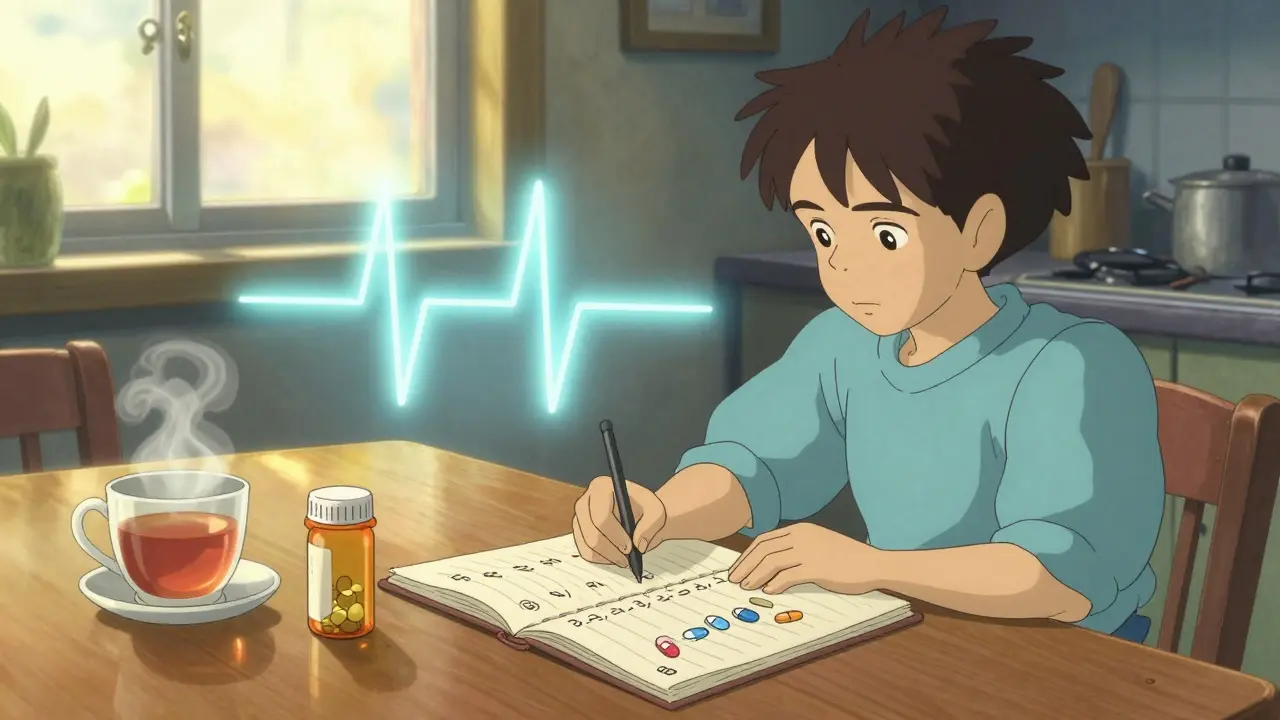
Keep a simple log: date, drug name, manufacturer, and how you felt. This helps your doctor spot patterns. One patient kept a notebook and realized every time they got the “blue oval” version of levothyroxine, their TSH spiked. They started refusing it-and their symptoms disappeared.
Who’s Responsible for Fixing This?
The FDA says generics are safe. And for most drugs, they are. But the agency doesn’t test how one generic performs against another. That’s a gap. In 2023, the FDA launched a pilot program requiring manufacturers to report major formulation changes. In 2024, Medsafe (New Zealand’s drug regulator) issued new guidance saying levothyroxine switches should be avoided whenever possible.Some health systems are taking action. Hospitals now require therapeutic drug monitoring after any switch in tacrolimus or warfarin. Some insurers are starting to limit switches for NTI drugs unless there’s a cost difference of more than 20%.
The real fix? Better labeling. The Generic Pharmaceutical Association is working on a 2024 initiative to standardize pill appearance across manufacturers. That means if you get a 25mg levothyroxine pill, it should look the same no matter who made it. Until then, you have to be your own advocate.
Bottom Line: Know Your Drug, Know Your Pill
Generic drugs save billions every year. That’s good. But safety shouldn’t be sacrificed for savings. If you’re on a medication where small changes matter-thyroid, seizure, blood thinner, transplant drug-don’t let random switches become your norm.Ask for consistency. Track your pills. Speak up if something feels off. Your doctor can’t protect you if they don’t know what’s happening. And your pharmacist won’t know unless you ask.
For most people, switching generics is harmless. For some, it’s life-changing. Don’t assume you’re in the first group. Find out which one you really are.
Can I ask my pharmacy to always give me the same generic brand?
Yes. You can ask your pharmacist to dispense a specific generic manufacturer. Some pharmacies will honor this, especially if your doctor writes "Dispense as Written" on the prescription. If they refuse, ask why-and consider switching to a pharmacy that will accommodate your needs.
Are all generic drugs the same as the brand-name version?
The FDA requires generics to be bioequivalent, meaning they deliver the same active ingredient within a safe range. But they don’t have to be identical in shape, color, or inactive ingredients. For most drugs, this doesn’t matter. For drugs with a narrow therapeutic index, differences can affect how your body responds.
Which medications are most risky to switch between generics?
Drugs with a narrow therapeutic index (NTI) are the most risky. These include warfarin, levothyroxine, tacrolimus, cyclosporine, phenytoin, and carbamazepine. Small changes in blood levels can cause serious side effects or treatment failure. Avoid switching these unless absolutely necessary and always monitor blood levels after a change.
Why don’t doctors know when my generic changes?
Insurance companies and pharmacy benefit managers make these switches automatically to save money. They don’t notify your doctor. In fact, 62% of doctors say they only find out when patients report problems. That’s why it’s up to you to track your medication and speak up.
Should I avoid generics altogether to stay safe?
No. Generics are safe, effective, and save billions in healthcare costs. The issue isn’t generics-it’s frequent, unmonitored switching between different manufacturers, especially for high-risk drugs. If you’re on a stable dose and feel fine, generics are a good choice. Just don’t let them switch without your knowledge if you’re on a narrow therapeutic index drug.
How can I tell if my generic has changed?
Check the pill’s imprint code (letters/numbers on the tablet) and compare it to the label or use a free pill identifier app like WebMD’s or Drugs.com. Also, look at the size, color, and shape. If it’s different from last time, ask your pharmacist who made it. Write it down. Don’t assume it’s the same.
If you’re taking a high-risk medication, keep a small card in your wallet with your drug name, manufacturer, and dose. Update it every refill. It’s a simple habit-but it could prevent a hospital visit.

Casper MacIntyre
Hello, my name is Casper MacIntyre and I am an expert in the field of pharmaceuticals. I have dedicated my life to understanding the intricacies of medications and their impact on various diseases. Through extensive research and experience, I have gained a wealth of knowledge that I enjoy sharing with others. I am passionate about writing and educating the public on medication, diseases, and their treatments. My goal is to make a positive impact on the lives of others through my work in this ever-evolving industry.
14 Comments
-
Faisal Mohamed
January 25, 2026 AT 00:52Let’s be real - the FDA’s bioequivalence window (80–125%) is a regulatory loophole dressed up as science. 🤷♂️ It’s like saying two different weights of air are ‘equivalent’ because they both float. For NTI drugs, this isn’t pharmacology - it’s Russian roulette with your endocrine system. And don’t get me started on PBMs playing Jenga with your meds. 💊💥
-
Kipper Pickens
January 27, 2026 AT 00:46As someone who’s worked in pharma logistics, I can tell you the system is designed to optimize cost, not clinical outcomes. The same pill, different fillers, different dissolution profiles - and the pharmacy gets paid the same regardless. It’s not malice, it’s incentive misalignment. The real villain isn’t the generic - it’s the algorithm that swaps your med based on quarterly rebate contracts.
And yes, I’ve seen pharmacists get yelled at by patients who don’t understand why their ‘same pill’ now tastes like chalk. The label says ‘levothyroxine 100mcg’ - but the body doesn’t read labels. It reads bioavailability.
-
Joanna Domżalska
January 27, 2026 AT 01:48Wow. So we’re supposed to panic because a pill looks different? People used to get different brands of aspirin and lived. You’re all acting like your thyroid is a quantum particle that collapses when you switch manufacturers. Get a grip.
-
James Nicoll
January 28, 2026 AT 02:03So let me get this straight - we’ve got a $400 billion healthcare system that can land rovers on Mars but can’t make one consistent pill for people on life-saving meds? 🤡
Meanwhile, my phone updates automatically, my coffee machine remembers my order, but my thyroid? Nah. Let’s flip a coin.
Someone get the FDA on the phone. And while you’re at it, ask them why their ‘bioequivalent’ definition sounds like a drunk math professor’s homework. -
Uche Okoro
January 28, 2026 AT 18:34The systemic failure here is not merely logistical - it is epistemological. The pharmacovigilance infrastructure is predicated on the assumption of homogeneity across generic formulations, yet no longitudinal cohort studies exist to assess inter-manufacturer variability in NTI drug outcomes. This is not negligence; it is institutionalized ontological violence against patient autonomy. The FDA’s regulatory framework is a neoliberal artifact, commodifying biological stability under the guise of cost-efficiency. You are not a patient - you are a data point in a profit-maximizing optimization function.
-
Ashley Porter
January 30, 2026 AT 09:53I’m on warfarin and switched generics last year. Didn’t notice anything… until my INR spiked to 5.2. Turns out the new batch had a different filler that slowed absorption. Took 3 weeks to stabilize. Now I screenshot the pill image every time I refill. It’s weird, but I’d rather be weird than in the ER.
-
shivam utkresth
January 30, 2026 AT 14:38Man, I’m from India where generics are the only option - and yeah, sometimes the pills look like alien artifacts. But here’s the thing: if you’re on a high-risk med, you learn to read the script like a detective. I check the batch number, the imprint, even the smell sometimes. My grandma used to say, ‘If the pill doesn’t feel right, it’s not right.’ Turns out she was a pharmacologist in disguise 😅
And hey - if your pharmacy won’t lock you in? Find one that will. Your life’s worth the extra 5 minutes. -
Aurelie L.
February 1, 2026 AT 05:15My sister had a seizure after a switch. Now she won’t leave the house without her pill card. I don’t care what the FDA says - this is a crisis.
-
Skye Kooyman
February 2, 2026 AT 16:02I just started taking levothyroxine and noticed my pills are a different shade of white this month. I called my pharmacy. They said it’s still the same manufacturer. I checked the imprint - it’s different. I’m going to ask for a log next time. Just in case.
-
Peter Sharplin
February 4, 2026 AT 08:58If you’re on an NTI drug, here’s what you do: write down the manufacturer name every time you refill. Use a notes app. Take a photo of the pill. Tell your doctor you want to be locked in. If your pharmacy says no, ask for the name of their PBM and call them. It’s annoying, but it’s your body. Don’t let a spreadsheet decide your health.
Also - if you’re on warfarin, get an INR test after any switch. Even if you feel fine. Seriously. Just do it. -
John Wippler
February 6, 2026 AT 05:45Think about it - we let AI choose our dating matches, our news feeds, even our Netflix recommendations… but when it comes to the medicine keeping us alive? We’re told to just ‘trust the system.’ 🤡
It’s not about generics. It’s about control. Who gets to decide what your body gets? Not you. Not your doctor. A middleman in a cubicle who got a bonus for cutting costs.
Be the glitch in the machine. Demand consistency. Write ‘Do Not Substitute’ on your script. Make them sweat. You’re not asking for luxury - you’re asking for safety. -
Alexandra Enns
February 6, 2026 AT 17:35Canada doesn’t have this problem. We have strict formulary controls. If you’re on levothyroxine, you get the same brand every time. No excuses. Why can’t the US just… do that? Oh right - profit. America’s healthcare is just capitalism with a stethoscope.
-
Marie-Pier D.
February 7, 2026 AT 02:11To everyone who’s been through this - you’re not crazy. 💙 I’ve been there too. I used to cry because I felt off and didn’t know why. Then I started tracking. Now I have a little card in my wallet: ‘Levothyroxine - Mylan 100mcg - DO NOT SUBSTITUTE.’
It’s not paranoia. It’s power. You’ve got this. And if you need someone to talk to? I’m here. No judgment. Just support. 🌿


Write a comment
More Articles

DOACs in Renal Impairment: How to Adjust Doses to Prevent Bleeding and Clots
DOACs like apixaban and rivaroxaban require precise dosing in kidney disease to avoid bleeding or clots. Learn how to adjust doses using Cockcroft-Gault, which DOACs are safest, and why apixaban is often the best choice.

Constipation from Medications: How to Manage It Without Stopping Your Prescriptions
Constipation from medications is common but often ignored. Learn how to manage it safely without stopping your prescriptions, using proven laxatives, avoiding harmful fixes, and knowing when to ask for stronger help.

rasna saha
January 24, 2026 AT 13:58I’ve been on levothyroxine for 8 years and never realized my pill changed colors until I started feeling like a zombie. I started checking the imprint code every time. Now I keep a note in my phone: "blue oval = bad, white oval = fine." It’s a small thing, but it saved my sanity.